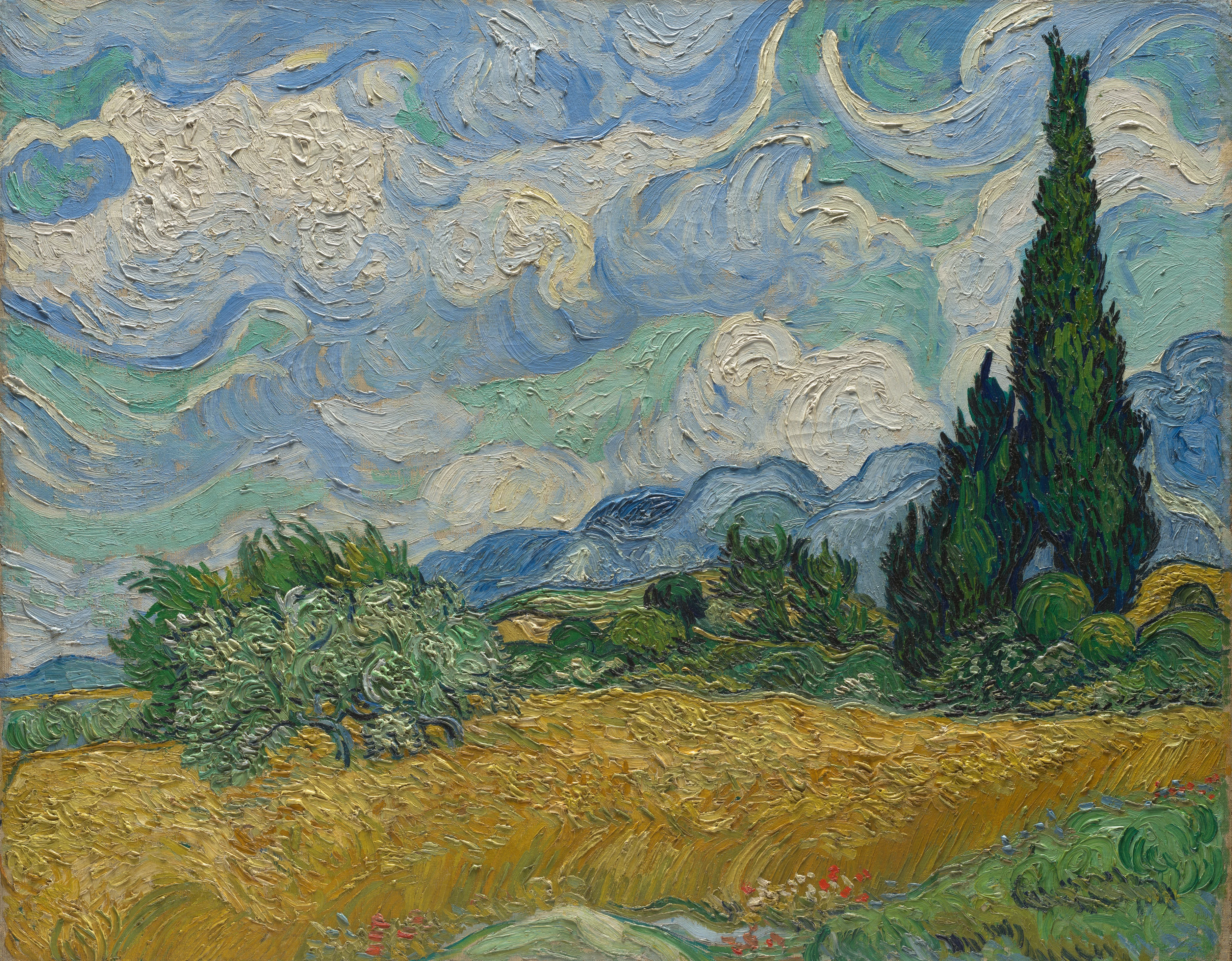

Wheat Field with Cypresses
How a field painted in one summer became a place to walk.
Saint-Rémy, early summer
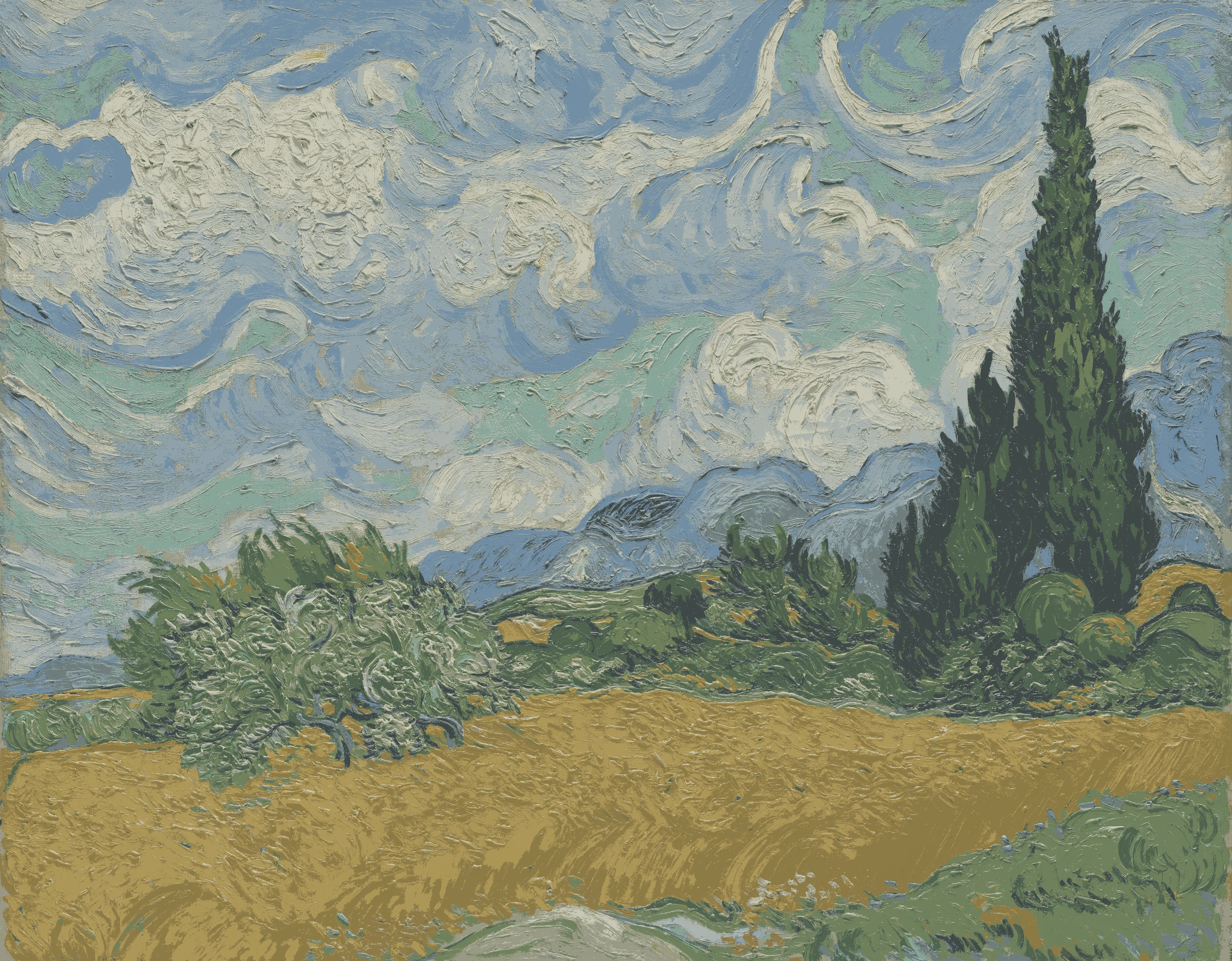
Saint-Rémy-de-Provence, early summer 1889. Van Gogh was a patient at the asylum of Saint-Paul-de-Mausole. Allowed beyond its grounds with a guardian, he painted this canvas on the spot, most likely in late June. In May his letters had seen “very, very green wheatfields” at the foot of “little grey or blue mountains”. Here the wheat has turned to gold, and by early July the cicadas were “singing fit to burst”.
That same week he wrote of cypresses “like an Egyptian obelisk”, “the dark patch in a sun-drenched landscape”. A 1901 exhibition called the picture a day of mistral; the title was not his. That autumn he painted the scene twice more, indoors. The land stays the same in all three. The sky changes every time.
how
docs/paintings/wheatfield/context.mdHis palette
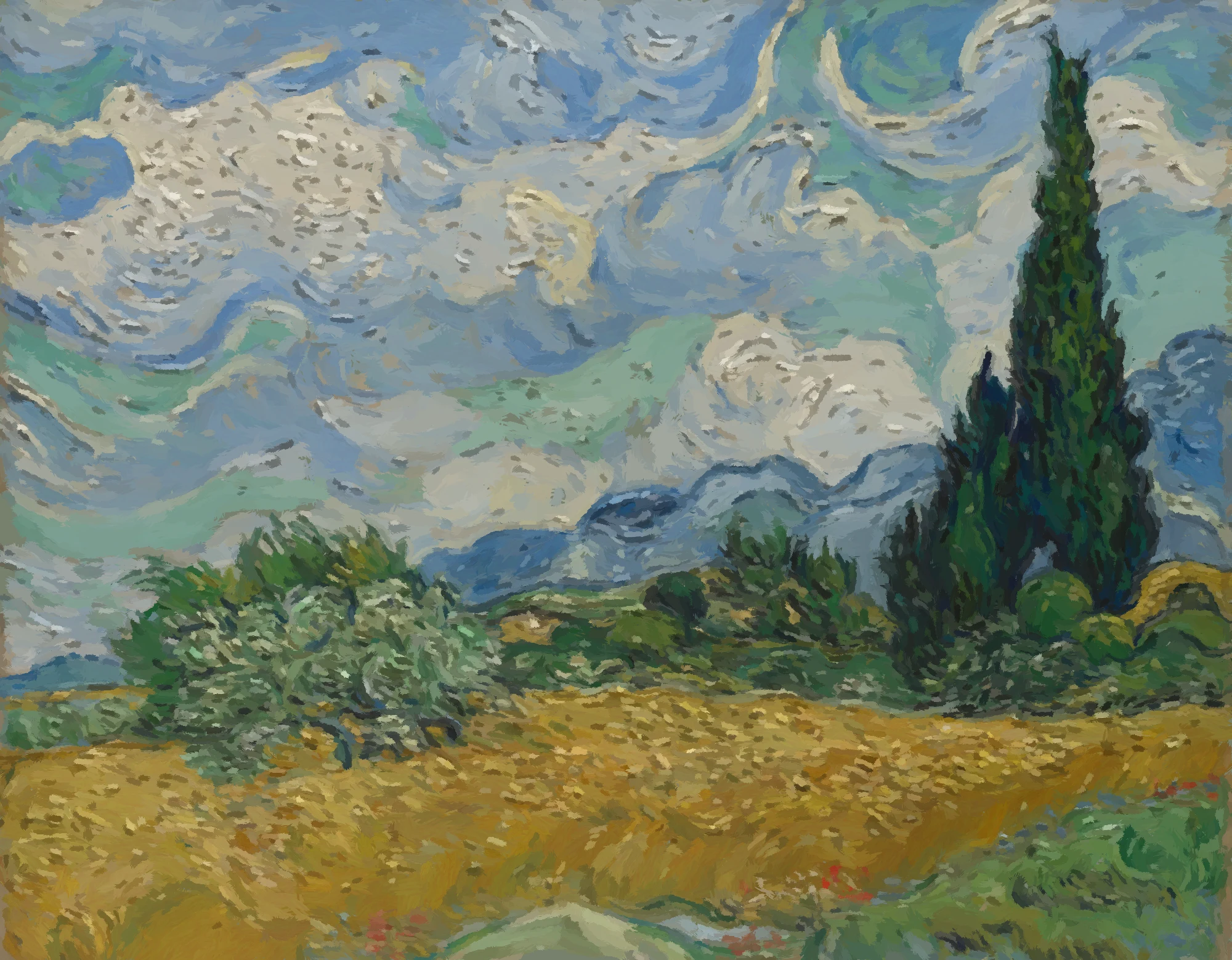
Twelve colours share the canvas. Read from the museum’s photograph and grouped by how alike they look to the eye, the largest is a soft grey-blue, about a seventh of the surface. Around it sit a pale grey-green, the cream of the clouds and a cool green-turquoise that runs low across the sky.
Two ochres make nearly a fifth: the wheat. Beside it the greens deepen to a near-black that holds the cypress upright. The photograph is muted, so these colours are too. His letters speak of violet shadows in June and a violet cloud in October. The photograph holds no violet, so none was allowed into the World.
how
prototype/analysis/analyse.pyHow the strokes flow
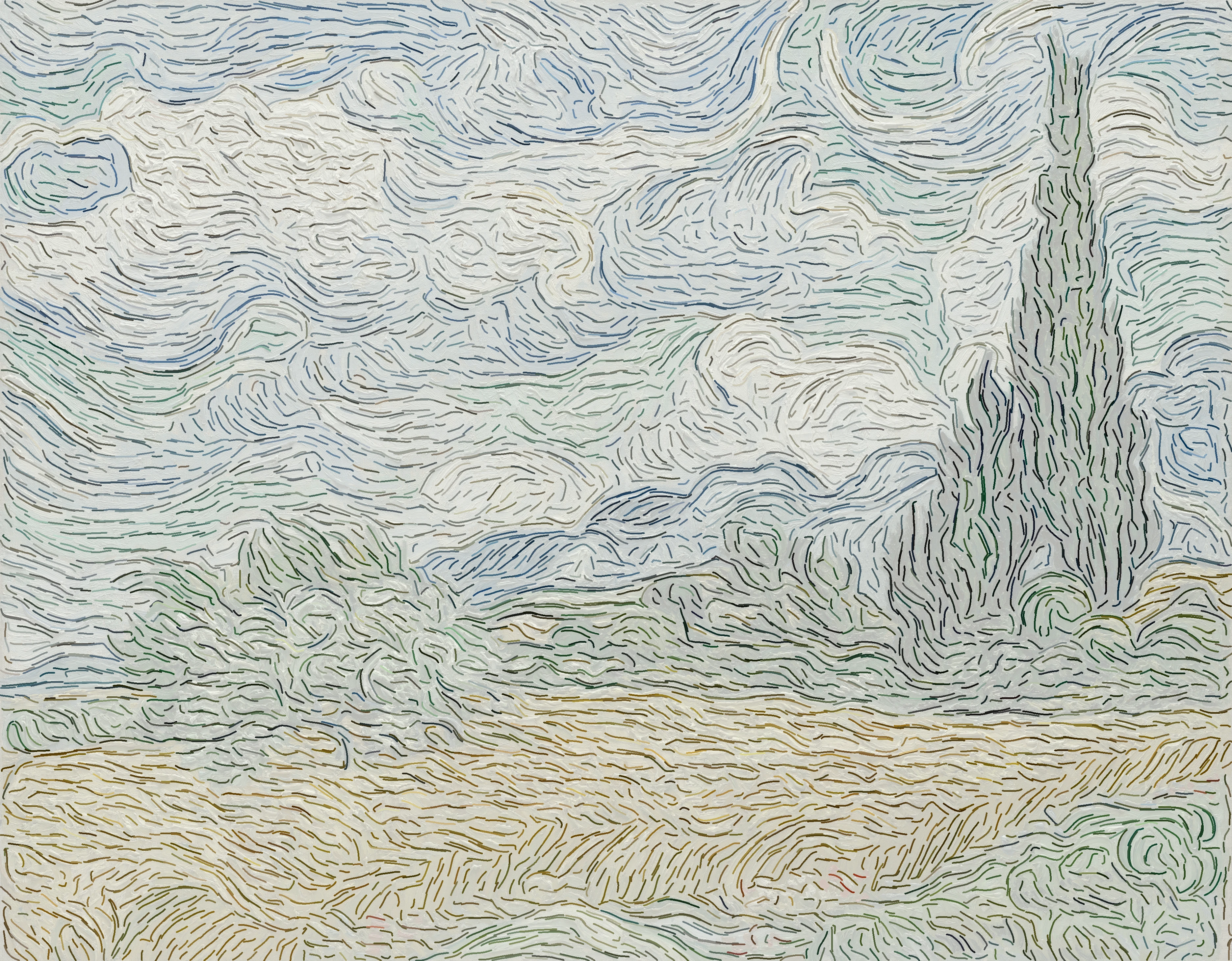
Every mark in the painting points somewhere. At each point of the canvas the direction of the paint was measured, and the result reads like a weather map. In the open sky the strokes run long, most of the paint laid in marks over 25 millimetres. Where a white band meets a blue one they bend into open hooks. Of 41 curls, one closes: they curl, but they rarely become spirals.
The same patch, read as directions: each small line follows the paint beneath it.
how
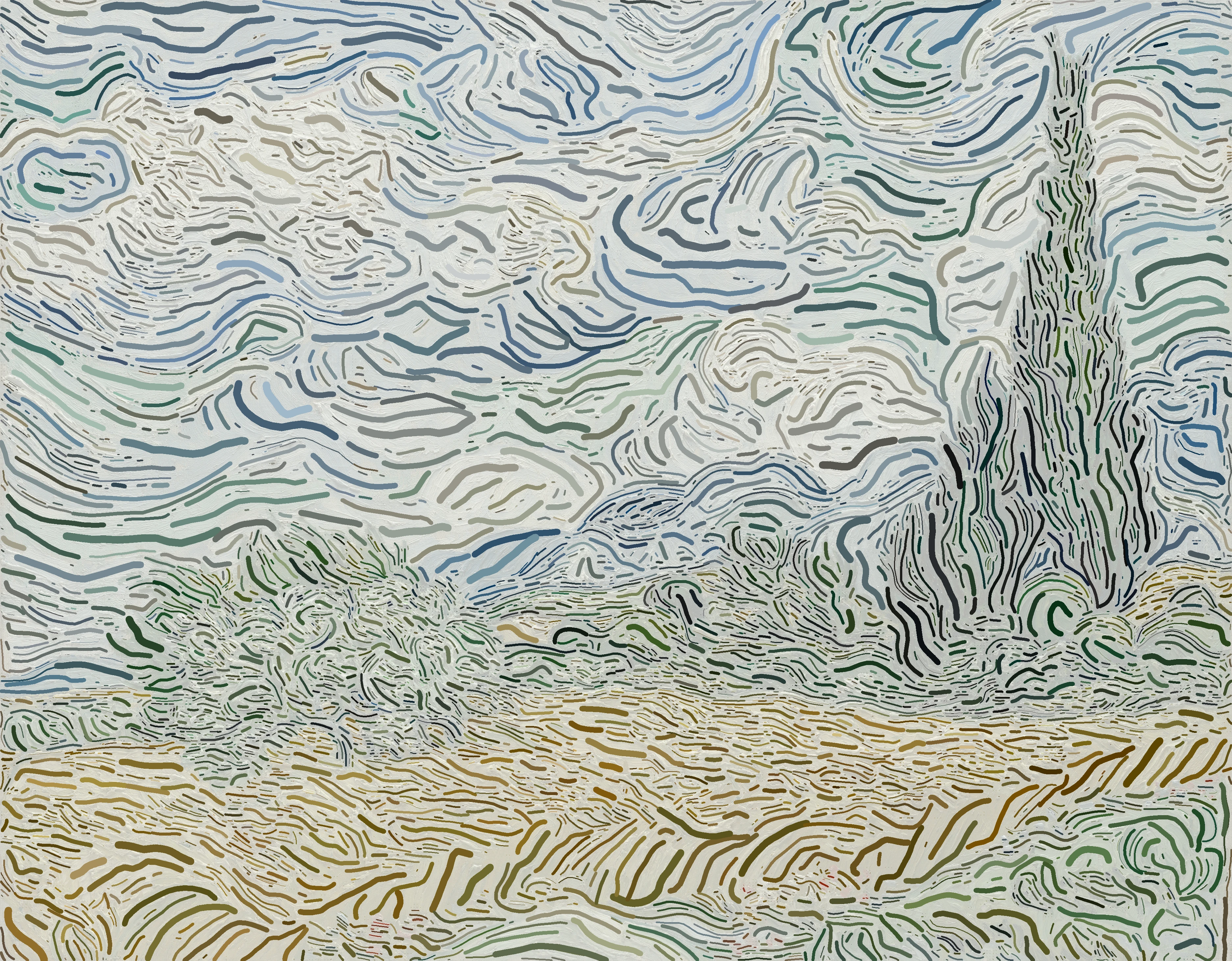
prototype/analysis/analyse.pyThe olives are the opposite: short commas, only a fifth of their paint in long marks. The cypress climbs in flames; the wheat lies in shorter strokes swept sideways. Before any program traced them, 89 strokes were marked point by point on a grid as a test, by the same hand that wrote the code. Tracing along the measured flow found 37 of them, most at about their true length, though drawn too wide.
how
groundtruth_strokes.json); trace_strokes.py traced 9,781 strokes along the field and found 37 of the 89 (recall 0.42: wheat 0.64, cypresses 0.25), their widths 1.6–3.3× too wide. An edge-first method (Li et al. 2012) found 4 of the 89. docs/research/2026-10-28-analysis-surface-depth.mdMasses and depth
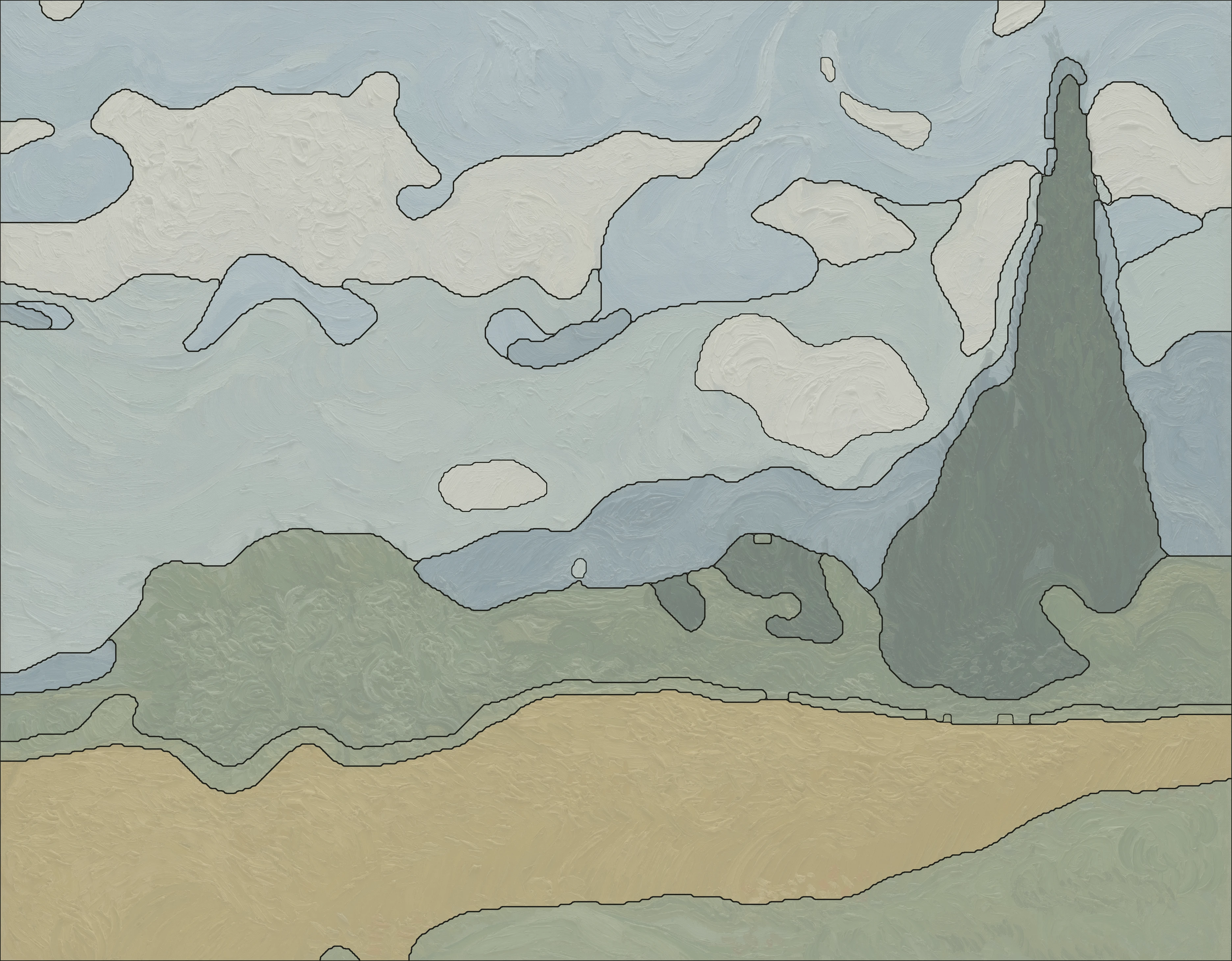
Blur the strokes away and eight shapes remain. Two bands of sky, the clouds, the blue hills, the olive trees and bushes, the cypresses with their dark bushes, the wheat, and the green bank at the bottom. Each has its own colours and its own kind of mark.
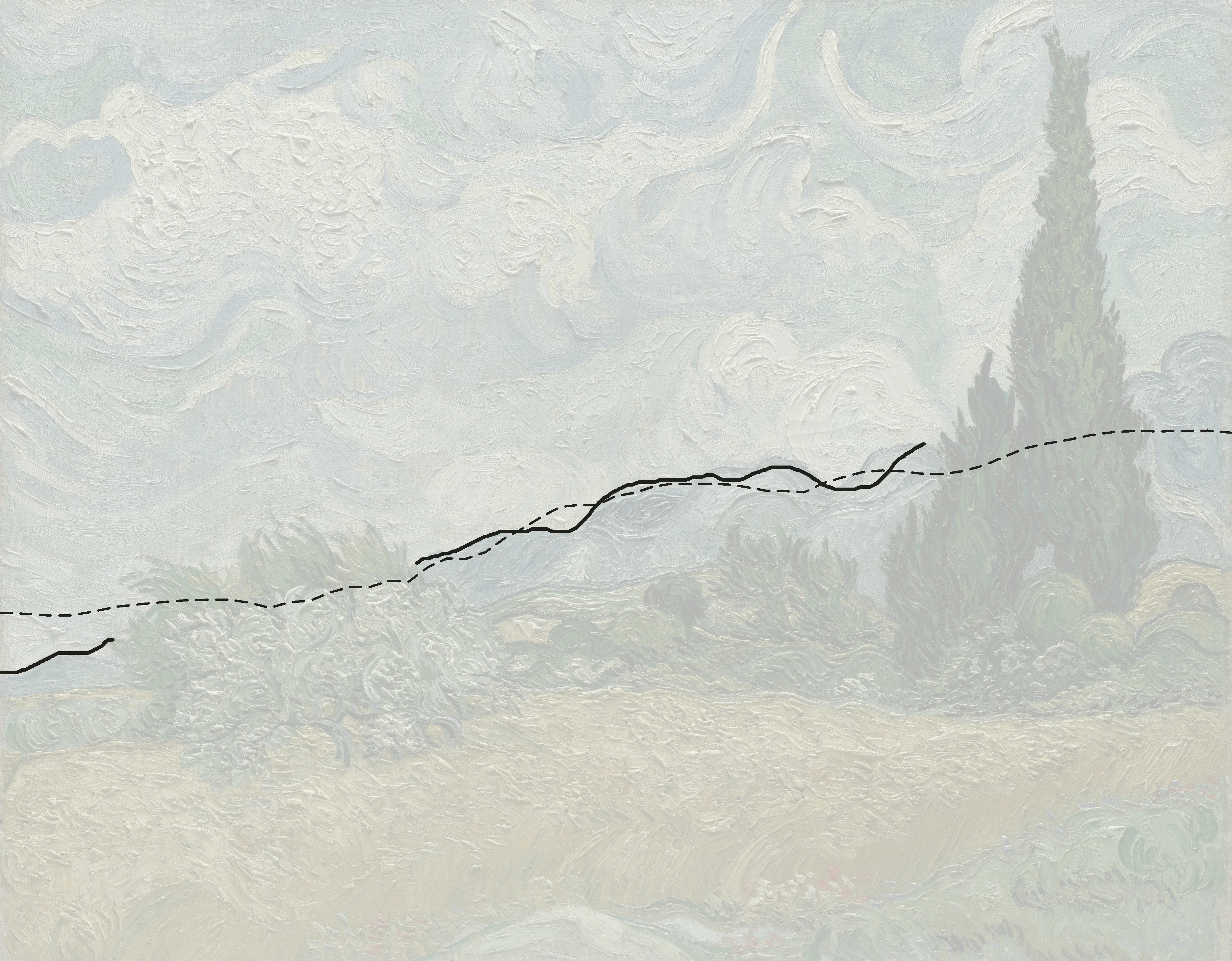
Depth comes from one line, where the flat plain meets the hills at the far left: the eye level of someone standing in the field. Each tree and bush was cut out alone and given a believable height. Read that way, the olive bush stands about 19 metres off and the cypress pair 35 to 40, on ground two metres higher. The tall cypress comes out 20 metres tall. A first try, with bushes still fused to it, made it seven.
how
prototype/analysis/depth_v2.pyRepainting stroke by stroke
Then the painting was painted again, stroke by stroke. Each mark becomes a line of instructions: where it starts, which way it turns, how long it runs, what colour it carries. A real painting engine with an oil brush lays every one; no image-making model touches a pixel. Two engines were tried on four paintings, and the one closer in colour was kept. Up close the copy is flatter than his, with no raised paint and fewer, shorter strokes.
how
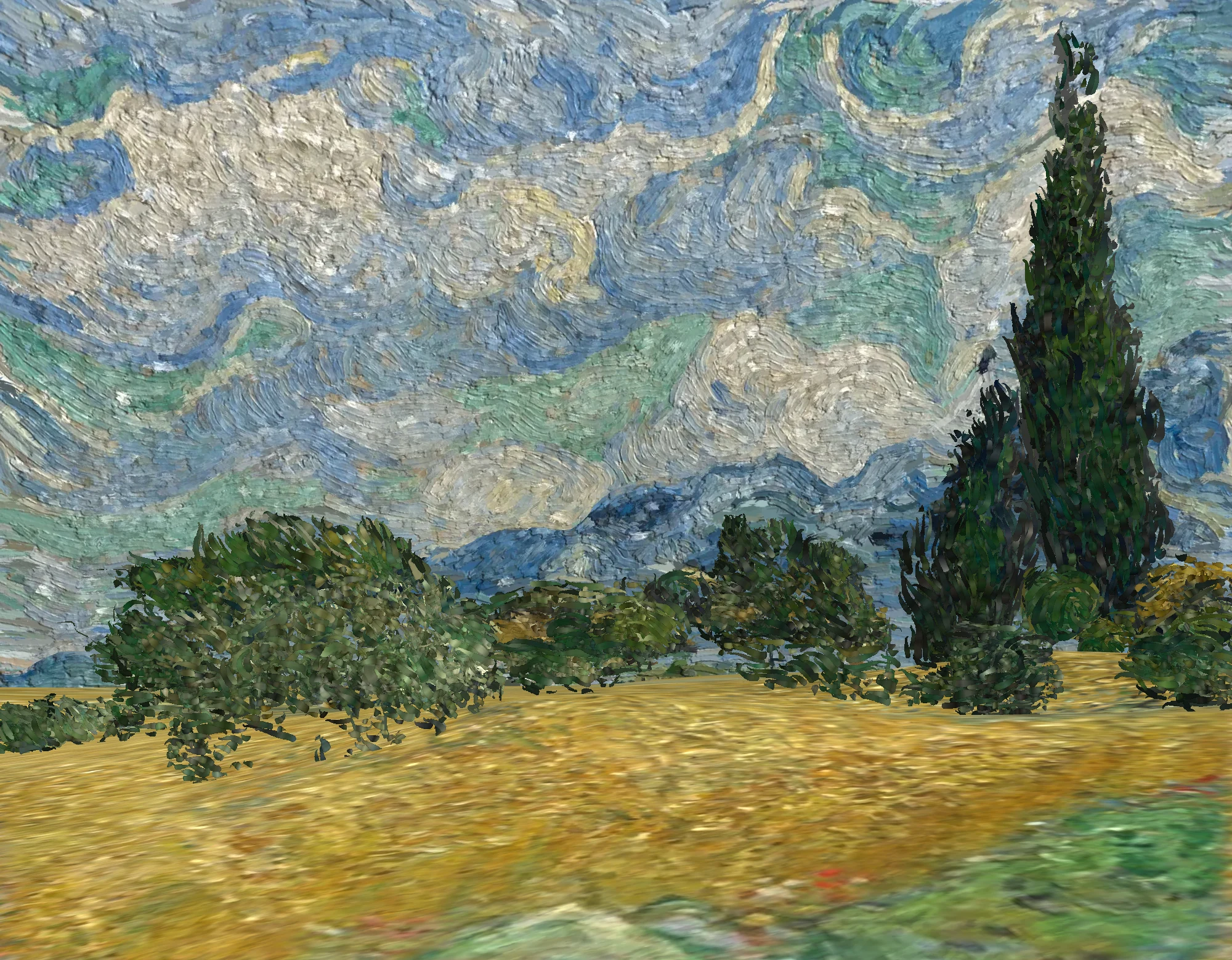
tanda/oil-03-paint, run headless. First repaint: 71,334 strokes in 12 s, colour difference ΔE2000 1.7. Engine test on four paintings: libmypaint ΔE 2.7–3.0 against Krita 3.0–3.7. docs/adr/0004-libmypaint-paint-engine.mdIn the World the cypress is grown, not modelled. Sprays branch from a stem along the flow of his painted flames, carrying thousands of single strokes, his own traced ones at the front. Two earlier cypresses were turned down: cards tilted at random, then ribbons wrapped round a solid like paper lined with strokes. From the spot where he stood, the grown trees settle close to his outlines.
how
prototype/models/tree.py): the final build has 4,235 strokes, 329 of them traced from his; outline overlap with his (IoU) 0.78. The World draws about 125,000 strokes, 30,800 of them unique. This view is the World rendered from his camera.Beyond the frame
No letter says where he stood, or which way he faced. Laid against his hill line, the real ridge near the asylum fits best facing south-east, with the Plateau de la Caume at the centre. His hills stand about 1.7 times taller than the land: he exaggerated, as he admitted of his mountains, or he stood closer. The direction is a reasoned guess, not a record.
how
prototype/world_plan/, docs/paintings/wheatfield/world-plan.mdPast his edges the sky continues from his own: every new patch points back to a place in his painted sky, then is repainted in strokes his size. The hills follow the real ridge at his height and in his colours, sliding past as the walker moves. The sun stands where a late-June noon puts it, high to the right, so the cypress is seen against the light.
how
Checking against his hand
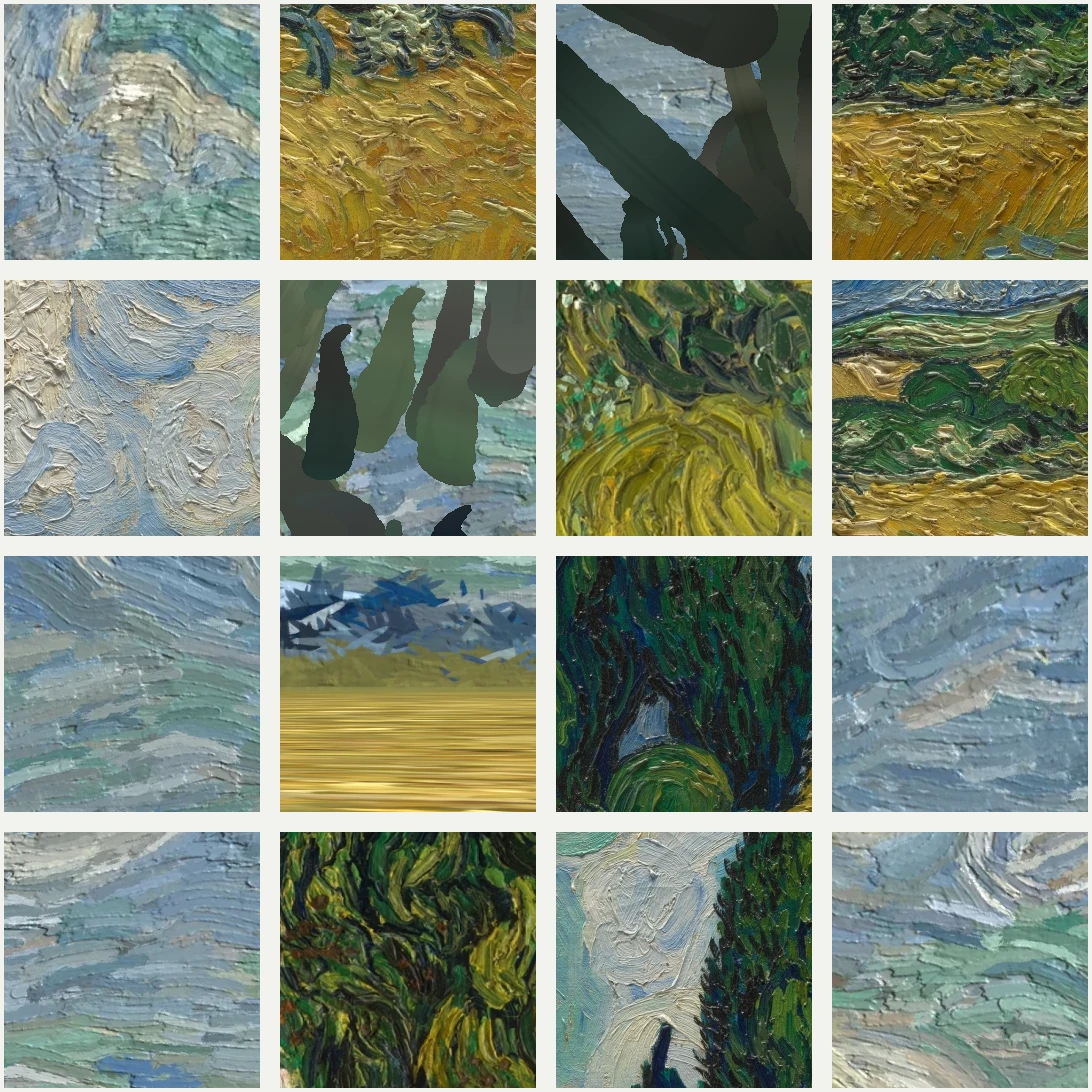
Beyond the frame there is no picture to copy. The test asks instead: could he have painted this? Squares from his canvases and from the World are mixed and marked “his” or “not his” before the key is opened. At first 15 of 16 were told apart. Later boards went to an automated stand-in, shown only the squares and nothing of the project. Three times it took a square of the World’s new sky for his; on the last board, one seen 45° left of his line of sight.
Much still fails. Up close the World’s cypresses turn into flat dark shapes and the near ground into a smear. The sky is still caught by its sameness, every dab the same size and height. Of the numbers that gate, built to measure his hand, only the colour of the plants told him from Pissarro. The plan’s farmhouse and stone wall remain drawings, the hills ring’s blind board was never marked, and the sky alone was built seven times.
how
prototype/consistency/The door
The frame opens here. Inside it the field and the cypresses stand where he left them; past its edges the place goes on, imagined in his manner. Walk in, and turn back to find his view.