 On the Motif
Contents
1 · Saint-Rémy, early summer2 · His palette3 · How the strokes flow4 · Masses and depth5 · Repainting stroke by stroke6 · Beyond the frame7 · Checking against his hand8 · SourcesWheat Field with Cypresses
The case study
The full record of how one painting was read, repainted and walked into, with every plate, the numbers behind it, and what did not work.
Every plate is redrawn from the analysis data (site/scripts/plates.py); where one was redrawn from a working image, "as recorded" shows that image instead.
1 Saint-Rémy, early summer
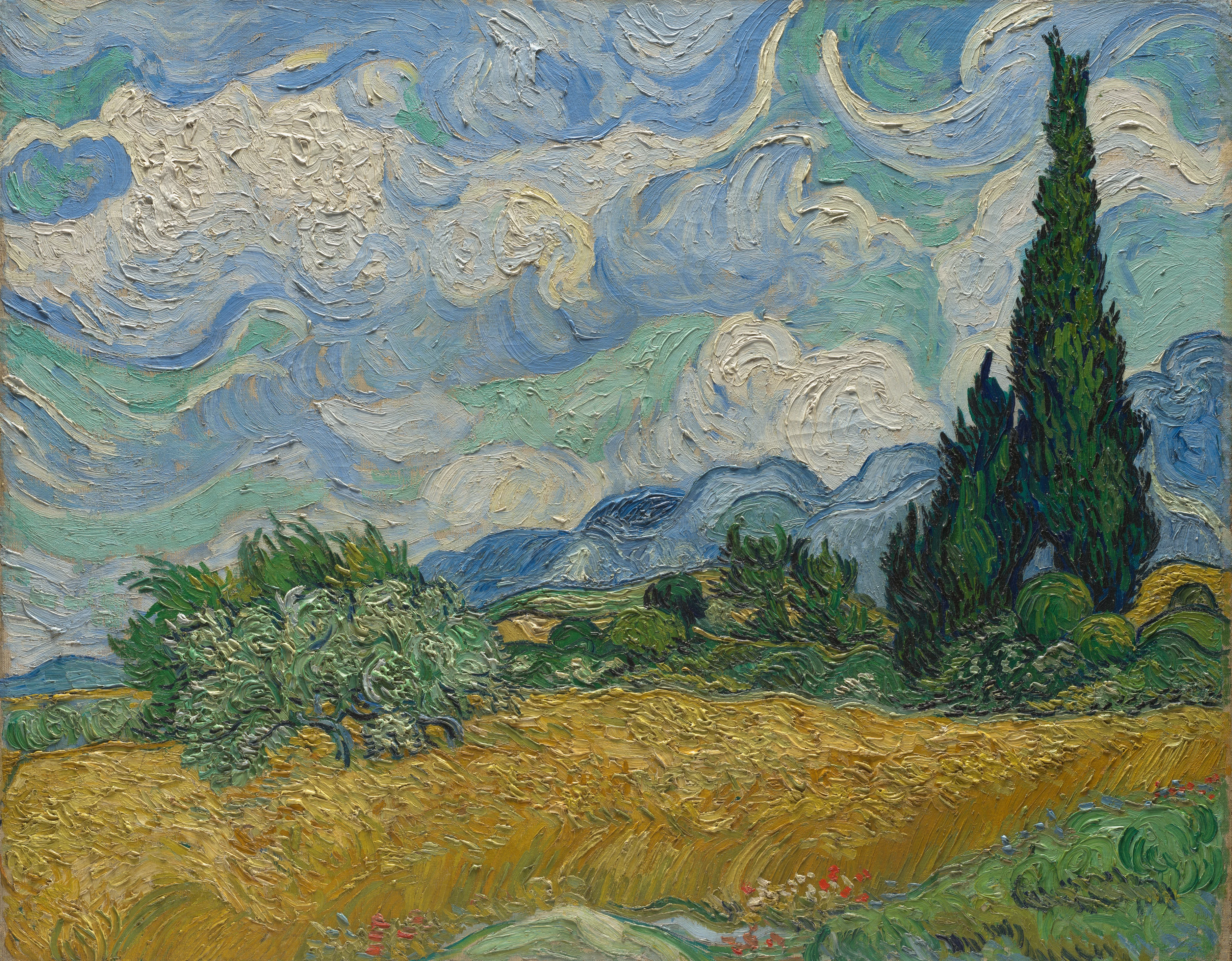
The canvas was painted outdoors near Saint-Rémy-de-Provence, in the early summer of 1889. Van Gogh was then a patient at the asylum of Saint-Paul-de-Mausole, on the plain below the Alpilles, a short limestone range that runs east to west.9 A 2015 book places the view at his bedroom window. Met, citing Mullins (2015) and Werthemann and Zimmer (2009). The Met calls that an error: he painted this subject only once allowed beyond the asylum grounds, and the National Gallery adds that a guardian went with him.12
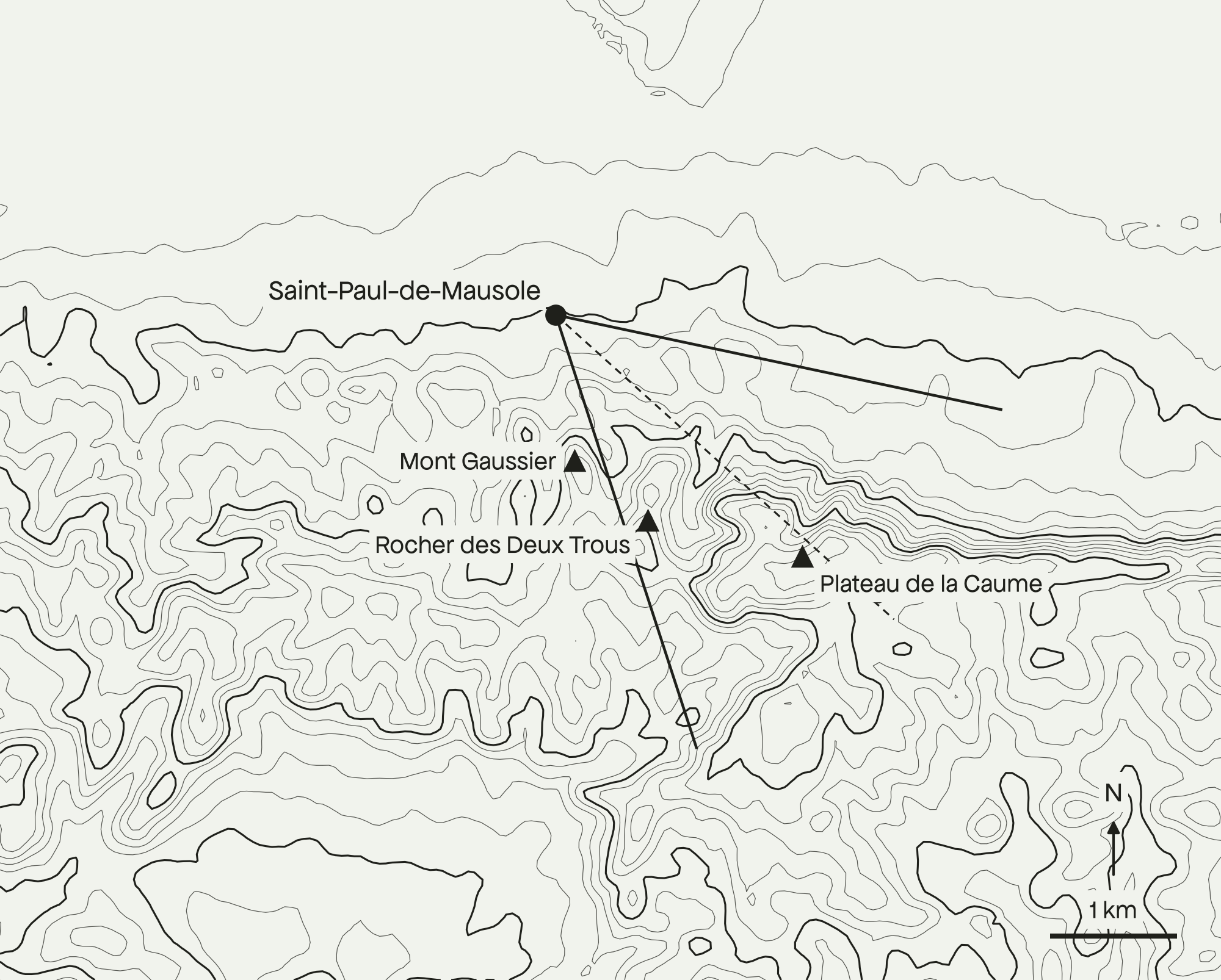
The asylum stands where the plain begins to climb. South of it, within three kilometres, rise three tops: Mont Gaussier and the Rocher des Deux Trous, both in his Saint-Rémy canvases, and the Plateau de la Caume (Plate 1.2). No document gives the spot he stood on, so the map shows only the asylum and the direction the terrain later argued for.
No document gives the day. A drawing fixes the latest date: on 2 July he sent his brother a reed-pen version of the composition, made after this canvas, so the painting existed by then.4 Letter 784, note 16 (the drawing, F1538). The National Gallery says late June. A 1990 study by Gedzelman, known here only through the Met’s summary, dates it, from weather records, to clear spells around two overcast periods, 10–14 and 18–20 June.5
The letters of those weeks describe the place but never this canvas, which appears only in lists of work (Plate 1.3). In May he saw “very, very green wheatfields” at the foot of “little grey or blue mountains”. On 25 June he wrote of cypresses in general as “the dark patch in a sun-drenched landscape”. By early July the scorched grass was “taking on beautiful tones of old gold”.

The Met reads the canvas as a study from nature: worked from far to near, wet paint into wet, with no changes of mind, and a wheat husk caught in the paint. In September he repeated the composition in the studio, and that autumn made a smaller reduction for his mother and sister. F717, this canvas; F615, London; F743, private collection. Across the three, the field, the olive bush, the cypress pair and the hill line keep their places. The sky changes each time. The method takes its first principle from this: the layout is the place, and the sky and the rhythm of the outlines are where he composed. His own account of working agrees. Letter 698 to Émile Bernard, about 5 October 1888. He did not “invent the whole of the painting”, he wrote, but found it “ready-made”, waiting “to be untangled” in the real world.
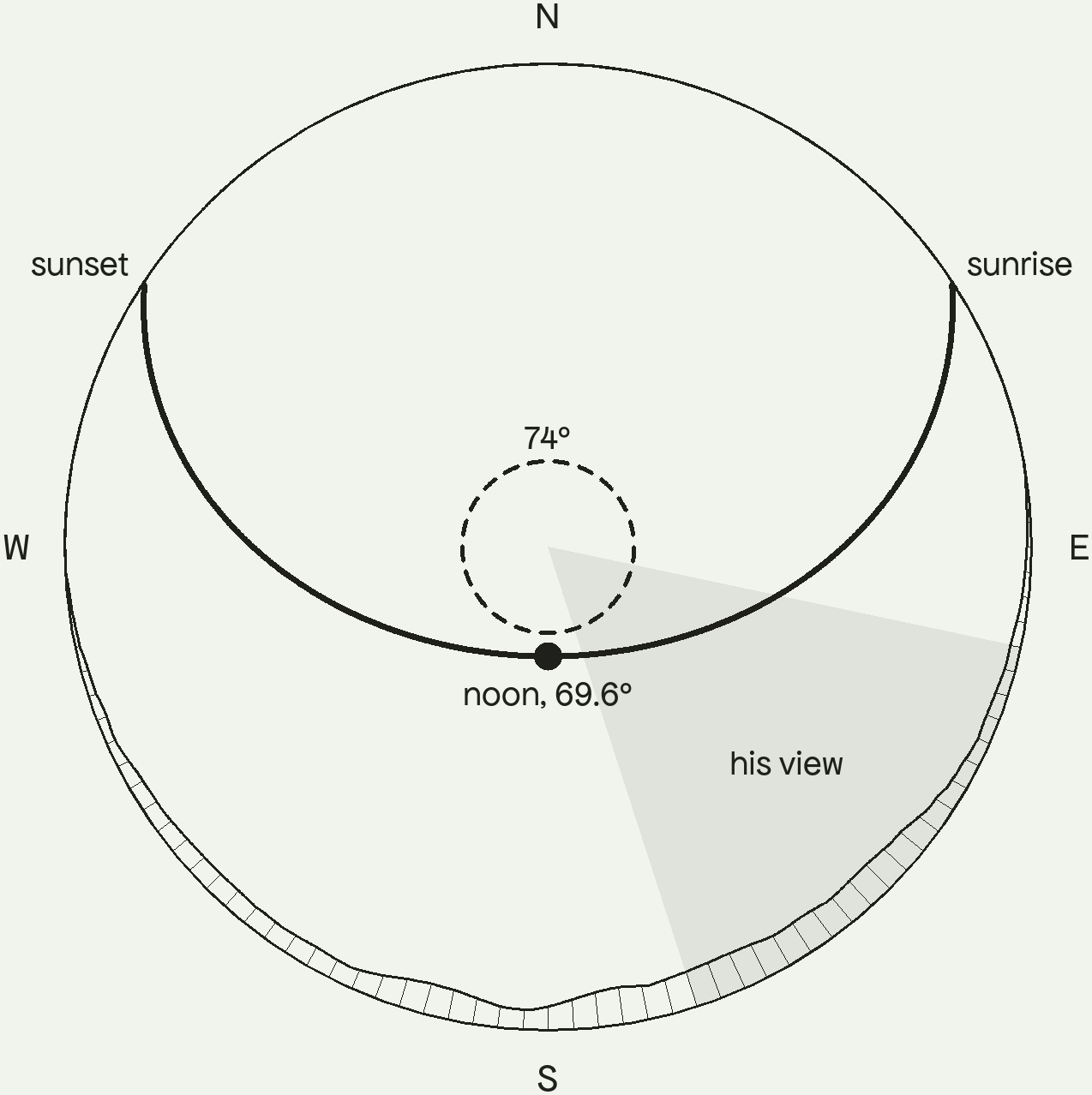
This historical research came late, after the first four steps had been built. By then the code assumed he faced due south under a sun 74° high, an angle the sun never reaches at Saint-Rémy (Plate 1.4). Two phrases, one about his “brightest canvas” and one about “extreme heat”, had been attached to this painting, though the letters’ editors assign both to the Reaper of the same weeks. Letter 783 note 8; 784 note 22 (the Reaper, F617). Both errors were corrected once the letters were read with their notes. The study still treats the place far more than the man: his illness and his months at the asylum are barely touched.
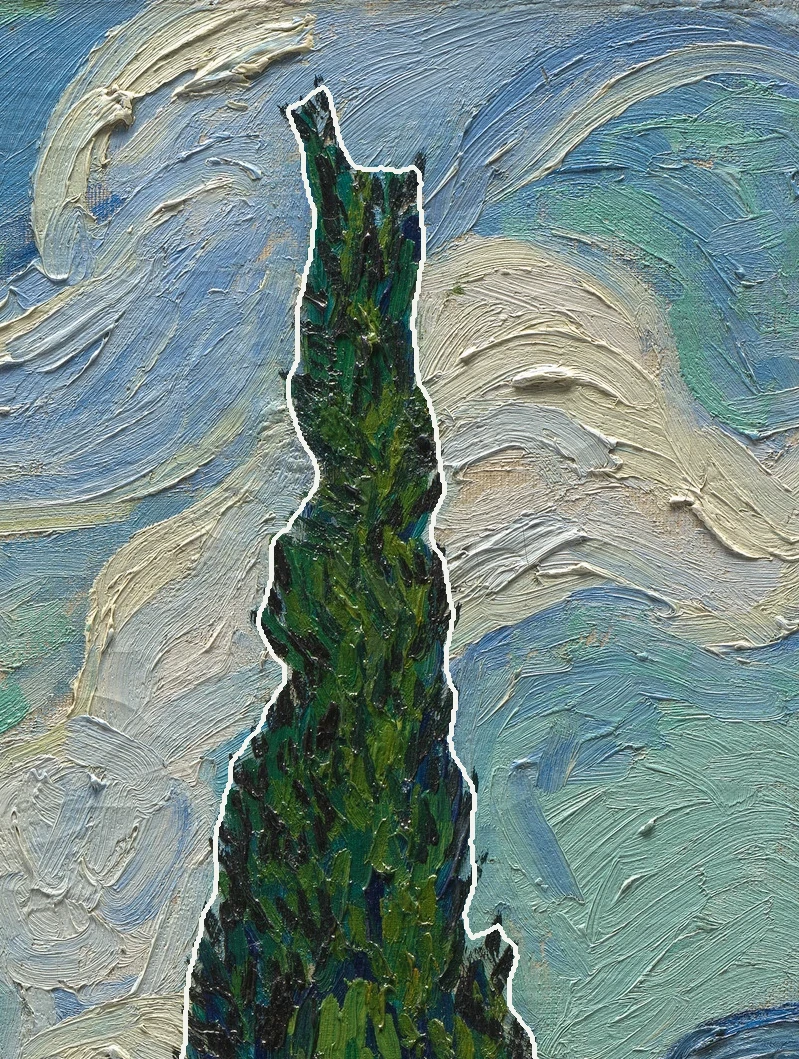
One more caution belongs to the record. The top of the tall cypress was retouched by a restorer, the Met notes, “in a way that may not reflect its original appearance” (Plate 1.5). Every reading of that crown inherits the doubt: its strokes, its outline, its height.
Method. The asylum stands at 43.7776 N, 4.8347 E, 104 m (OpenStreetMap8; EU-DEM height); the Alpilles run about 25 km, their top at 498 m. Plate 1.2 draws EU-DEM 25 m (via OpenTopoData)7, sampled every 50 m, over about 9.7 × 7.8 km, from 9 to 388 m, with the tops from OpenStreetMap. The versions: F615 in the National Gallery, London, 74 × 93 cm; F743 about 52 × 65 cm (51.5 or 52 by source), its sky read from a small black-and-white plate in the NG Technical Bulletin 11 (1987), p. 43, fig. 3.3 Letters cited from the 2009 edition: 772, 783, 787; lists of work 784, 800, 806, 824. English Wikipedia still ties the cypress paintings to the window view. The noon sun follows Spencer’s 1971 declination.11 Plate 1.3 dots the five letters Station 1 draws on (772, 783, 784, 787, 806), not the whole correspondence, and leaves out Gedzelman’s weather windows. Plate 1.4 is equidistant in height; the skyline is the terrain without the 1.7 lift. Records: docs/paintings/wheatfield/context.md, retrospective.md §4, §7.
2 His palette
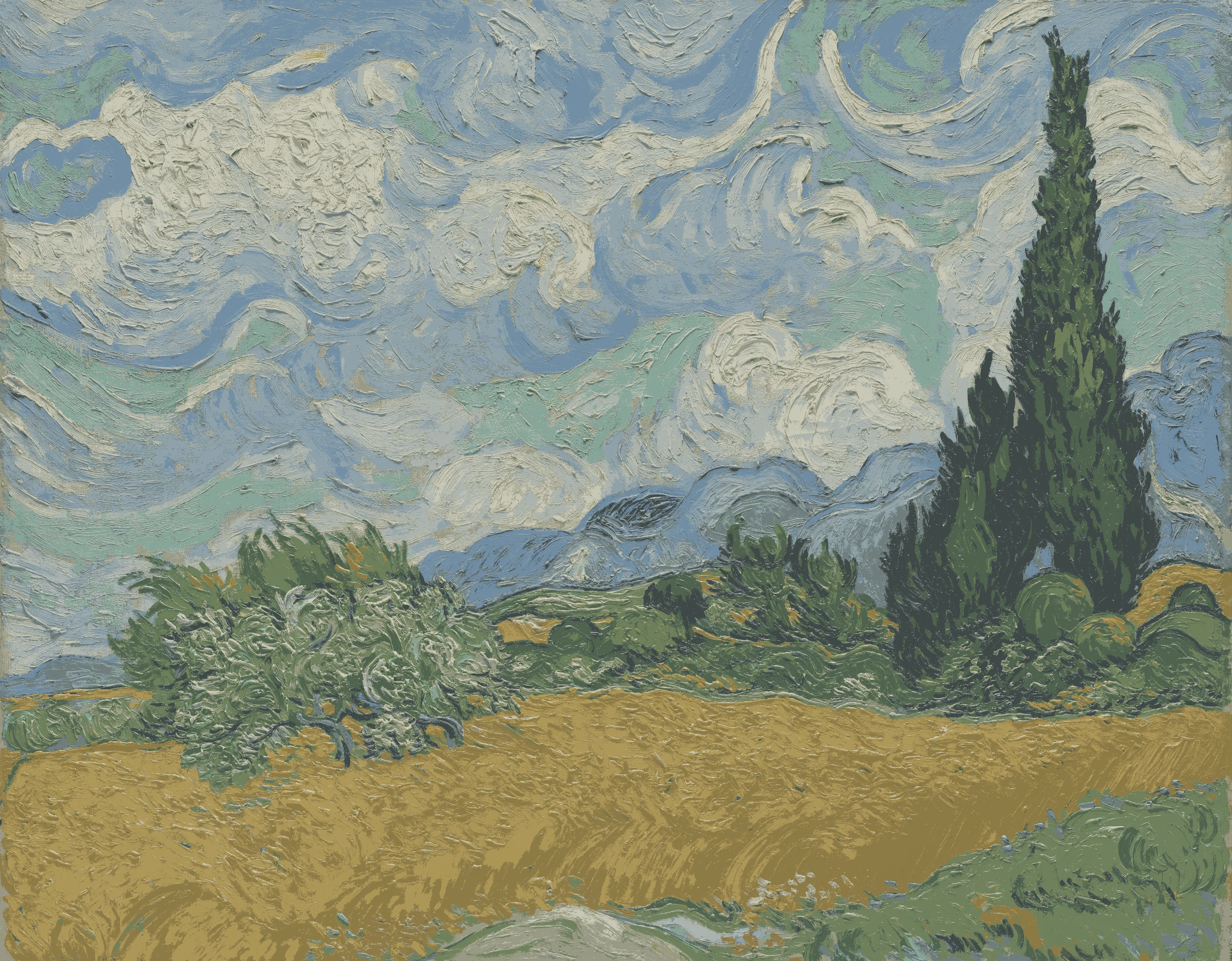
Twelve colours, measured from the photograph, share the canvas between them. Strictly, they are colours of the Met’s photograph: no instrument touched the paint, and every number below inherits the camera’s lighting and colour handling.1
The image was first flattened. Mean-shift filtering pulls each pixel toward the average of nearby pixels of similar colour, so canvas weave and glints of light on ridges fall away while the edges of strokes survive. The flattened pixels were then grouped by k-means, a procedure that divides a cloud of points into a chosen number of groups so that each point sits as close as possible to its group’s average. The points here are colours placed in CIELAB, a colour space built so that equal distances look roughly equally different to the eye: L* for lightness, a* from green to red, b* from blue to yellow.
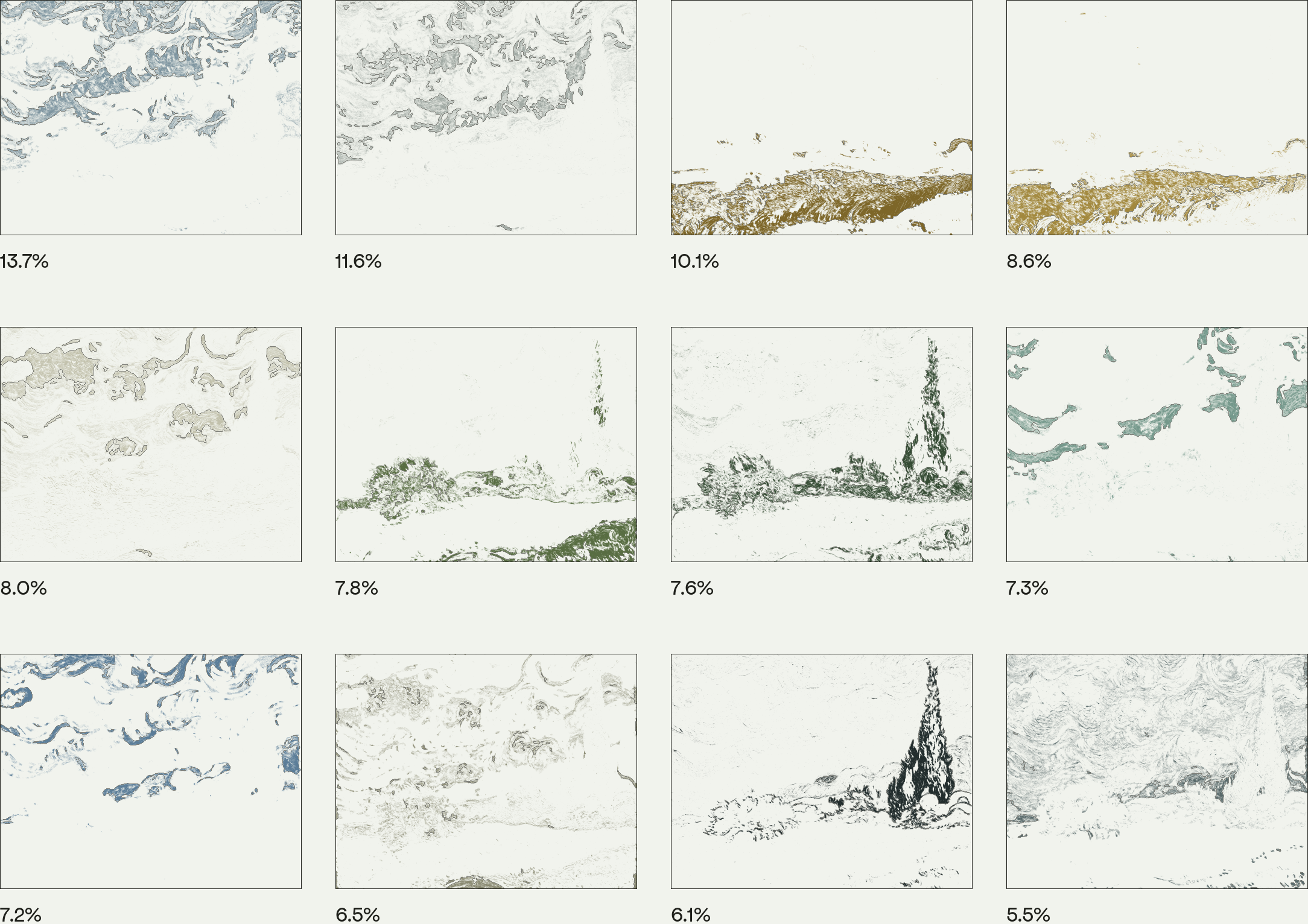
The largest group is a soft grey-blue, about a seventh of the surface. A pale grey-green follows. The two ochres of the wheat together cover almost a fifth. The cream of the clouds takes 8%, and a near-black green, the cypress, 6%. Between them run olive and bottle greens, a cool turquoise and a mid-blue.
The whole range is muted, because the photograph is. Its median chroma, a measure of colourfulness as distance from grey, is 15, Chroma = √(a² + b²); the twelve span L* 17.0 to 77.5. and its lightest colour stops at L* 77.5. The clouds read as white to the eye, yet none of the twelve is white. The palette map shows how much twelve colours can carry (Plate 2.2). Every pixel is set to the nearest of the twelve. The outlines, the bands of the sky and the division of the field all survive. What goes is the small variation inside a stroke.
The working record says a single palette for the whole canvas came out grey, so each of the eight masses of Station 4 also received four colours of its own (Plate 2.3). Measured again here, against the flattened canvas, the claim does not hold: mass by mass, the four sit as close to the paint as the twelve, a little closer in the clouds, the cypresses and the wheat, a little farther in the skies. Mean ΔE76 to the flattened paint, twelve against own four: within 1.5 in every mass. What the fours give is a palette that belongs to one mass, which is how the World later paints it.

The palette also set a limit. In June he wrote of violet shadows on sand, and in October of a “small white and violet cloud”.4 This canvas contains no violet: no cluster leans toward red, and the only warm colours are the ochres (Plate 2.4). Largest a* of the twelve: 1.5. The ochres sit at b* 37–43. A violet tint was later proposed for the World’s sky and refused. His palette bounds the World’s. One honest gap remains. The analysis is empirical only: it records which colours he used, not how he set them against each other. No study of complements or contrast entered the method.
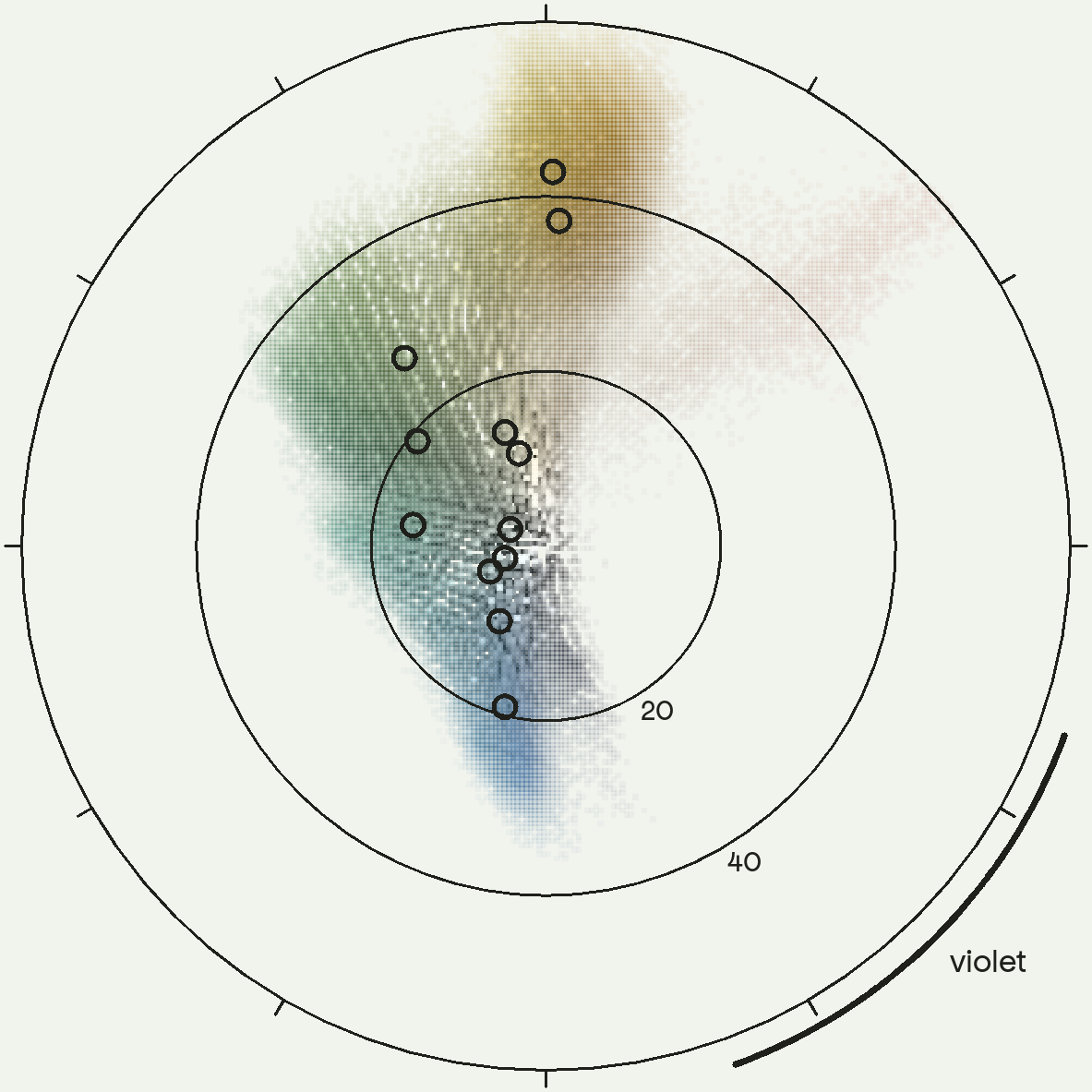
Method. Flattening: OpenCV21 pyrMeanShiftFiltering, spatial radius 6 px, colour radius 14, on the 2000 px analysis image. Palette: k-means, k = 12, 4 restarts, seed 0 (prototype/analysis/analyse.py). The six largest colours: #7e95a0 13.7%, #a0a9a3 11.6%, #7d6628 10.1%, #a2883d 8.6%, #c2c1ac 8.0%, #212c2c 6.1%; the other six take 5.5–7.8% each. Rejected in step 1: one palette for the whole canvas; kept: four colours per mass, k-means on each mass’s own pixels. Plate 2.1’s maps are redrawn on the full-size image and differ from the recorded shares by up to 2.4 points; the labels give the recorded shares. Plate 2.4 bins a* and b* at 0.5, fainter where fewer pixels fall; the violet arc (about 290–340° of hue) is an estimate. ColourLex records a mauve streak in the London version6, so the claim holds for this canvas only. The violet letters are 780 and 810. Not covered: colour theory, or how he set colours against each other (retrospective §7).
3 How the strokes flow
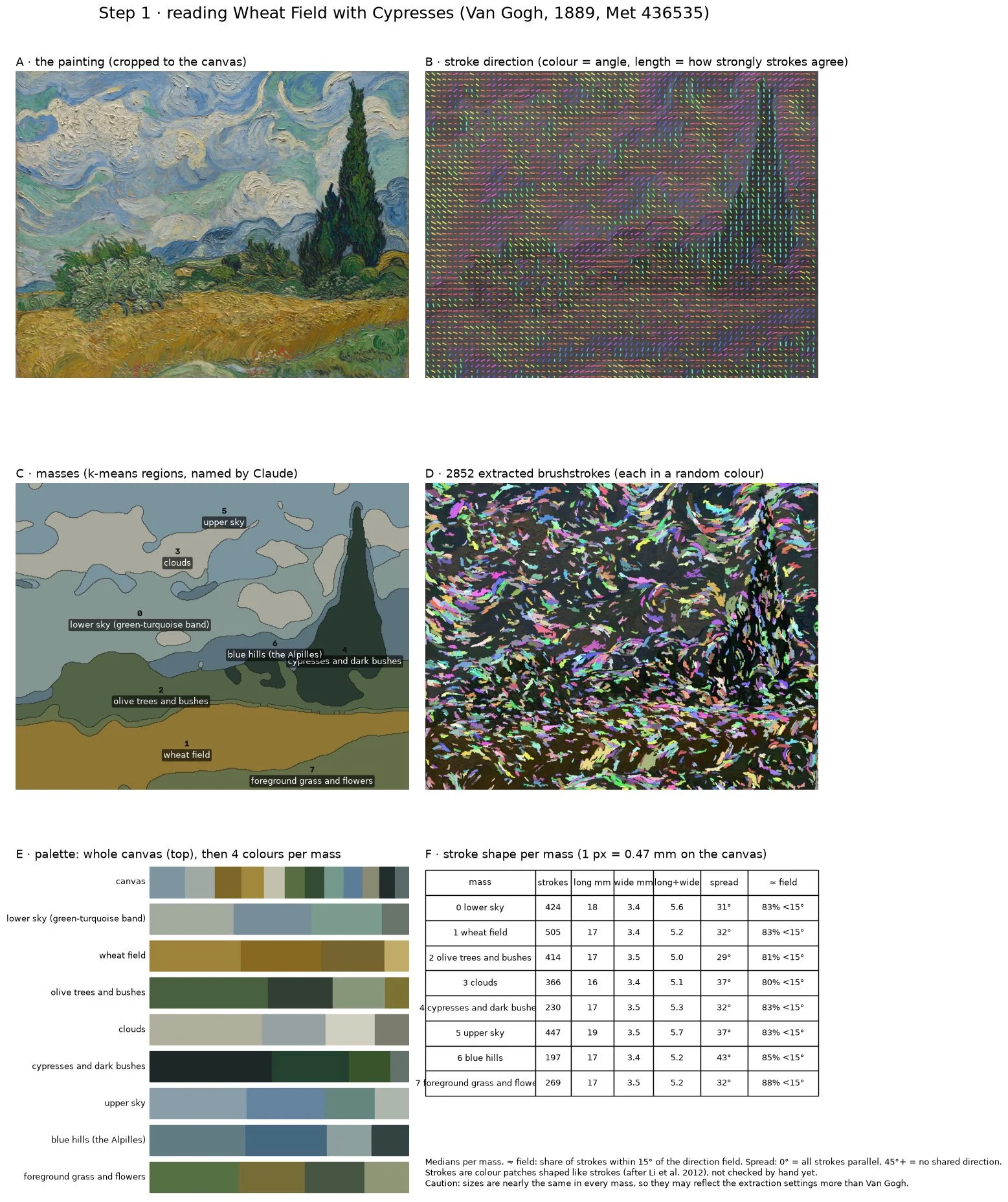
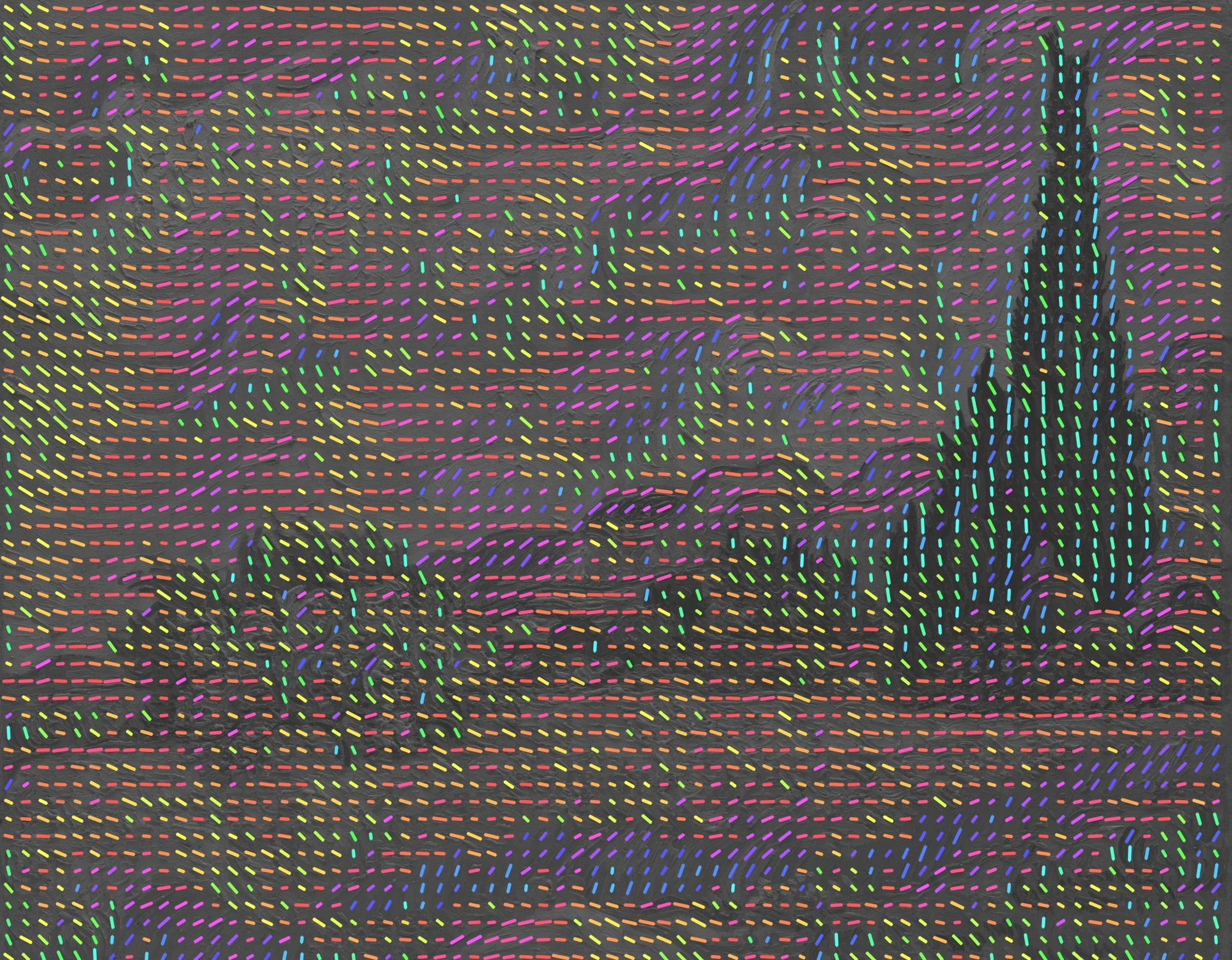
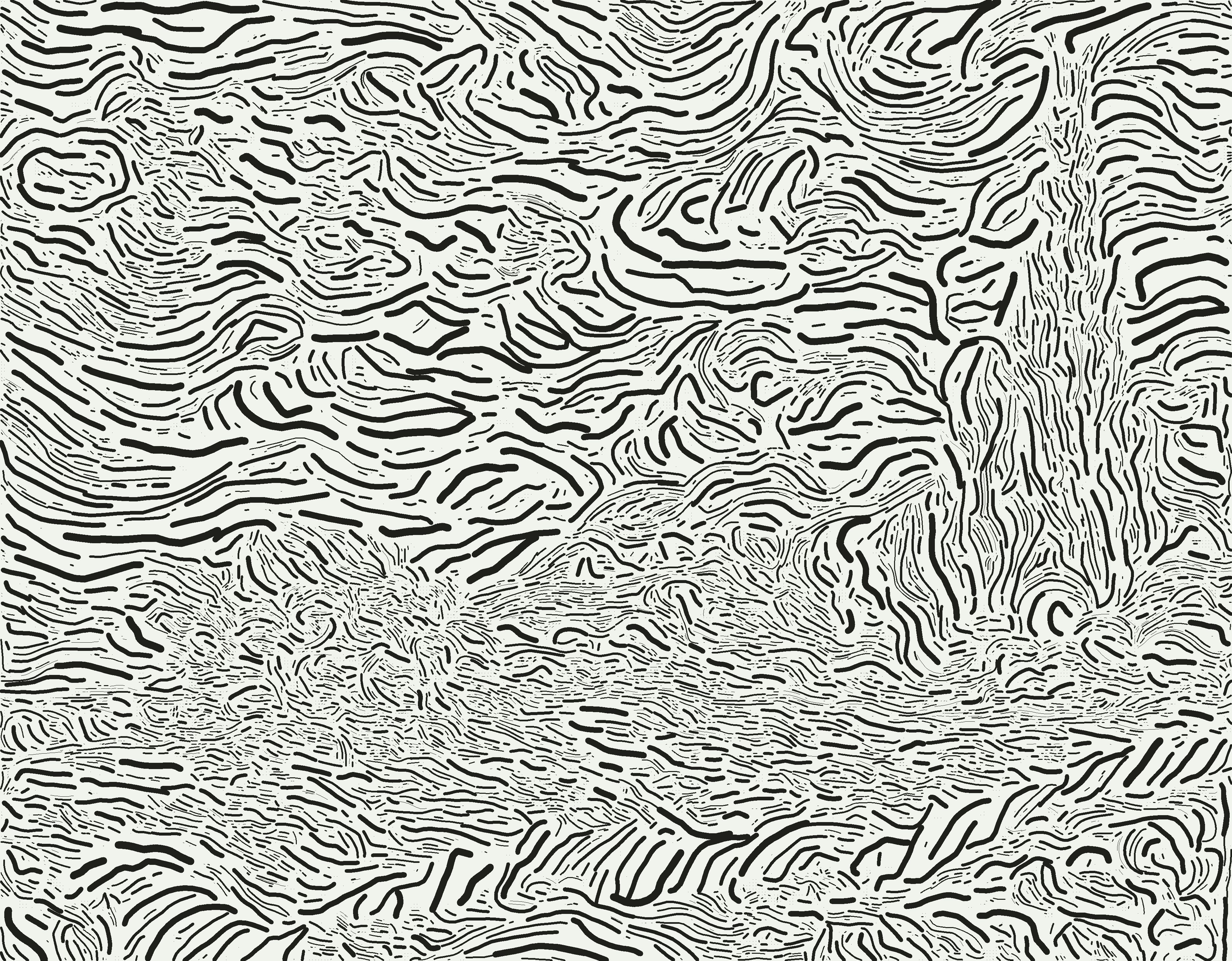
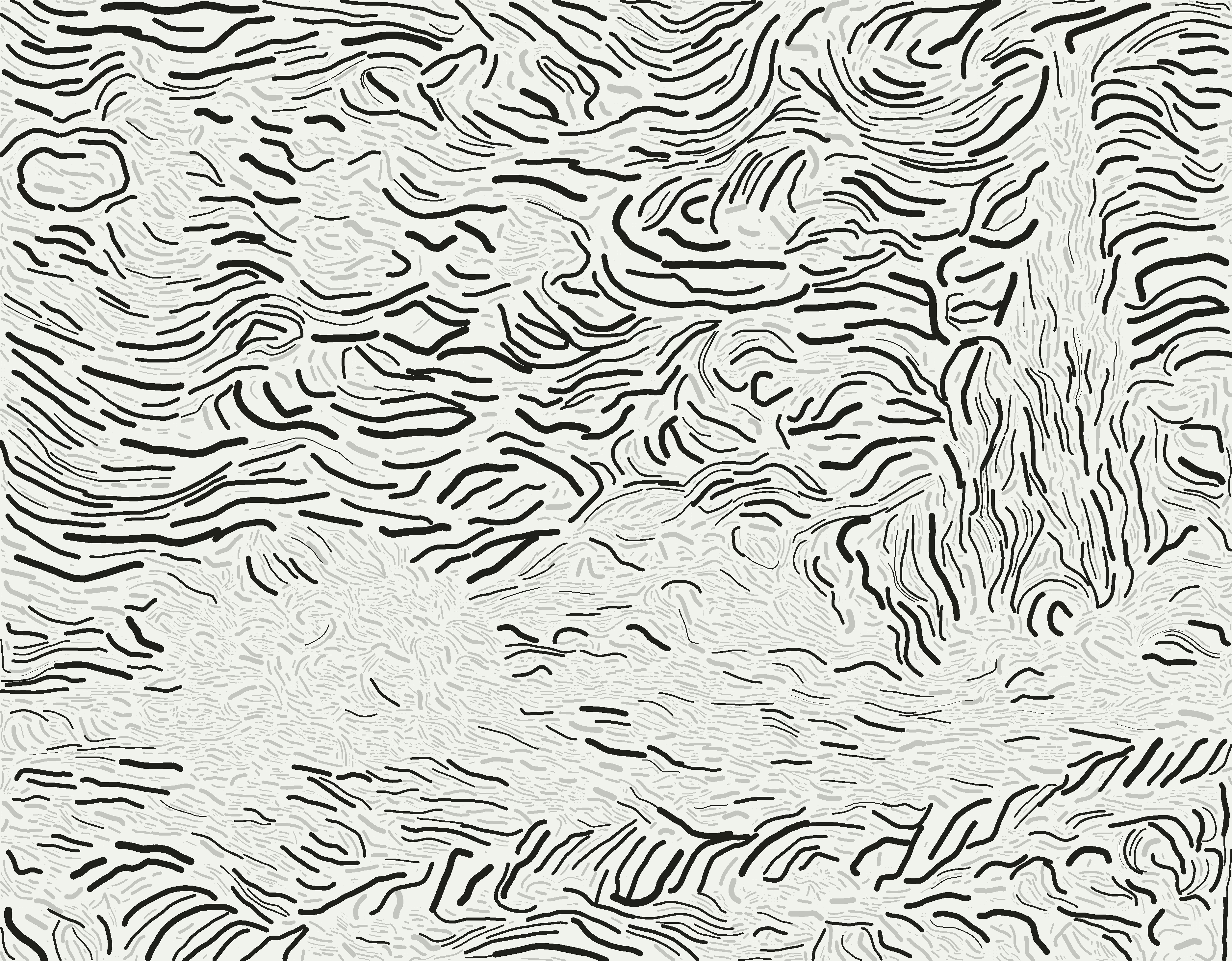
Each brushstroke on the canvas runs in a direction, and that direction was measured. At every pixel the method looks at how lightness changes in a small neighbourhood. Across a stroke it changes sharply; along it, hardly at all. The direction of least change is taken as the stroke’s direction. A second number, coherence, says how strongly one direction dominates there, Coherence = ((λ₁ − λ₂) / (λ₁ + λ₂))², from the structure tensor. from 0 (no preferred direction) to 1 (a single clear one). Drawn as lines that follow these directions, the canvas reads like a weather chart (Plate 3.1).
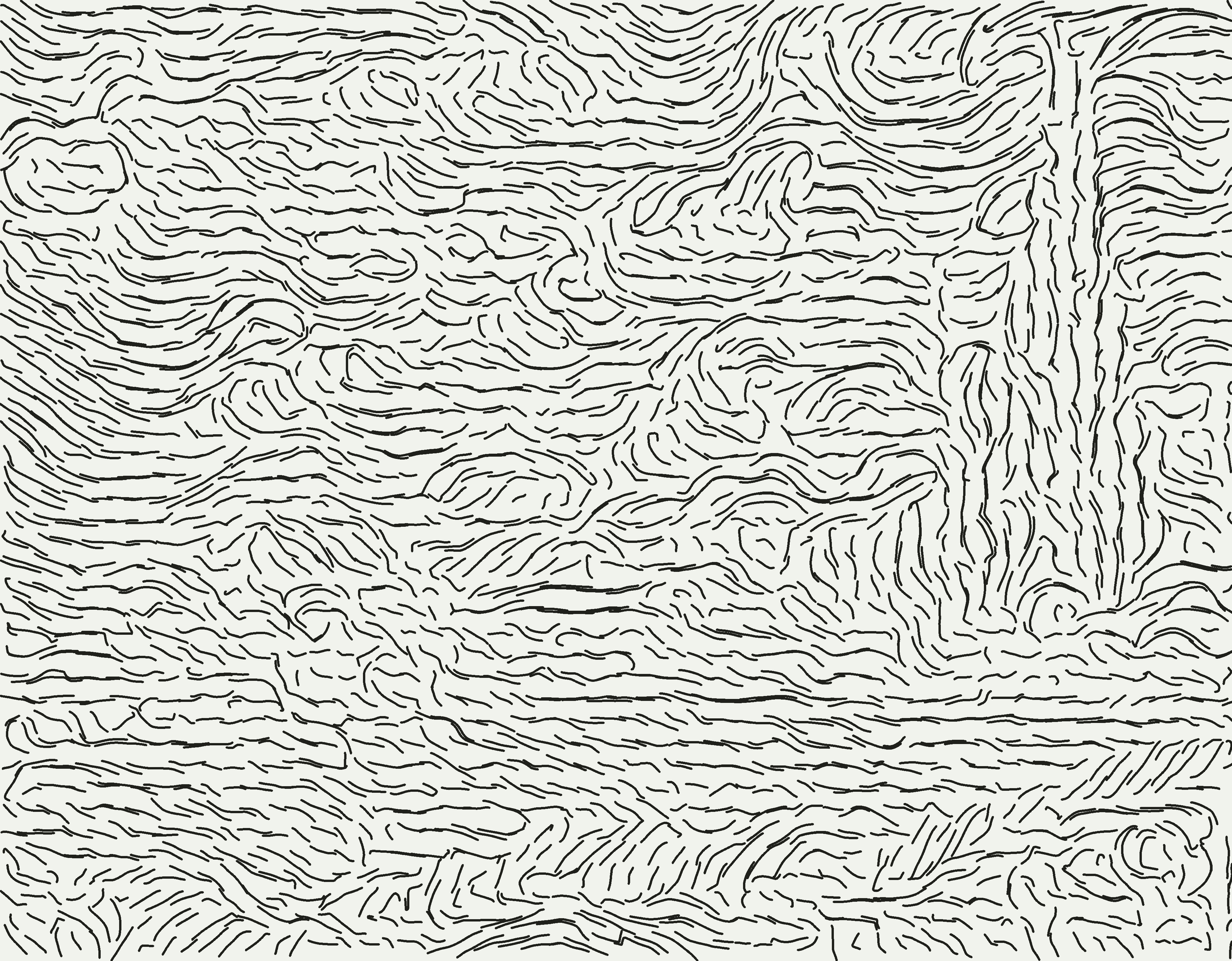
Finding single strokes proved harder. The first extractor cut the image into regions and kept the long, thin ones. It returned 2,852 strokes of nearly the same size in every part of the picture, about 17 by 3.4 mm. Felzenszwalb segments14, kept by size as in Li et al. 2012, whose fixed 100–800 px window has the same flaw.13 That uniformity was suspicious. It came from the method’s fixed window, not from Van Gogh.
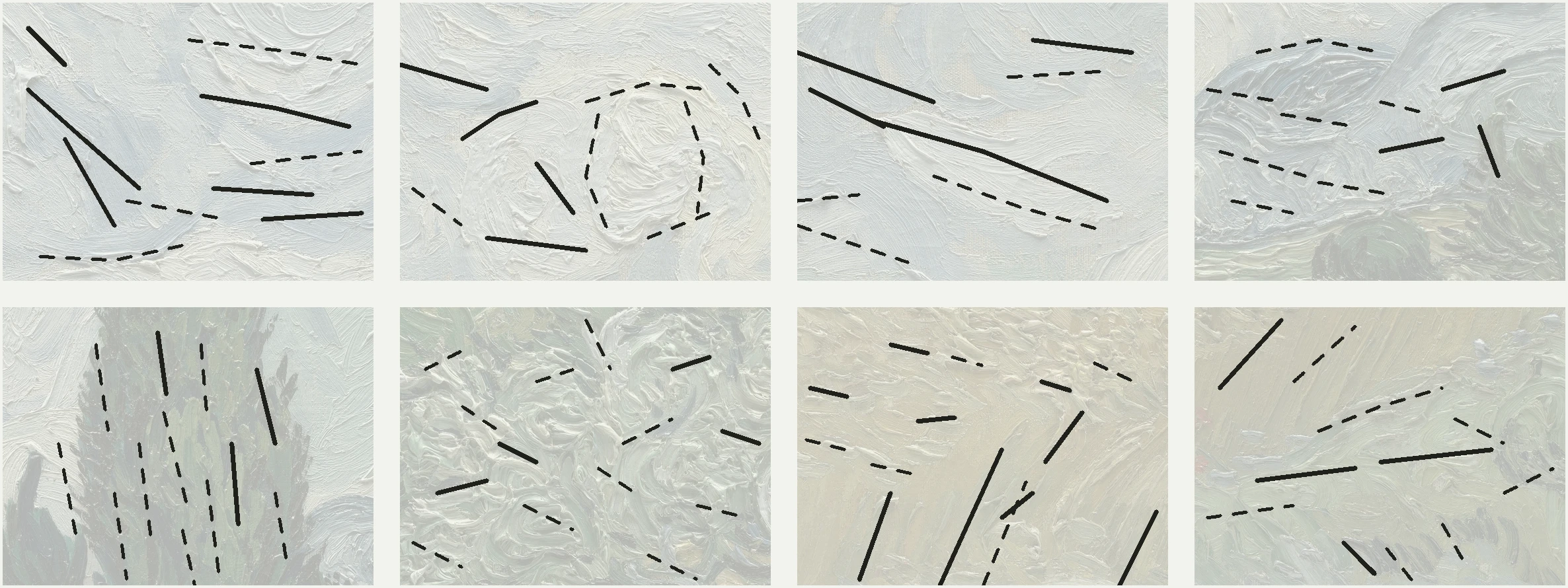
Before writing a second extractor, 89 strokes were marked point by point on a coordinate grid, by the same hand that wrote the code, on eight crops of the canvas as a ground truth: a small set of known answers to test against (Plate 3.2). Found: one traced stroke covers half the marked centre line, within 25°. An edge-first method, which looks for the borders of strokes, found 4 of the 89. The edges it found followed the light on the paint’s ridges, not the strokes themselves. An earlier cut along sharp edges had shattered strokes into slivers one or two pixels wide.
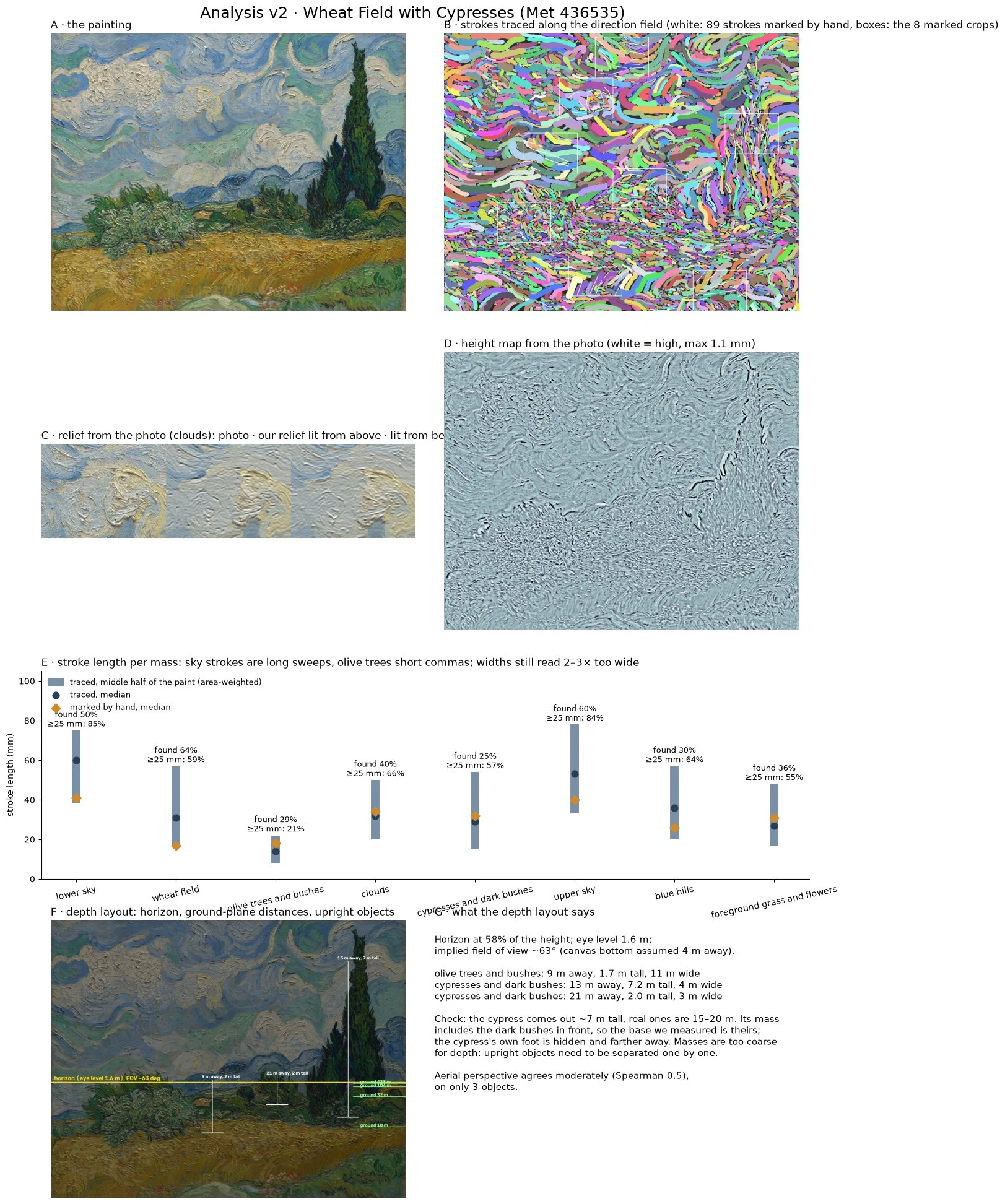
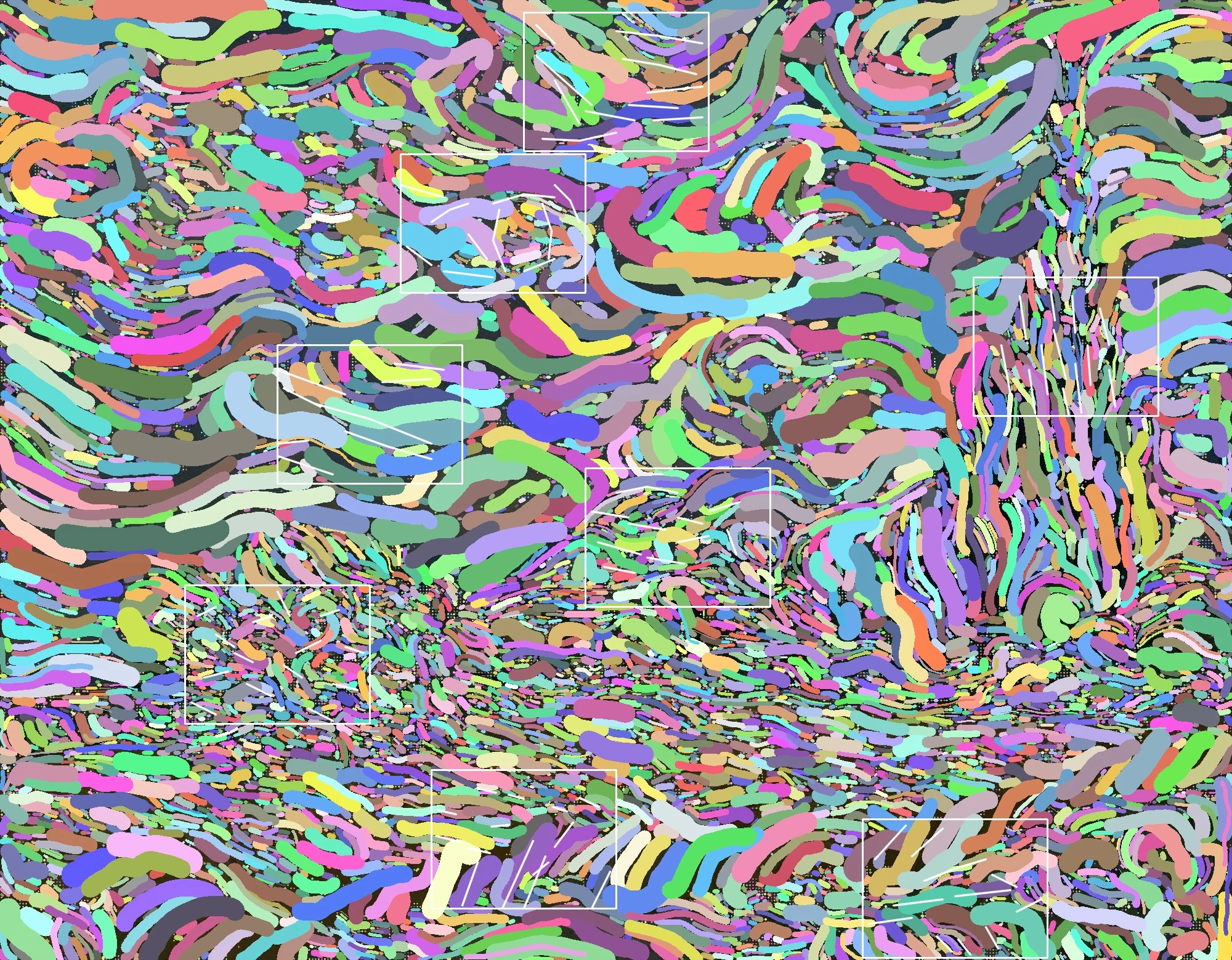
Tracing worked better. From seeds spread over the canvas, a line is walked along the direction field in both directions for as long as the colour stays close, and the longest candidates are kept first. This found 37 of the 89 marked strokes, most of them at about their true length (Plate 3.3). It did best in the wheat and worst in the cypresses. Recall 0.42: wheat 0.64, upper sky 0.60, cypresses 0.25. The traced widths still came out too wide, by 1.6 times in the olives and the cypresses and over three times in the sky and the wheat.
The traced strokes give the canvas a measurable character (Plate 3.4). In the sky, 84–85% of the paint lies in strokes 25 mm or longer. In the olive trees, only 21% does: short commas against long sweeps. The strokes marked on the grid agree on the order but not always on the size: in the sky they are shorter than the traced ones, in the olives longer.
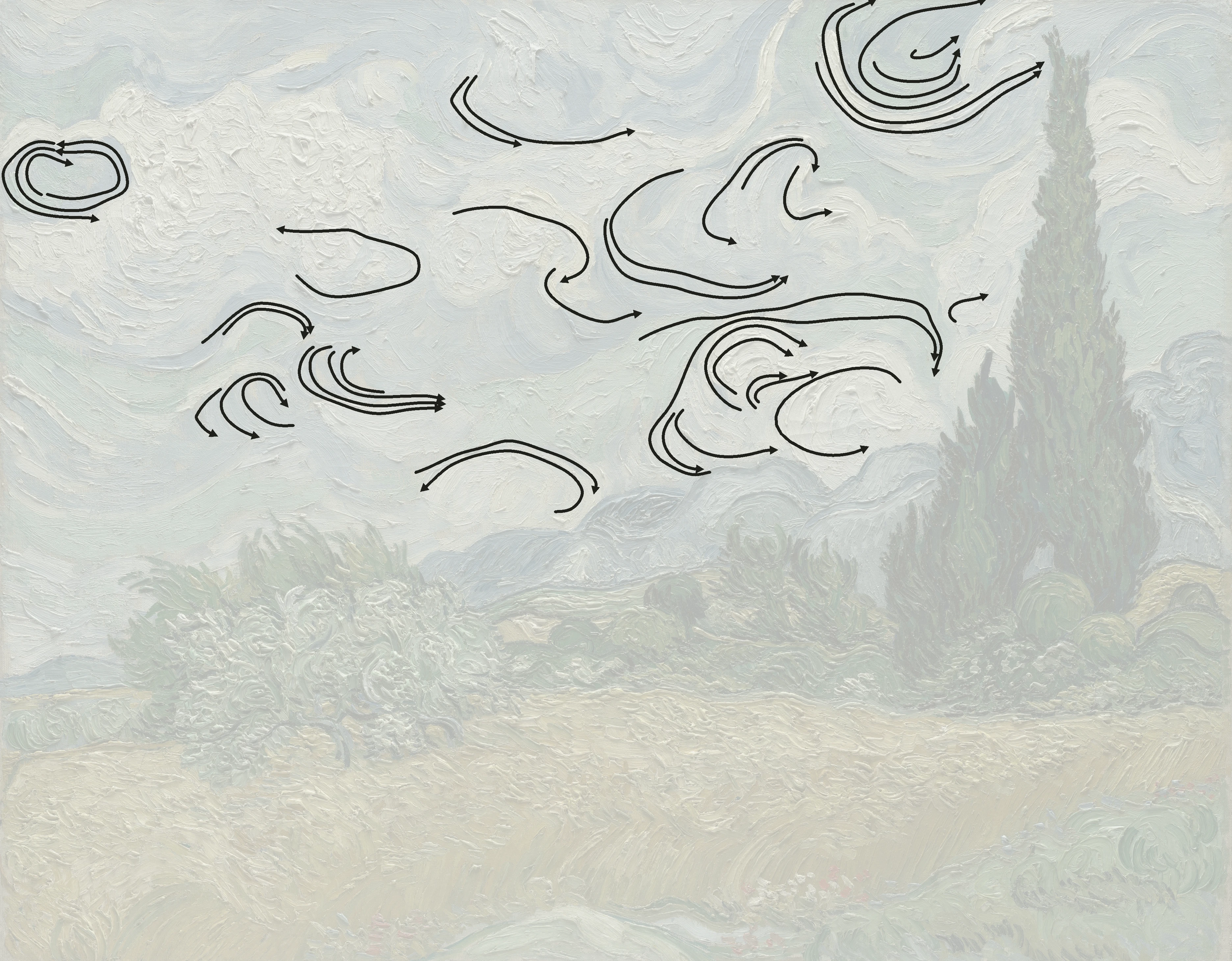
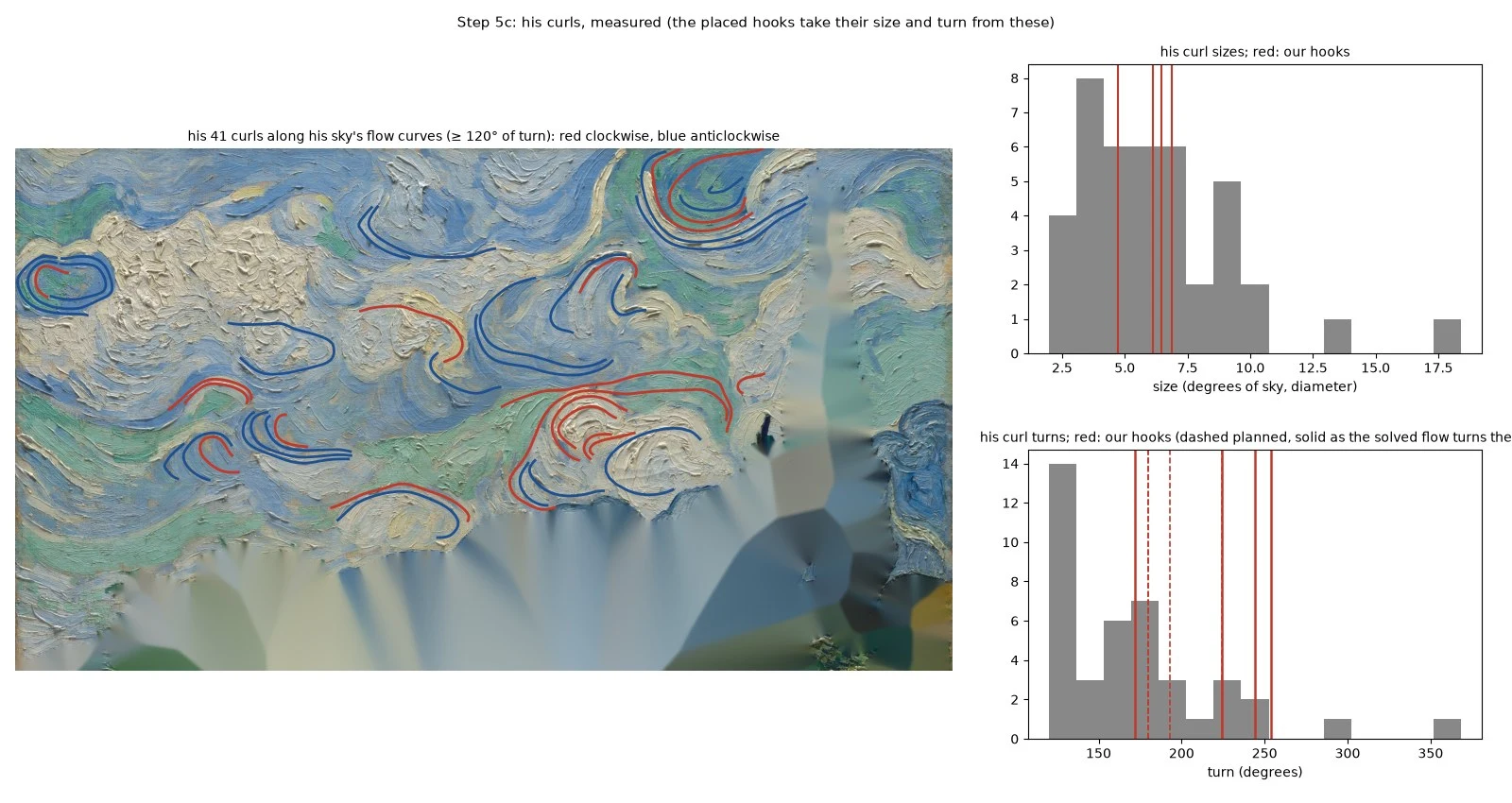
The sky’s curls were measured too, 41 of them (Plate 3.5). A curl is a run along the sky’s flow that keeps turning the same way through at least 120°. Turn 122–224° (10th–90th percentile), one at 368°; 3–10° of sky across. Most are open hooks, set where a white band meets a blue one; only one closes on itself. They curl, but they rarely become spirals. These sizes and turns later shaped every hook placed beyond the frame.
The same photograph also yields an estimate of the paint’s relief. The Met’s photograph1 appears lit from above, judged by eye, so each ridge leaves a light upper edge and a shaded lower one. That shading was separated from the paint’s own colour and turned into a height map, which changes correctly when the light is moved. Its scale is not measured: the heights were set to a 1.1 mm peak taken from scans of other paintings. Height after TU Delft’s painting scans (Elkhuizen et al. 2019).18 It is an estimate from one photograph, not a survey of the surface.
Method. Direction: a structure tensor on blurred lightness, gradients at σ 1.5 px, tensor smoothed at σ 6 px; strokes run normal to the gradient, after Hertzmann 1998.12 Ground truth: 89 strokes marked on 2× crops with a grid, ±5 px (prototype/analysis/groundtruth_strokes.json); Canny edges and Li et al. 2012 rejected. Tracer: 9,781 strokes, step 1.5 px, seed grid 5 px, after Im2Oil (2022), at 0.467 mm per pixel (trace_strokes.py). Lengths are weighted by paint area, so half a mass’s paint lies in strokes at least as long as its median (stroke_stats.py). A specimen drawer of single strokes on one millimetre ruler was tried for Plate 3.4 and dropped: at a true scale his strokes curve across each other’s rows. Curls: prototype/sky/curls.py on his visible sky’s flow curves; median 6° across, 41% clockwise, two more inside single strokes; earlier notes say 44. Relief: light from above, judged by eye; rejected, integrating shading as slope and finding the light automatically (relief.py).
4 Masses and depth
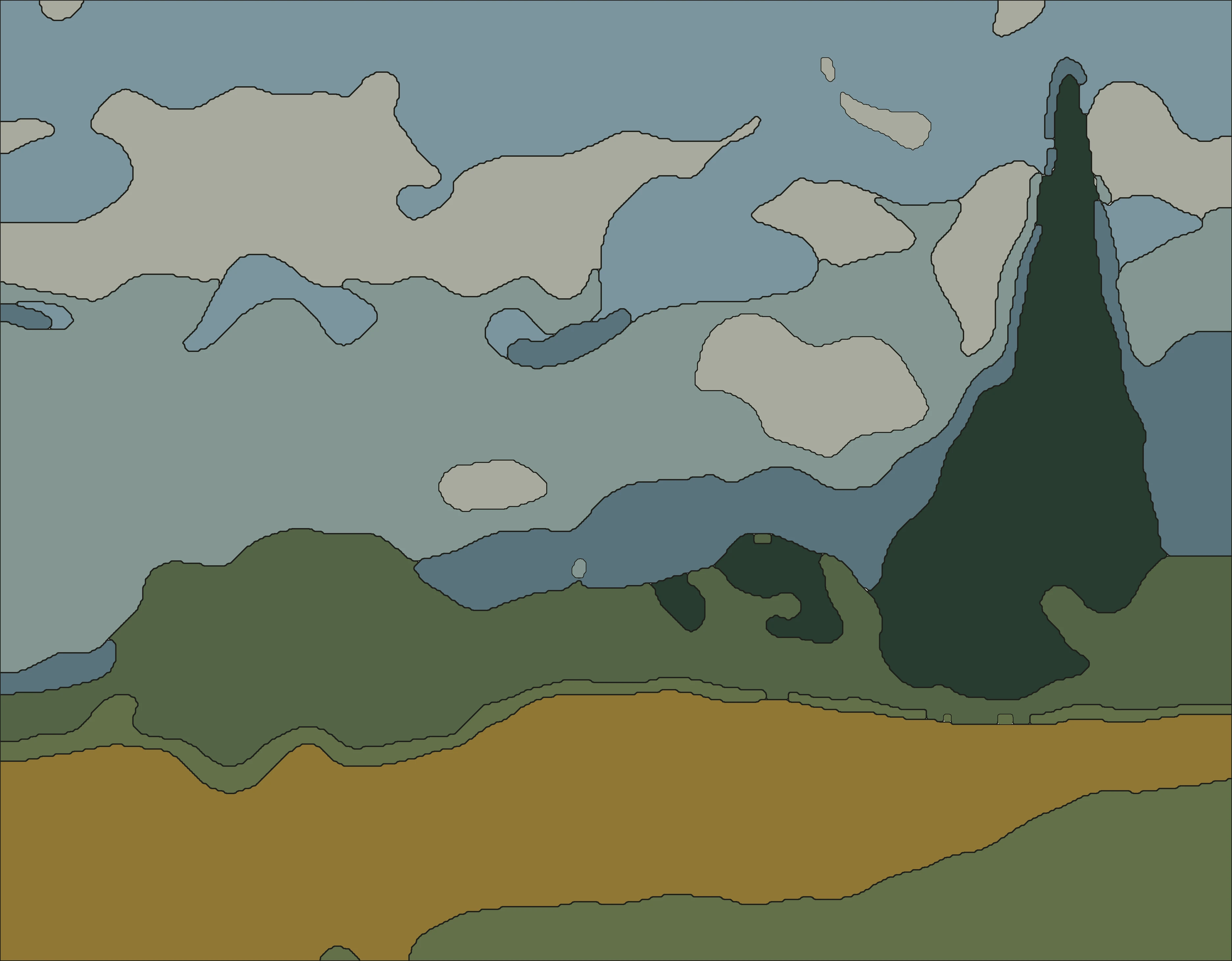
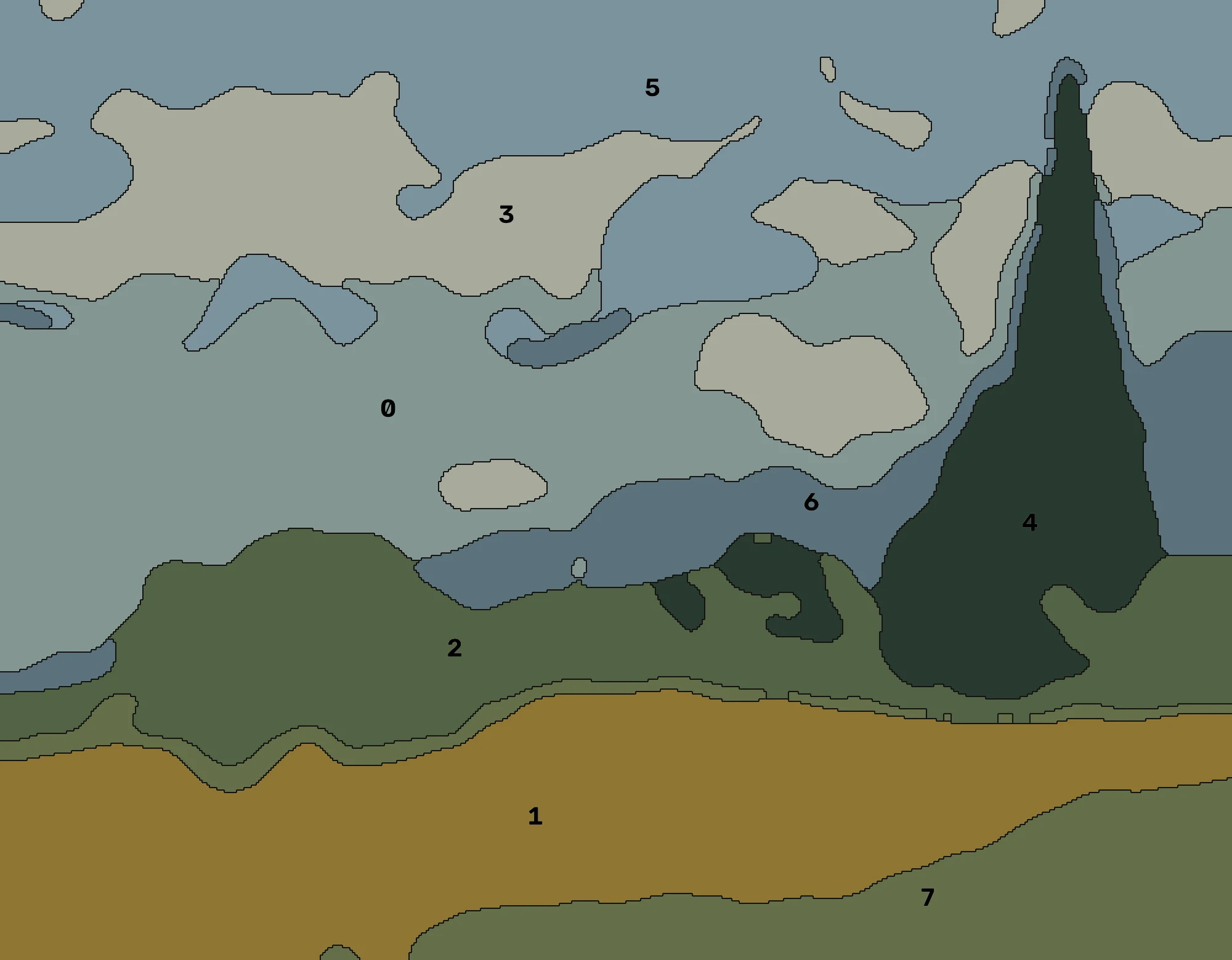
Blurred until single strokes vanish, the canvas resolves into eight masses: two bands of sky, the clouds, the blue hills, the olive trees and bushes, the cypresses with their dark bushes, the wheat, and the green bank at the foot. They were found by k-means again, this time on heavily blurred colour with a little weight given to height in the picture, so that sky and field do not merge. They were then named by looking (Plate 4.1).
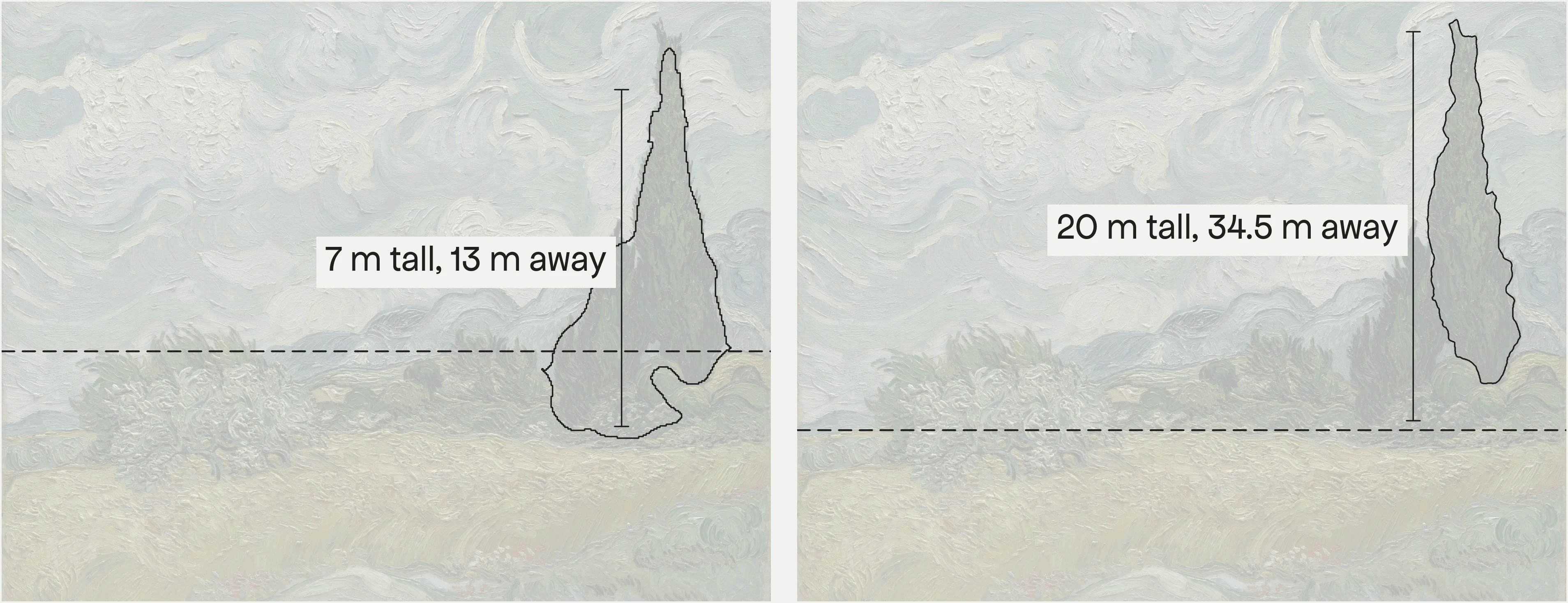
Depth comes from a single line. In a level view, the horizon sits at the eye height of a person standing in the field; fixing it fixes the camera’s tilt, and every foot on the ground then has a distance. The first reading put that line at the base of the hills, and treated the cypress mass as one object. But that mass includes the round bushes in front of the tree, and read that way, the cypress came out seven metres tall and thirteen metres away (Plate 4.2).
The second reading looked to the far left of the canvas, where a strip of flat plain meets the foot of the hills. That is the true horizon, lower in the picture. Horizon at row 1114 of 1559; eye 1.6 m. With it, and with the tall cypress cut out on its own, the tree stands twenty metres tall, some thirty-five metres off. Every upright thing had to be cut out on its own.
The lens is less certain. With the horizon and the eye height fixed, the angle of view only scales the whole scene nearer or farther: any value lines up at the painter’s spot. A 60° lens was chosen for the feel of walking and then held fixed. Distances below move by about a quarter across a 50–70° lens; heights of the ground do not.
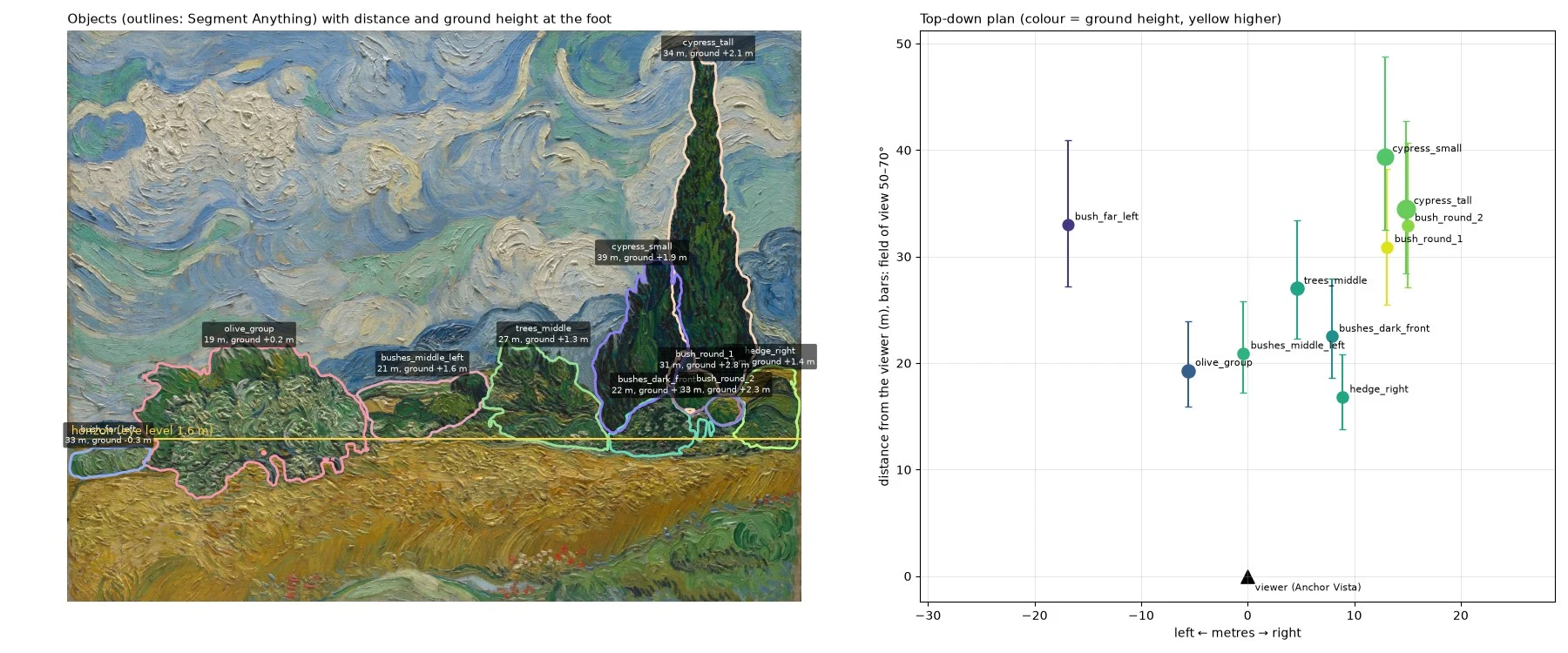
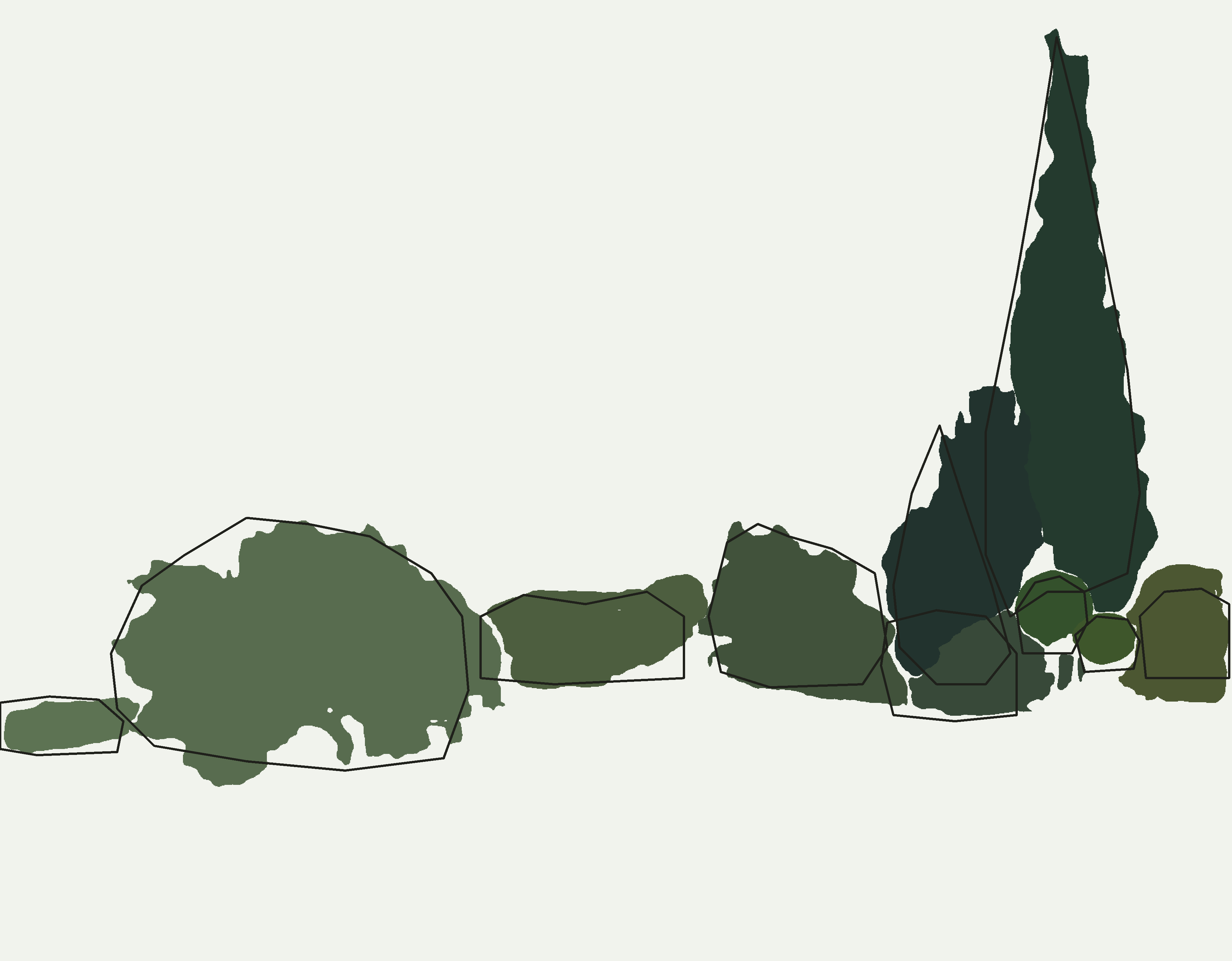
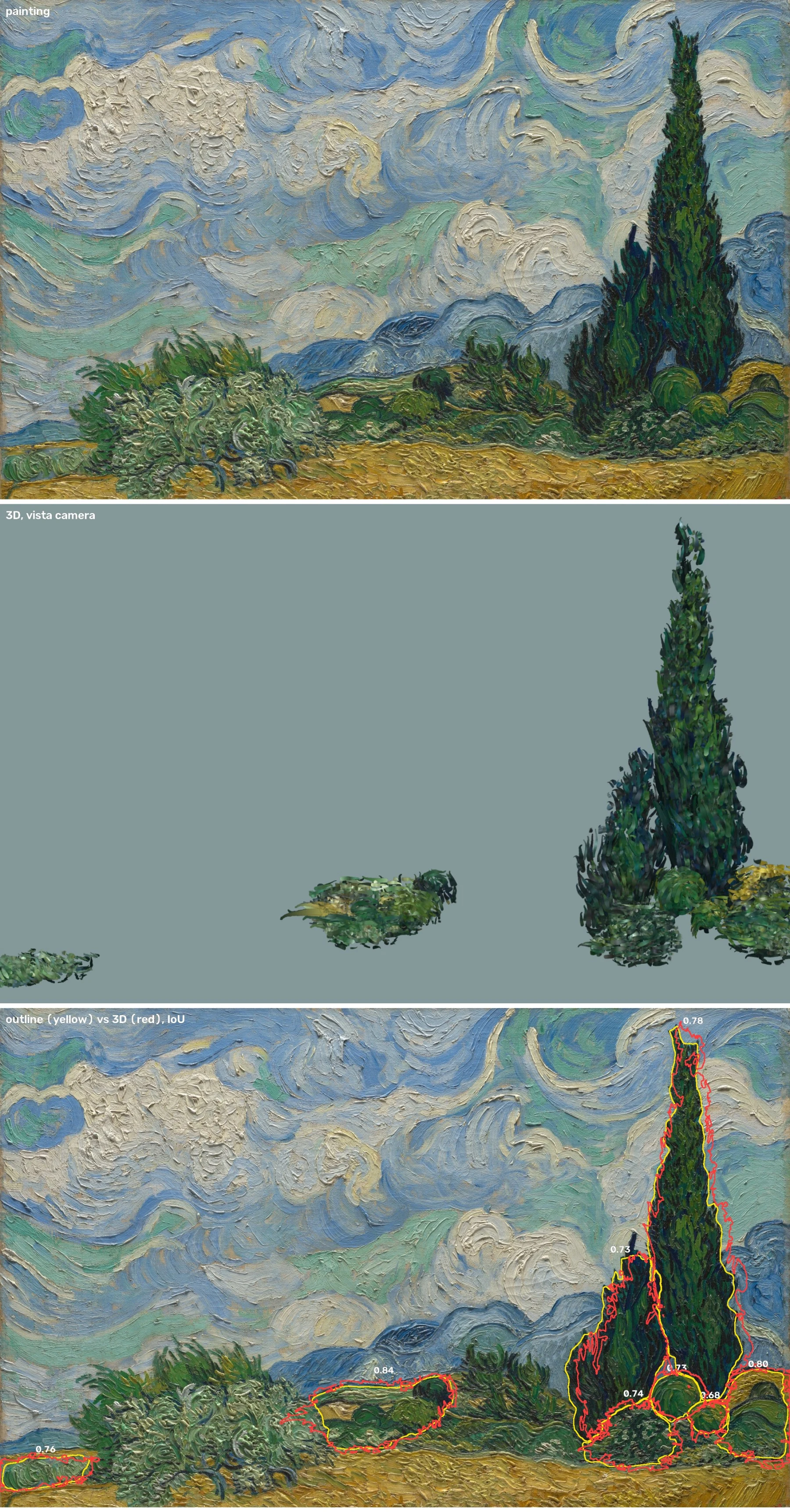
Ten upright objects were outlined. Outlines first marked as points on a grid were rough; Segment Anything, a neural segmentation model,15 followed the true edges far better (Plate 4.3). Their overlap, measured as IoU (shared area over combined area, 1 for identical), ran from 0.41 to 0.80. The model was used for outlines only: its output is a mask that is inspected, never a pixel that is shown, which the project’s rule on AI allows for analysis. It made its own mistake: one bush’s outline swallowed 88% of its neighbour, so outlines were made exclusive, any overlap going to the smaller object.
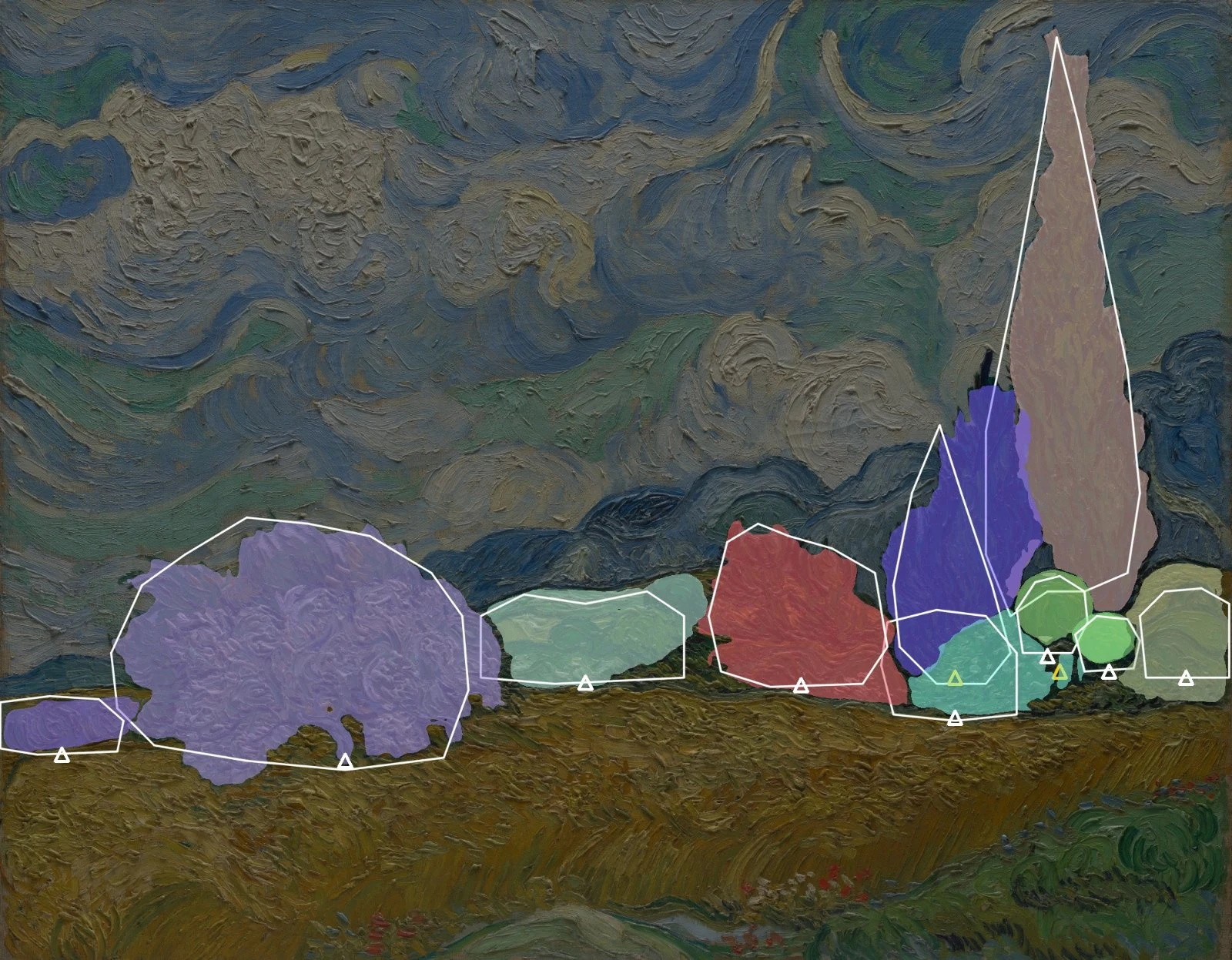
Each object then received a believable size, and each pair where one covers another (“the round bushes hide the cypress’s base”) became a hard rule. Solved together, the scene is about 40 m deep (Plate 4.4). The olive trees stand about 19 m away on level ground; the bushes and the hedge 17–33 m; the cypress pair 35–40 m off, on ground about 2 m higher. Flat ground would not fit: the far plain lies below the cypress’s feet, so the land must rise. The tall cypress solves to 20 m, just past the 15–20 m expected of the species, and is flagged as such.
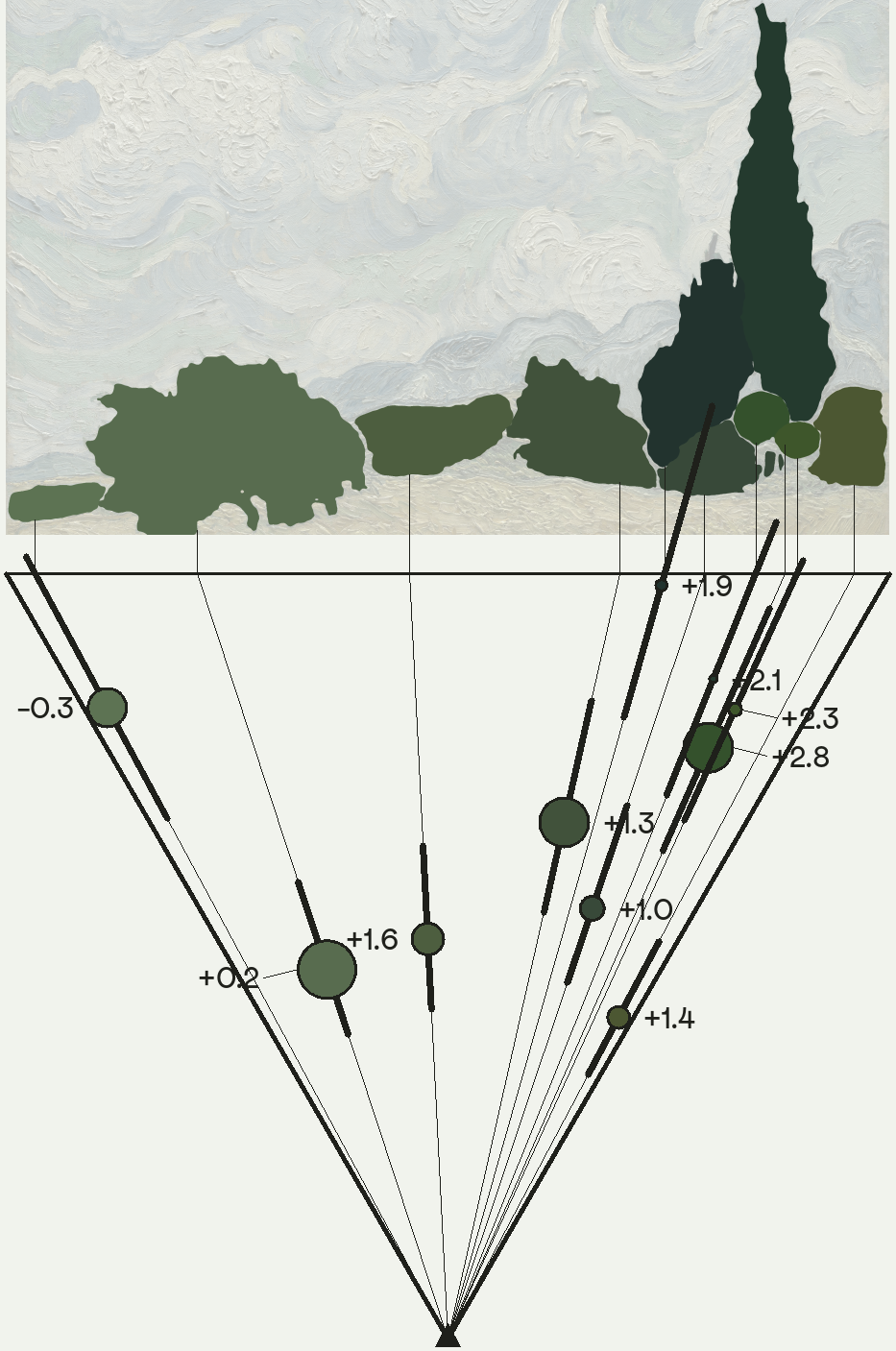
These numbers are a reading, not a survey. Nothing in the record confirms the spot, the lens or the trees’ real heights.
Method. Masses: the image shrunk to 500 px wide, blurred at σ 6 px, vertical position weighted like 40 ΔE, k = 8, median filter 7 px, named by eye (prototype/analysis/analyse.py, masses.json). The first layout put the horizon at row 909 with a 63° lens (depth.py; journal 2026-10-28-analysis-v2.md). Across a 50–70° lens, distances move ±25%. Outlines: Segment Anything (Kirillov et al. 2023), allowed for analysis by ADR 0001’s clarification of 28 October; two round bushes overlapped at IoU 0.03 before the exclusive fix (common.object_masks). The solve: size priors, feet and occlusion pairs in prototype/analysis/objects.json, solver depth_v2.py, result work/analysis/met-436535/depth_v2.json.
5 Repainting stroke by stroke
A real paint engine then painted the canvas again, one instruction at a time. Each stroke becomes a line in a Stroke List: where it starts, the path it follows, its pressure, its colour and its brush. An engine-neutral list of brush strokes, so any engine can paint it (ADR 0003). The list, not a picture, is what the analysis hands on.
No image-generating model made any pixel. ADR 0001: no diffusion, text-to-3D or AI audio, even for placeholders. Every mark was laid by libmypaint, the open-source brush engine of the MyPaint program, with an oil-brush preset, dab by dab.19
The first repaint laid 71,334 strokes in layers: broad brushes first, smaller ones only where the canvas still differed, every stroke following the direction field, in 12 seconds. Layering after Hertzmann 1998.12 Its colour difference from the photograph averaged 1.7 on the ΔE2000 scale, a standard measure of how different two colours look, where 0 means identical (Plate 5.1).
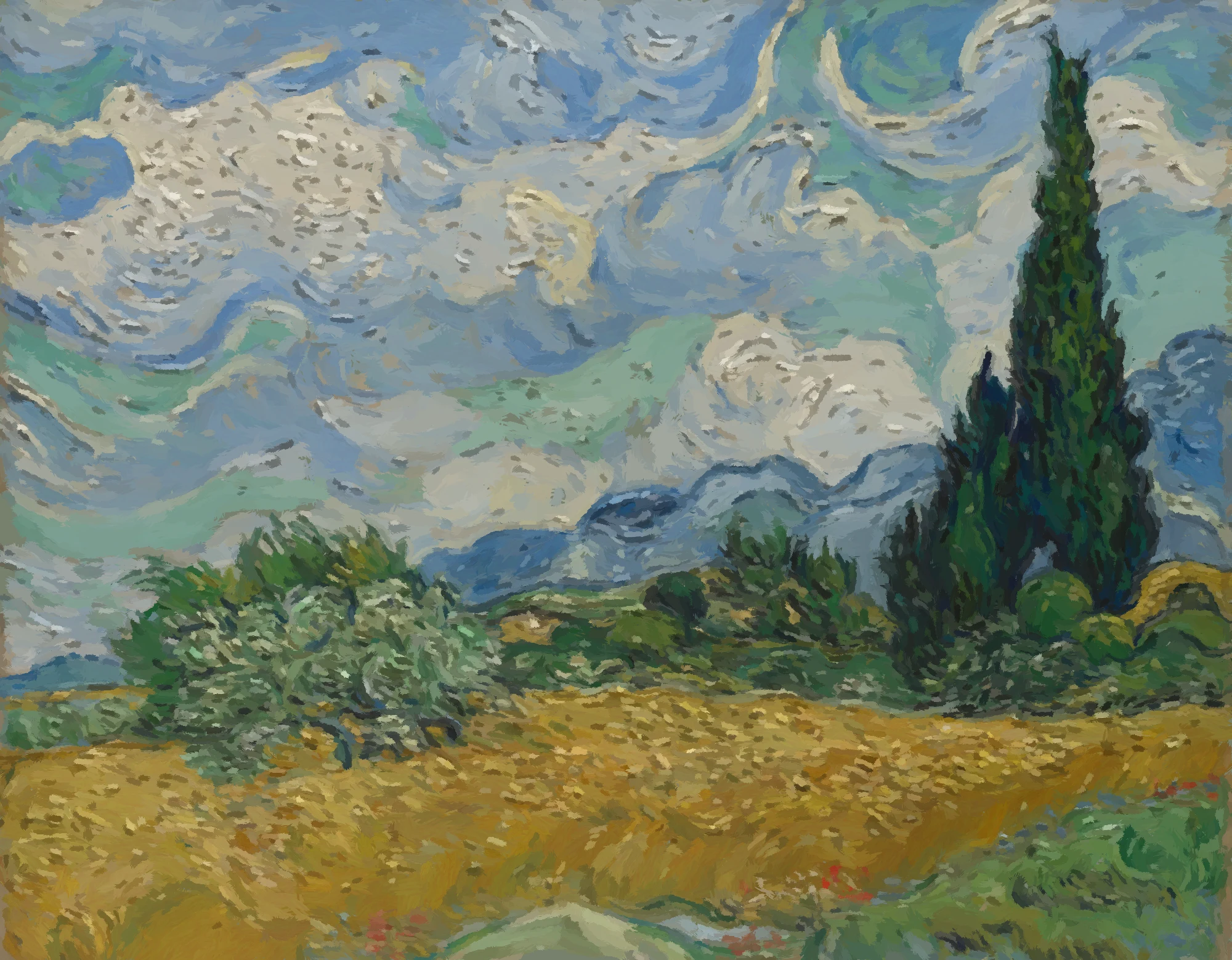
Krita, an open-source painting program,20 painted the same list to the same score of 1.7, so a wider test decided. Four paintings, three by Van Gogh and one by Pissarro, were repainted from their traced strokes by both engines. ΔE2000: libmypaint 2.7–3.0, Krita 3.0–3.7. libmypaint came closer on all four, and it ran without a window, in 5–12 seconds against Krita’s 40–360. A palette knife under the brush cost colour everywhere and was dropped. So was a strong raking light on the relief, which looked like crumpled foil; a light one was kept.
Up close the copy stays flatter than his. Two reasons lie outside the engine: there is no raised paint, and the strokes are shorter and sparser than his. A modelled relief made the sky and the cypress read as thick oil, at a cost of ΔE 1.7 to 2.1. After Baxter et al. 2004, without their paint flow. It was set aside, and the sky later took up the same idea.
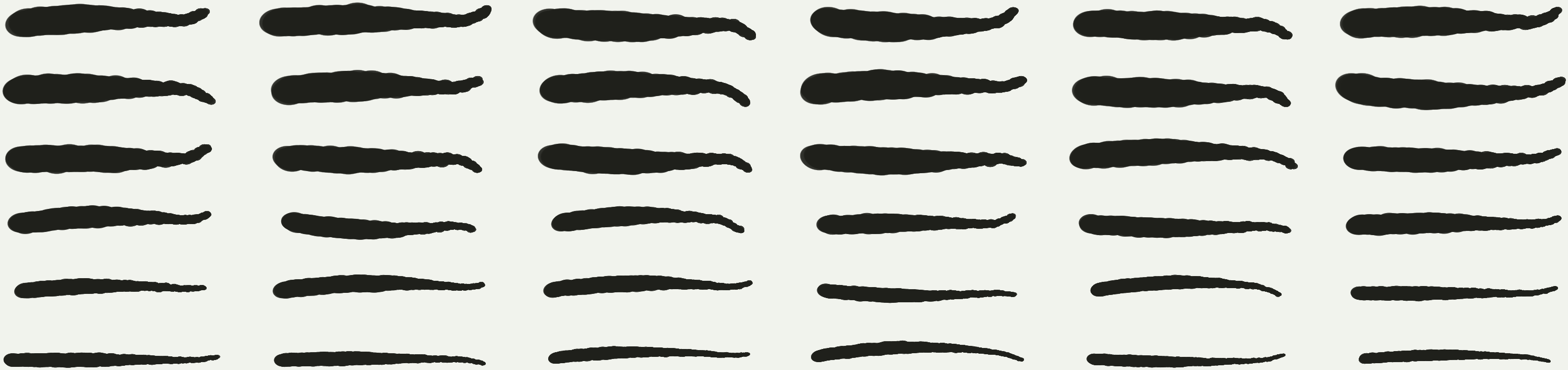
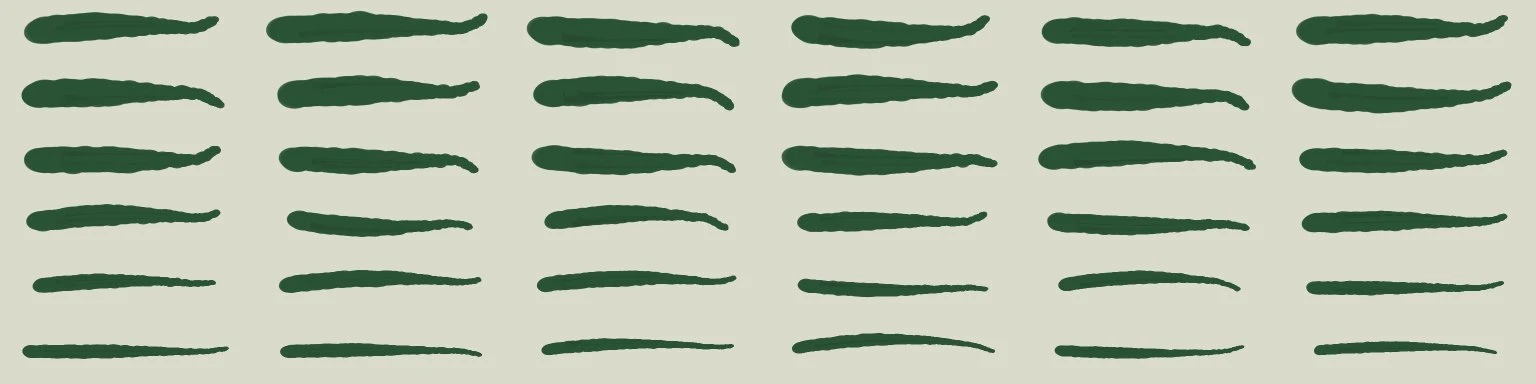
Its objects are built in pure 3D, with no projected image; from one spot, the Anchor Vista, its objects line up with his composition. Its trees are made of single strokes, and every stroke is one of thirty-six commas that libmypaint painted once (Plate 5.2), then bent, turned and tinted where it grows.
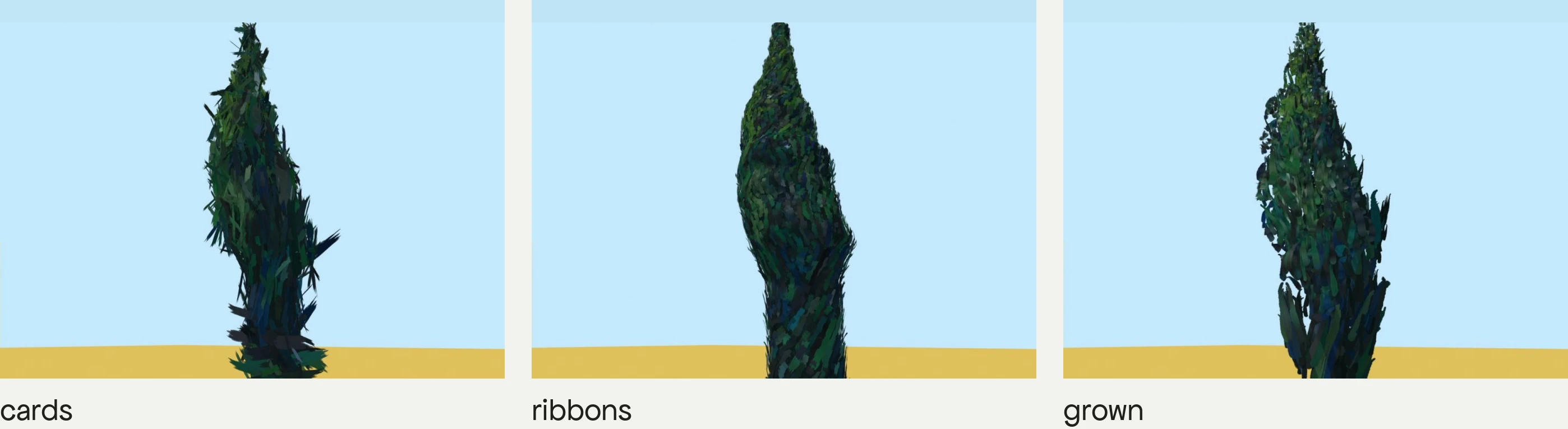
The cypress is grown rather than modelled (Plate 5.3). Two earlier versions were refused: cards tilted at random (“too spiky, the flow isn’t there”), and ribbons wrapped round a solid, which looked like paper with stroke lines on top. Final build: 4,235 strokes, 329 of them his; IoU with his outline 0.78. The third grows a stem up the painting’s centre line, a spray for each tuft he painted and more round the back, rooting thousands of single strokes in them, his own at the front.
The olives grow from limbs marked on the scan, branching toward points spread through the crown (space colonization, Runions et al. 2007)17. Each of the ten objects, rendered alone from his spot, fills the outline it was grown to (Plate 5.4), and together they stand where he put them (Plate 5.5).
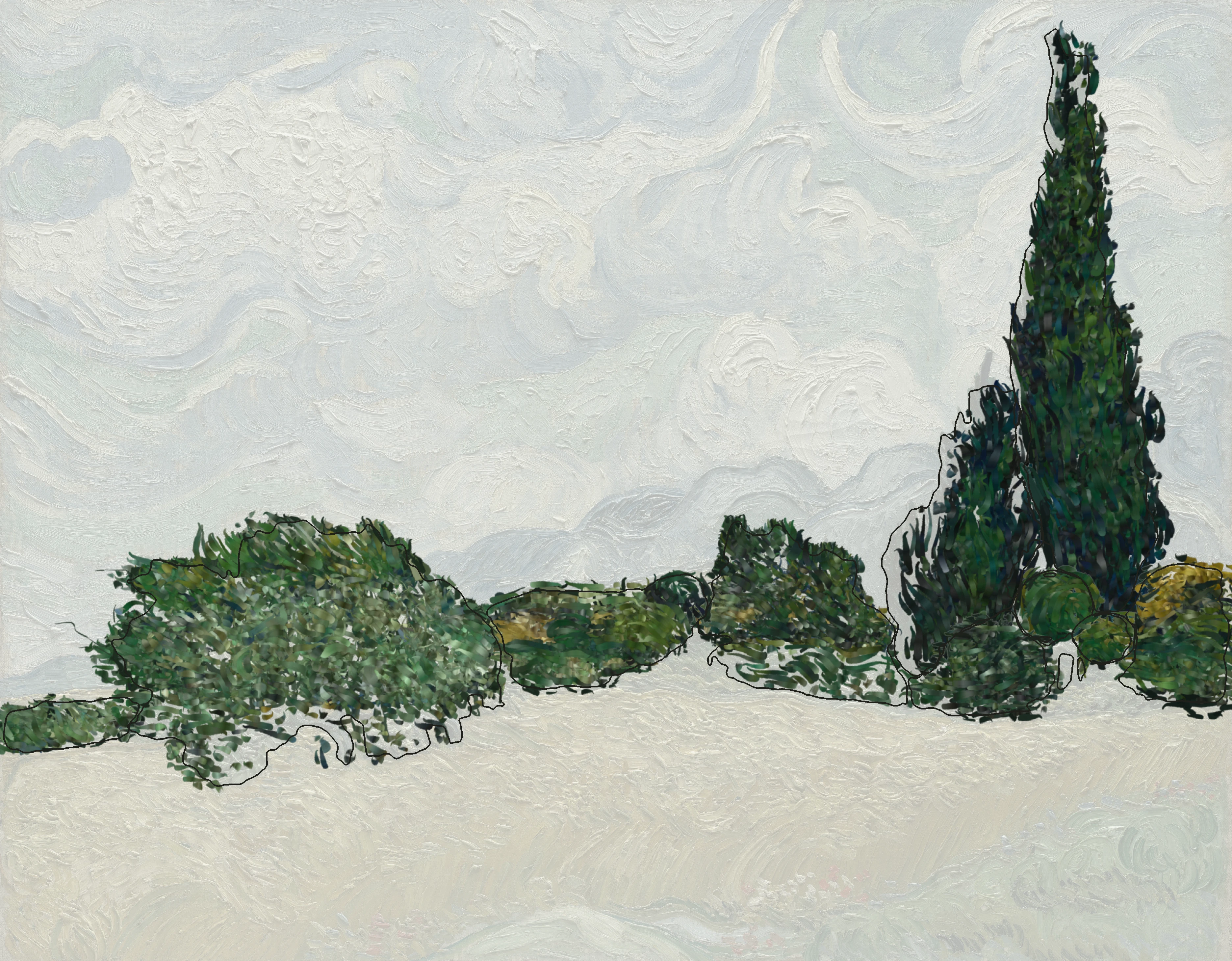
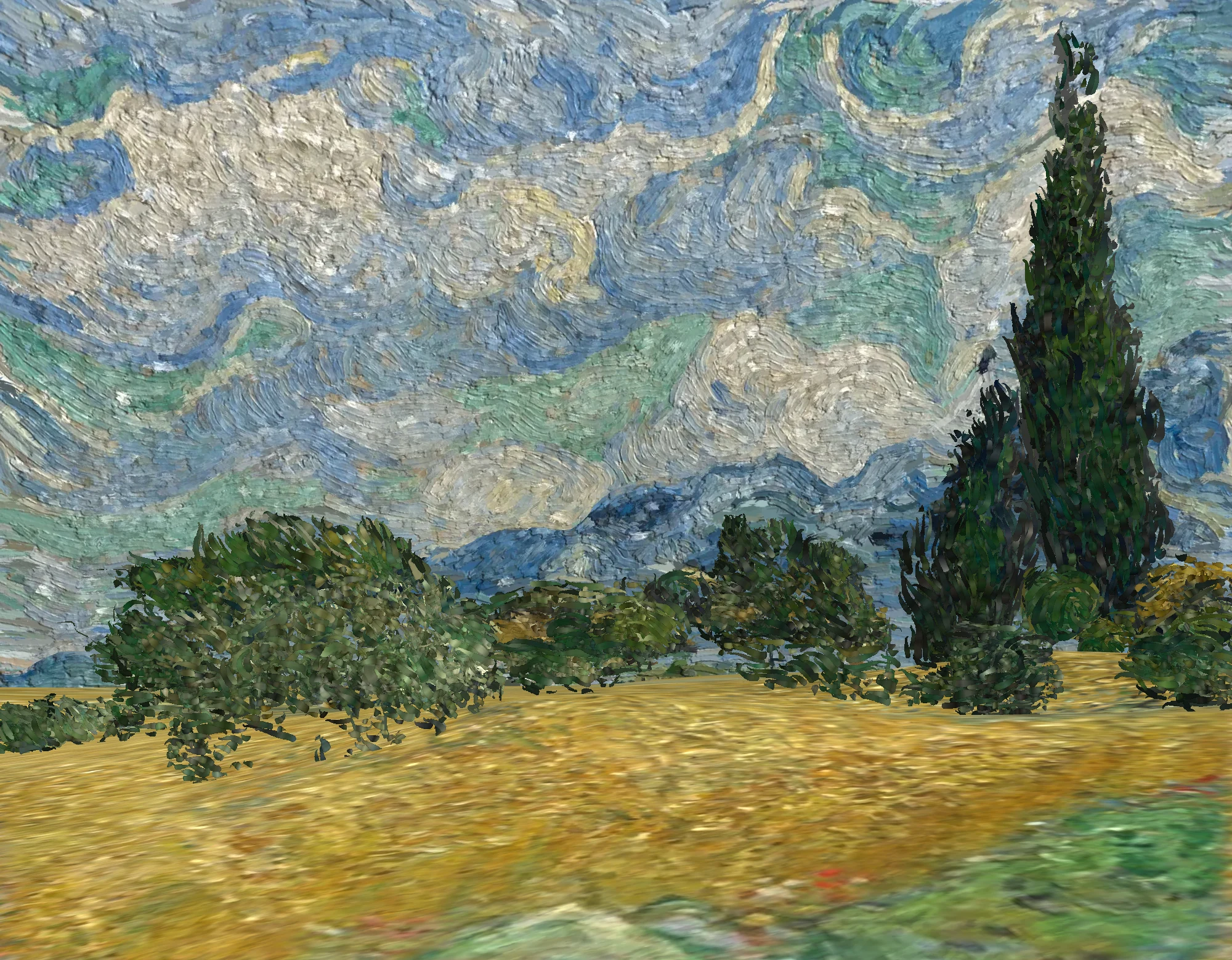
In the browser the World draws about 125,000 strokes, 30,800 of them unique, at 60 frames a second. three.js on WebGPU23; browser against Blender22, ΔE 2.7. From the vista the browser render sits at ΔE 11.7 from his painting, close in shape, still distant in colour. At arm’s length a cypress breaks into what the art-director later called “fat sausage strokes”: its strokes were sized for the vista only. Off his spot, the first World stood his trees inside a ring of copies placed by rule (Plate 5.6).
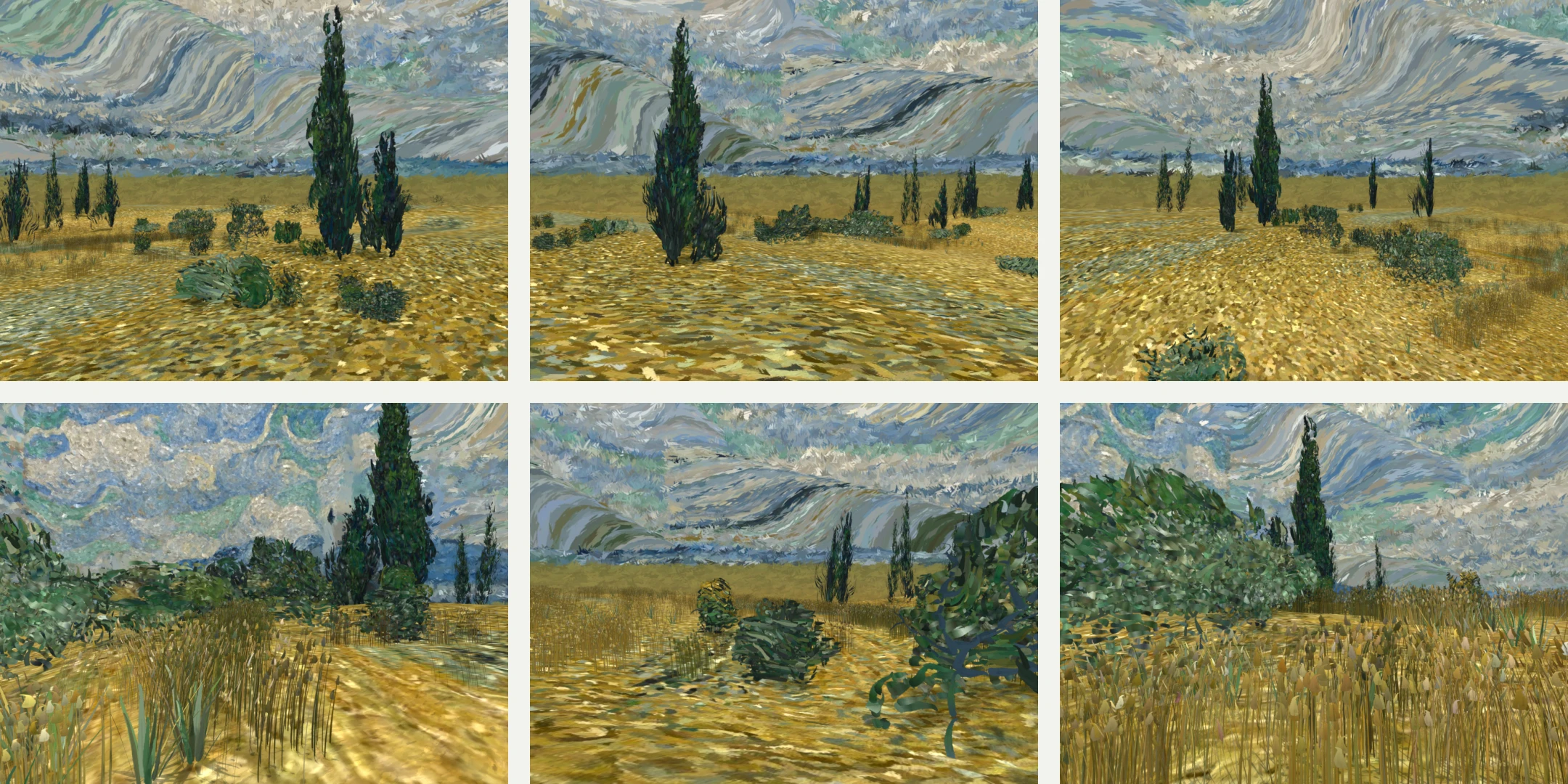
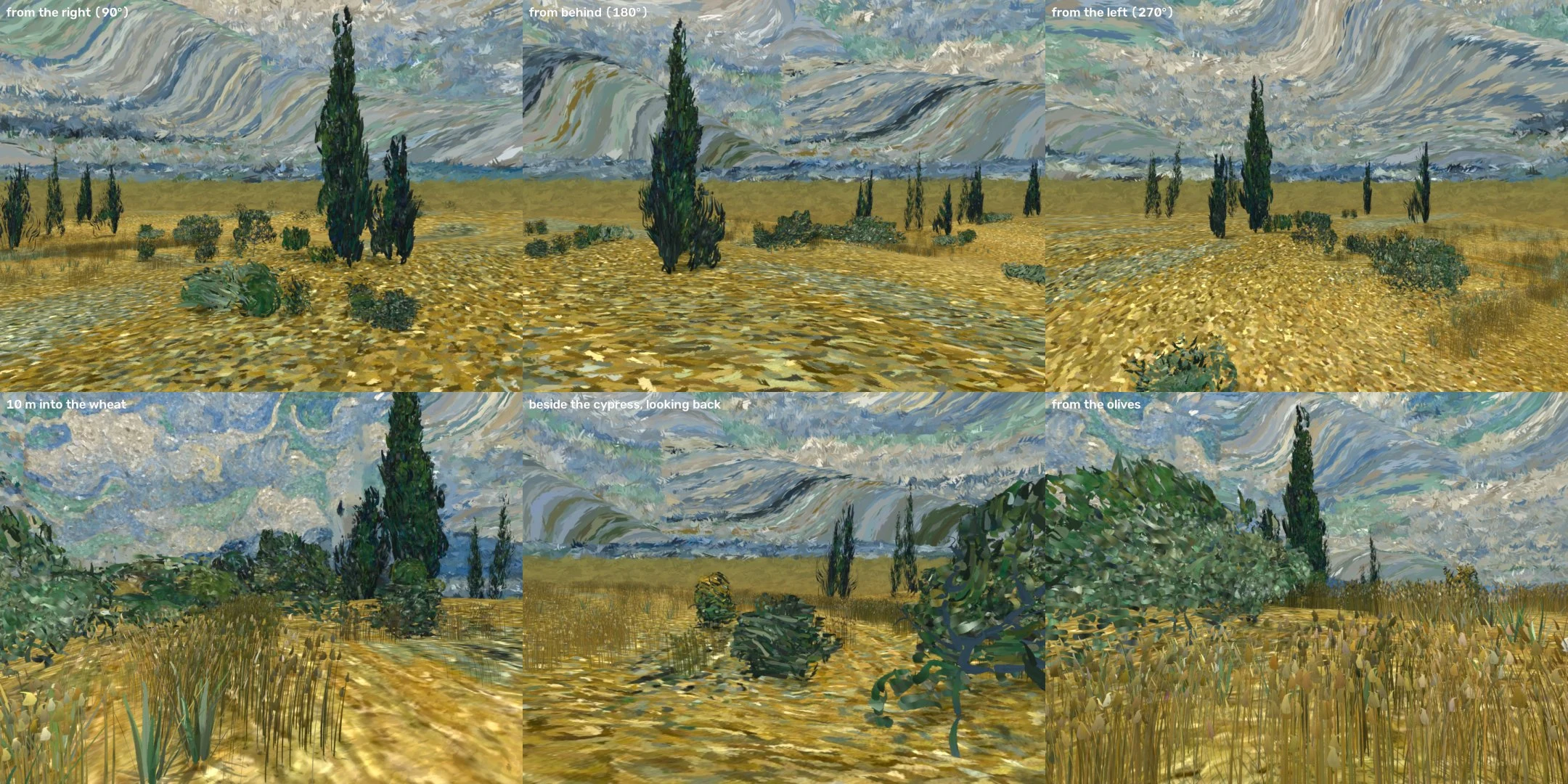
Method. Engine: libmypaint 1.6.1 with the brush tanda/oil-03-paint, driven by a small C program (prototype/repaint/mypaint_render.c); the stroke plan is plan_strokes.py, and ΔE2000 is the mean over all pixels. On the first list libmypaint took 12 s, Krita 194 s (ADR 0004). Relief: prototype/repaint/impasto.py. Trees: prototype/models/tree.py; the third cypress build counted 5,665 strokes, 351 of them his, before later fixes changed the recipe. The ten objects hold 19,881 strokes, IoU 0.68–0.84 against their outlines. The Blender render of step 3 measured ΔE 8.1 from his painting. A ladder of stroke sizes for near views was planned and never built. Plate 5.3 crops the fourth panel of each step 3a orbit board (commits a4107f4 and 7b430c2 for the first two); the atlas is work/models/atlas/atlas.png, its coverage shown in ink.
6 Beyond the frame
Outside his frame there is nothing to copy, so the place had to be reasoned. The first World filled it with rules and swirling noise: one step aside from the vista, it read as a framed picture with filler around it. The response was a World Plan: a map of the place the painting belongs to, each item tied to a source and tagged documented, inference, computed or unverified.
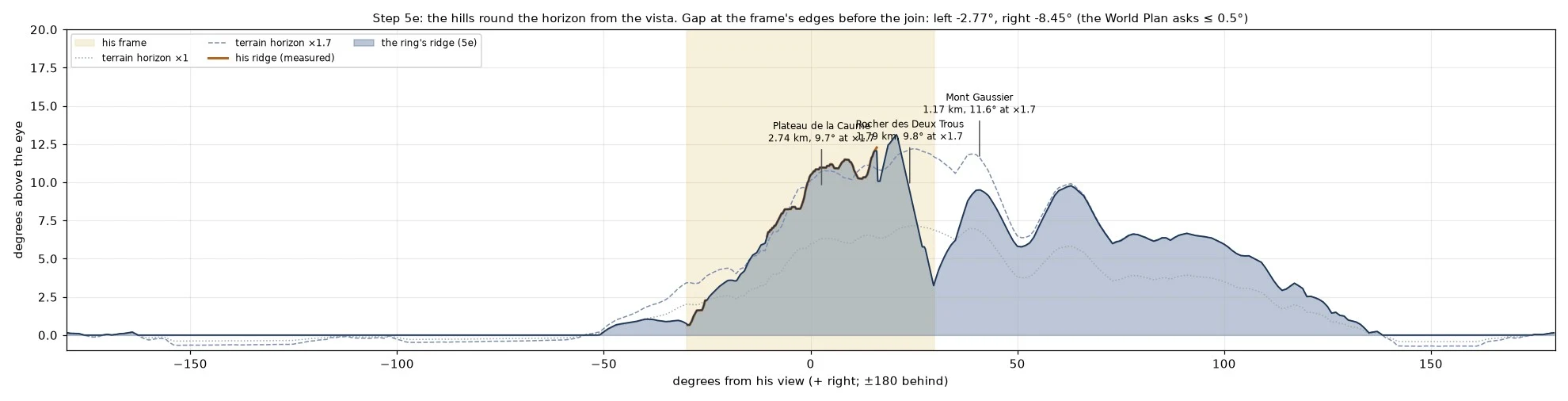
No letter says where he stood or which way he faced, so the terrain was asked instead. Around the asylum, from the eye of a standing person, a ray was cast across a European elevation model every degree of the compass to find the highest skyline.7 That skyline was then compared with his hill line, with one height factor fitted per direction (Plate 6.1).
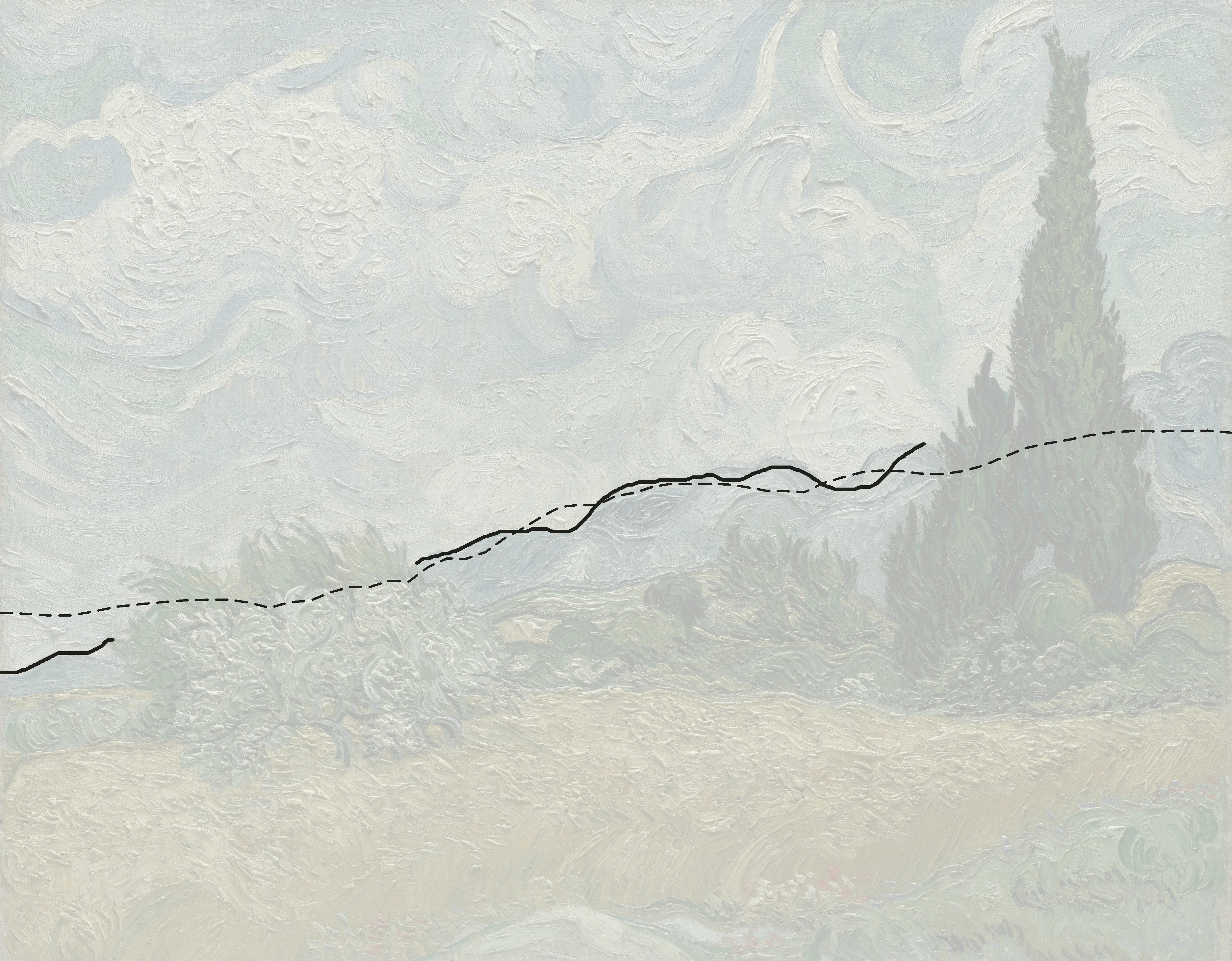
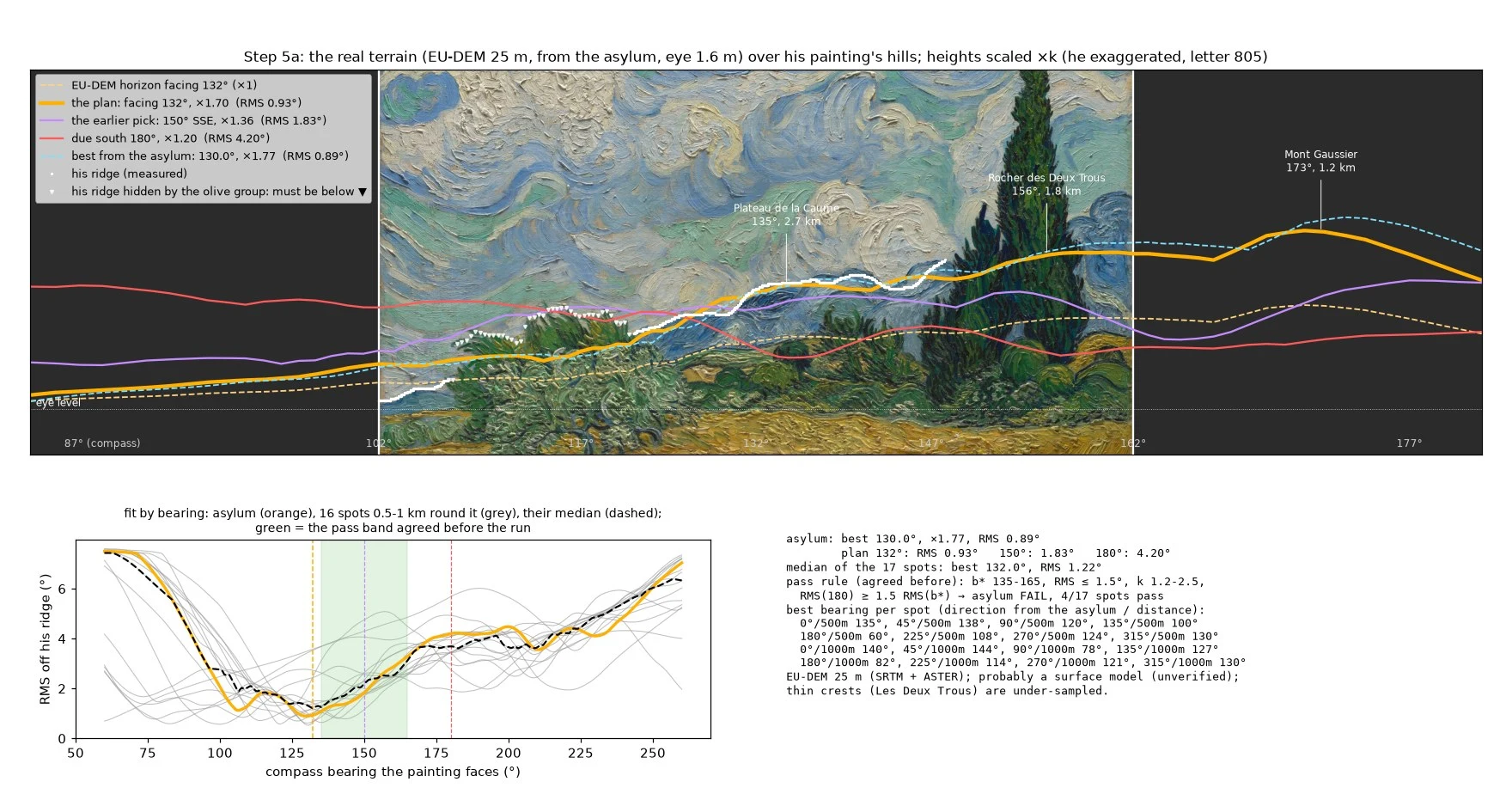
Taken over seventeen spots round the asylum, the best fit faces south-east, 132°. There the Plateau de la Caume, 2.7 km off and the highest ground nearby, sits where his hills peak. Error (RMS) 0.93° at 132°; 1.83° at 150°; 4.20° due south. His hills stand 1.70 times taller than the land. He may have exaggerated, as he said of his work (“I exaggerate”, letter 698), and expected to be told of another canvas of these hills that “mountains aren’t like that” (letter 805);4 or he stood closer. A pass band of 135–165°, agreed before the run, failed, and the earlier guess of 150° was dropped. The fit rests mostly on his central hump; any direction from 128° to 134° fits equally well, and the spot itself is unknown. Other spots on the plain give 135–144°; near the hills, 100–208°. The direction is a reasoned estimate, not a record.
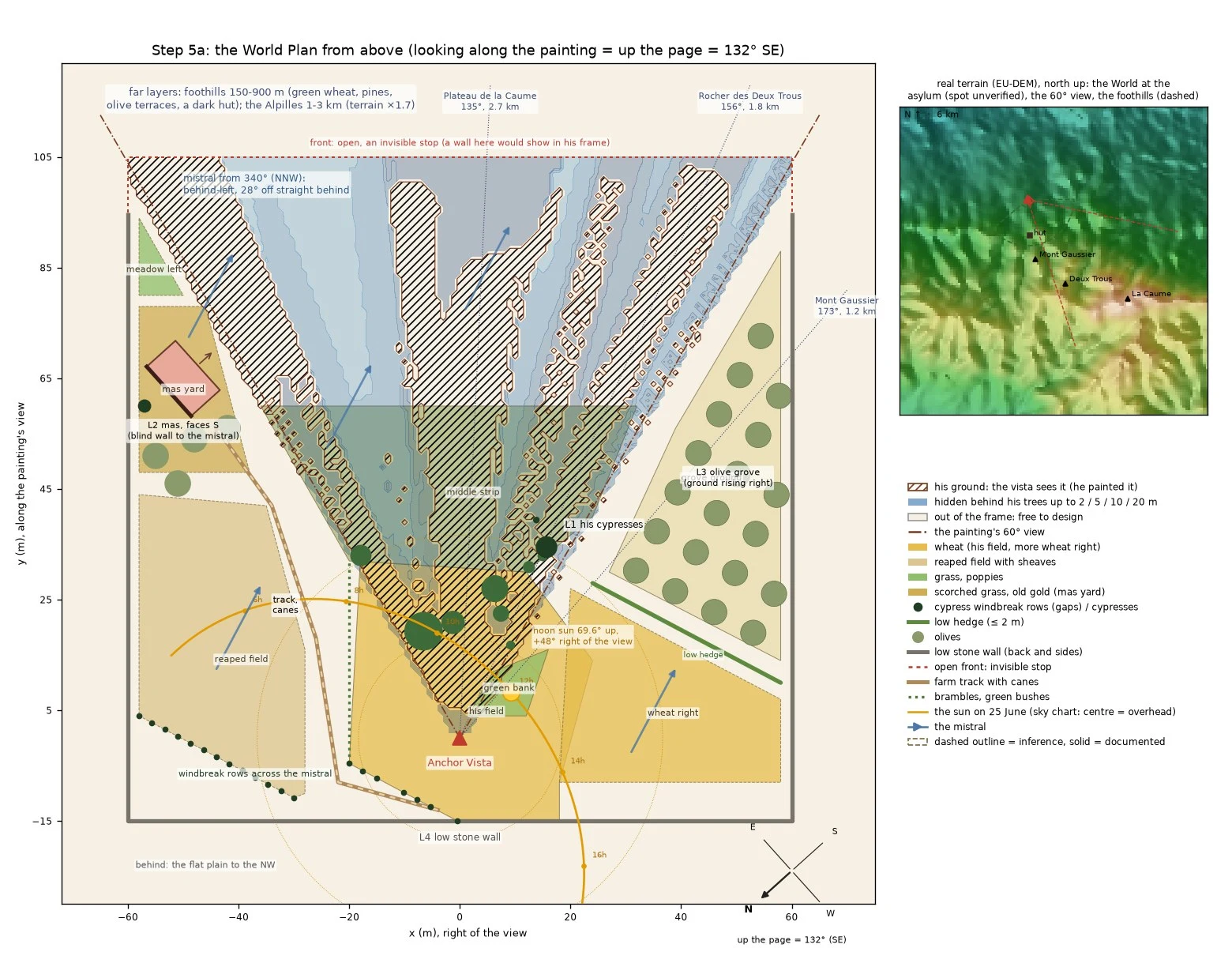
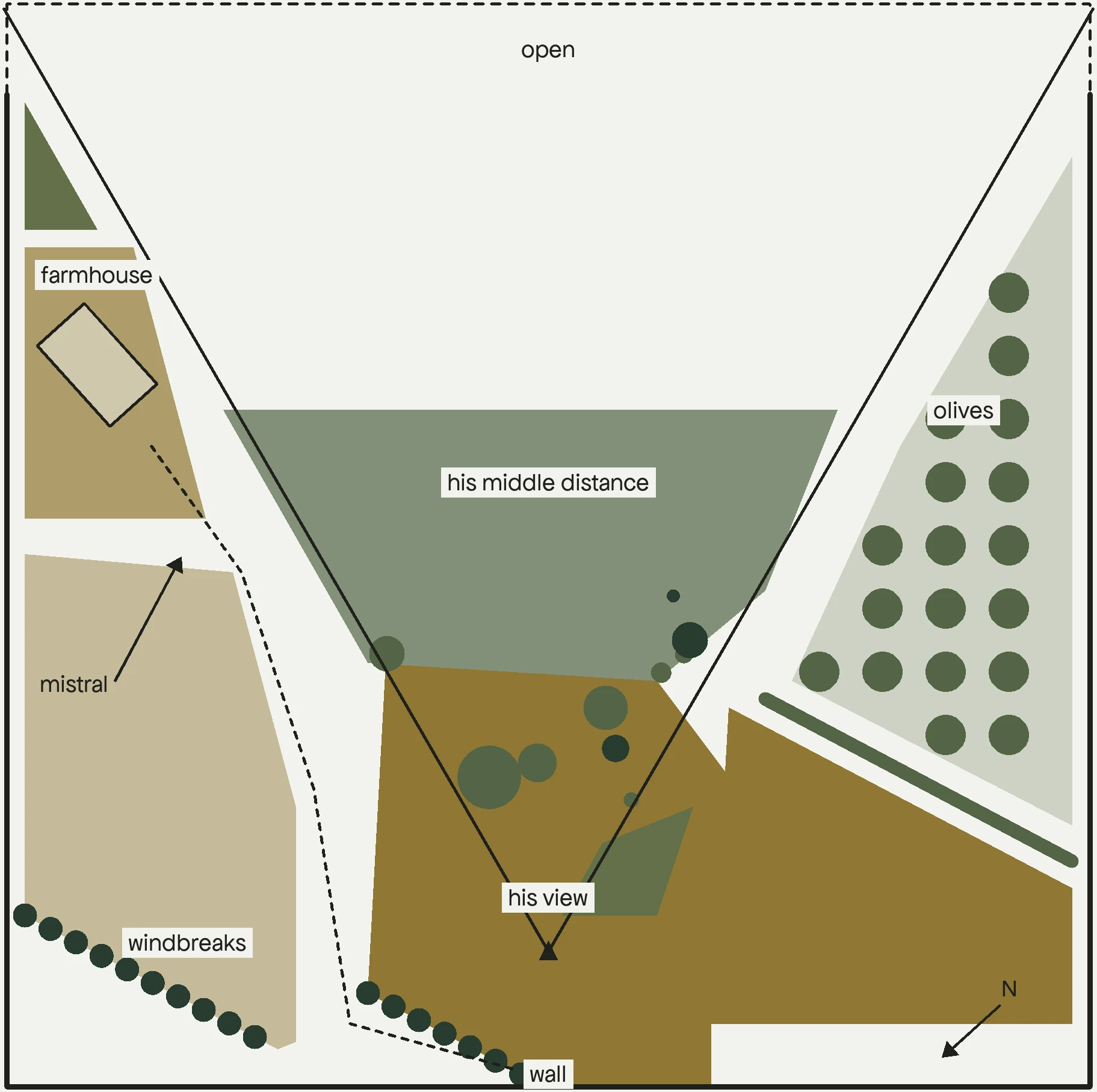
The bearing fixes the sun and wind. On 25 June the noon sun stands 69.6° high, 48° right of the view, so the cypress is seen against the light; the mistral comes from behind-left, from 340°.10 The plan sets the rest of the place round them (Plate 6.2): windbreak rows across the mistral, a farmhouse with its blind wall to the north, an olive grove on rising ground, and a low wall round the back and sides, the front left open.
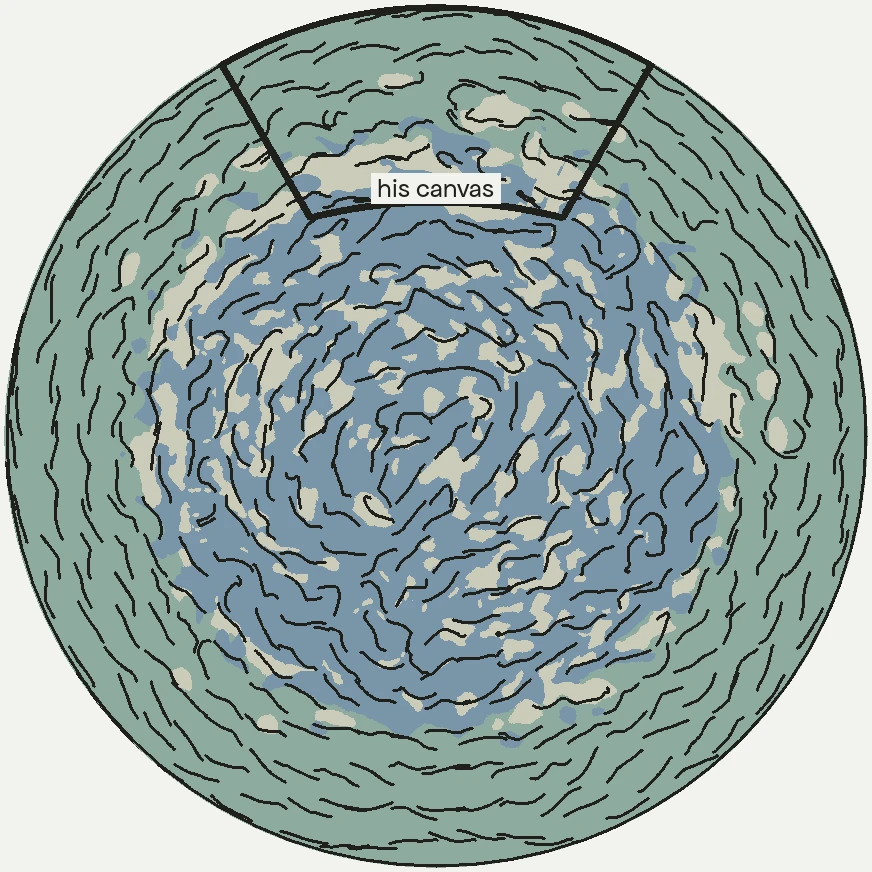
The sky beyond the frame is synthesised, then painted. A patch search gives every new patch of sky a pointer back to the spot in his painted sky it most resembles. Guided PatchMatch (Barnes et al. 2009)16; no style transfer (ADR 0005). Only pointers are synthesised, never pixels: through them every part of the new sky takes the mass and the flow of the place in his sky it points to (Plate 6.3). libmypaint then paints over these maps in strokes his size, bundled four to ten together, with their relief lit as the Met’s photograph appears lit.1
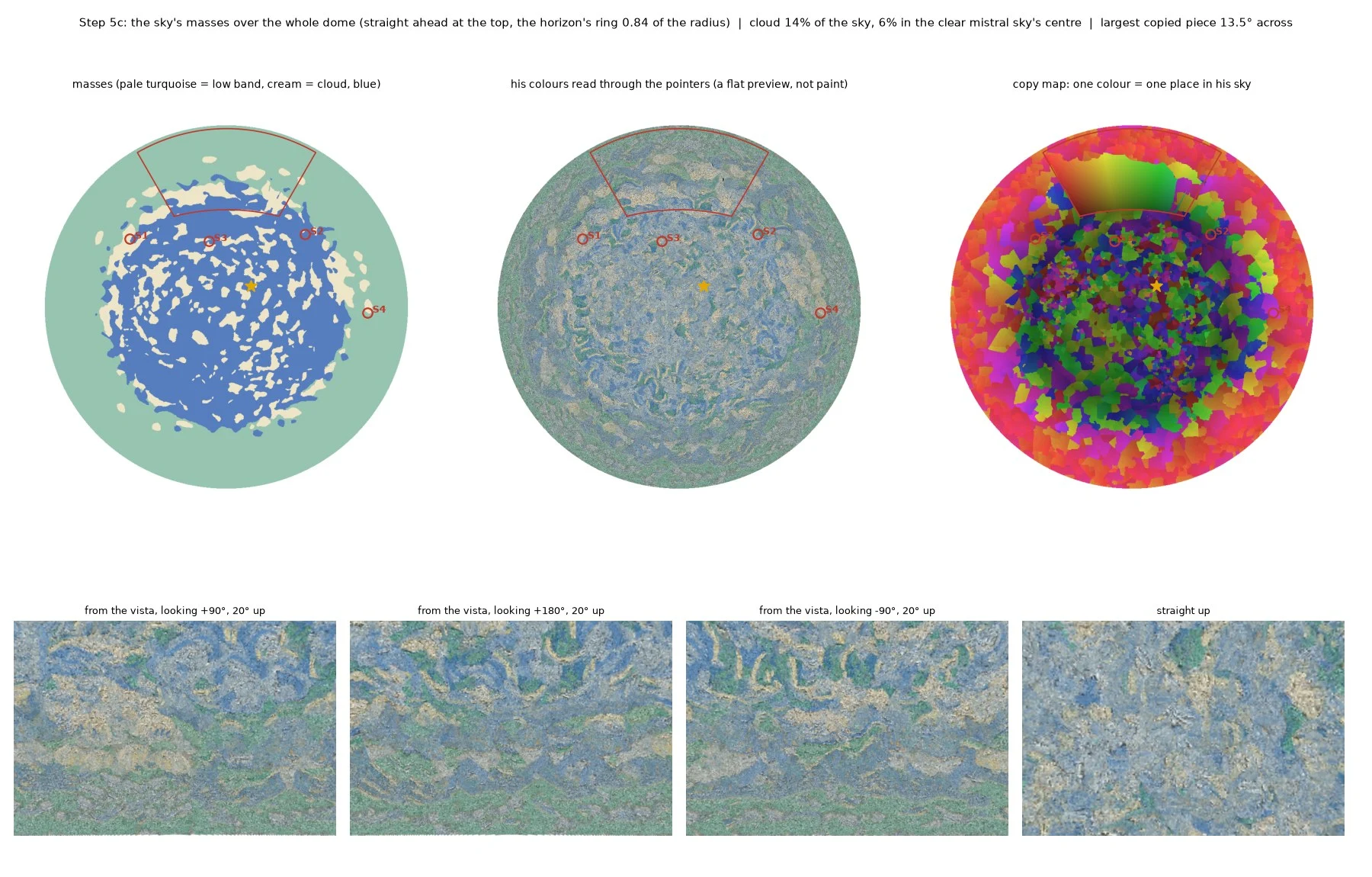
This was the sky’s seventh build. Early domes pinched overhead; long strokes piled about fifty deep and greyed his cream and blue. Round by round the same patch of sky moved from swirled noise to his bands, then to his marks (Plate 6.4).

The hills are painted on a ring hung at their real distance, so they slide past as the walker moves (Plate 6.6). Beyond the frame they follow the real ridge, raised 1.7 times, and take their colours from his hills, chosen by how lit each slope is. Colour by lightness after Bratkova et al. 2009. Inside the frame his own ridge rules (Plate 6.5).


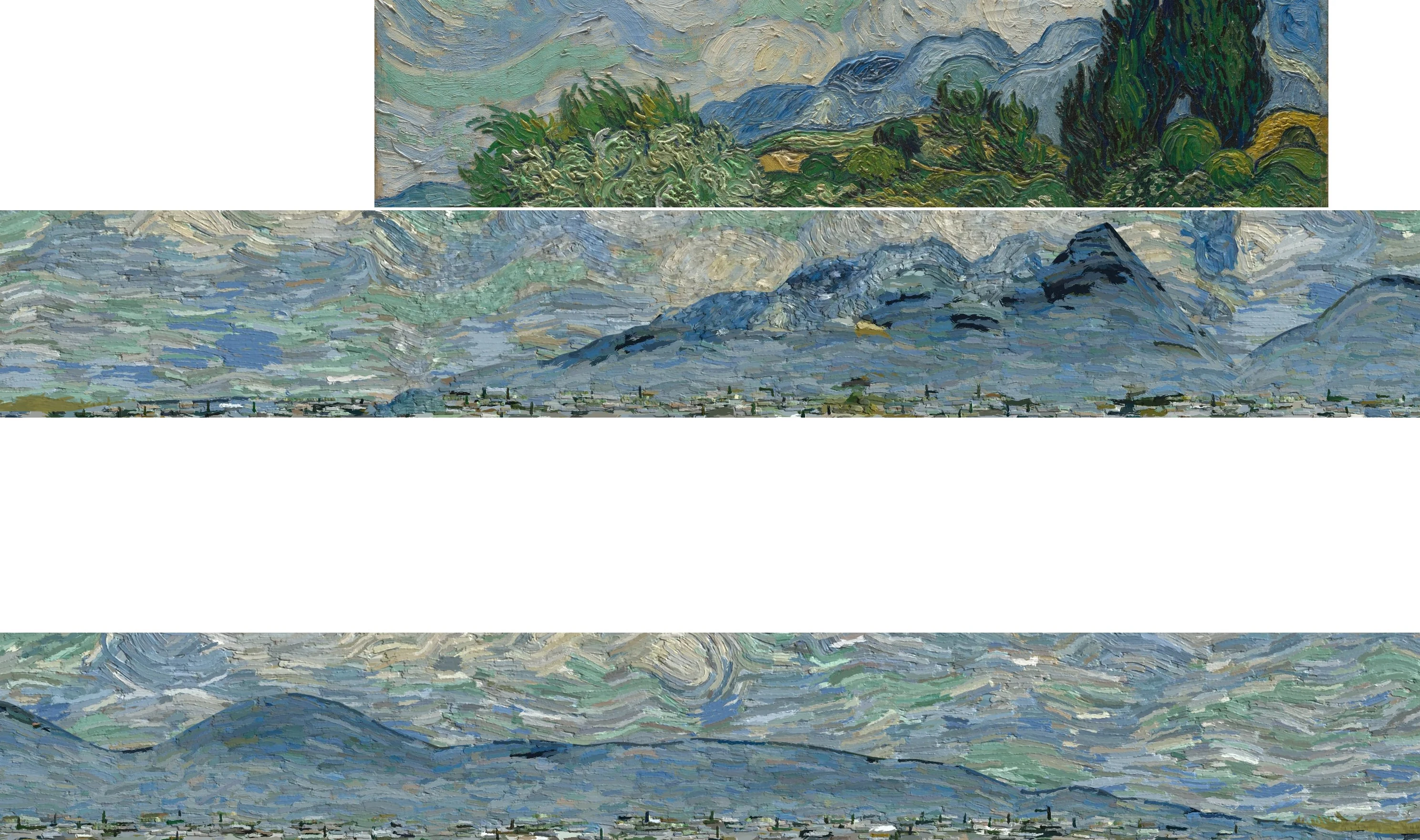
Much of the plan remains drawn only. The ground plan and its repaint, the farmhouse, the low stone wall, the reaped field with sheaves, objects placed from the plan, compression and a final palette pull were never built. The walkable area is about 120 × 120 m. The olive grove and windbreaks beyond the frame are still the earlier rule-placed copies. No music has yet been made.
Method. World Plan: docs/paintings/wheatfield/world-plan.md, data prototype/world_plan/world_plan.json. Horizon: EU-DEM 25 m via OpenTopoData, rays from 30 m to 15 km at 1.6 m eye height, earth curvature and refraction corrected (prototype/world_plan/horizon.py); 825 of 1,009 measured columns lie within −15° to +16° of centre. The sun follows Spencer’s 1971 declination at 43.78 N.11 The sky: own NumPy PatchMatch on source coordinates, a 5120 × 5120 dome, strokes 40–120 × 8–15 px, lit from 330° and 35° up. The hills ring is 5955 × 435 px, 0.29 MB (prototype/hills/); the World totals 60.0 MB, its budget. Steps 5f–5k were deferred on 30 October. Plate 6.3 colours the dome’s masses with three of his twelve colours and draws the solved flow (work/sky/dome_maps.npz, stored as a doubled angle); Plate 6.5 shows the World’s ridge (work/hills/ridge.npz) and the terrain without its 1.7 lift.
7 Checking against his hand
Inside the frame a copy can be measured; beyond it, nothing exists to measure against. The question therefore changed from “does this match the canvas?” to “could he have painted this?”. A first check, built region by region against this one canvas, was set aside for that reason.
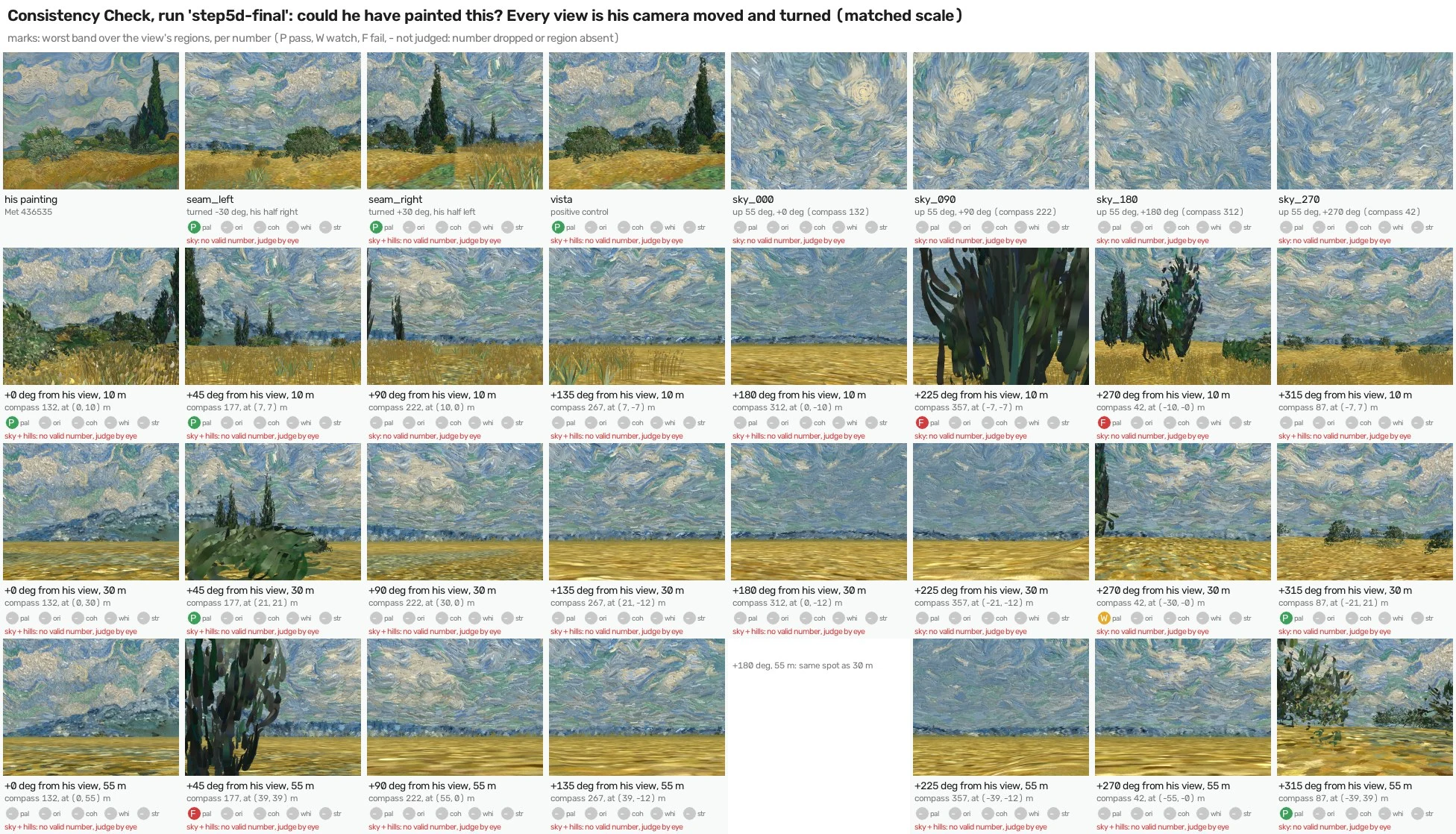
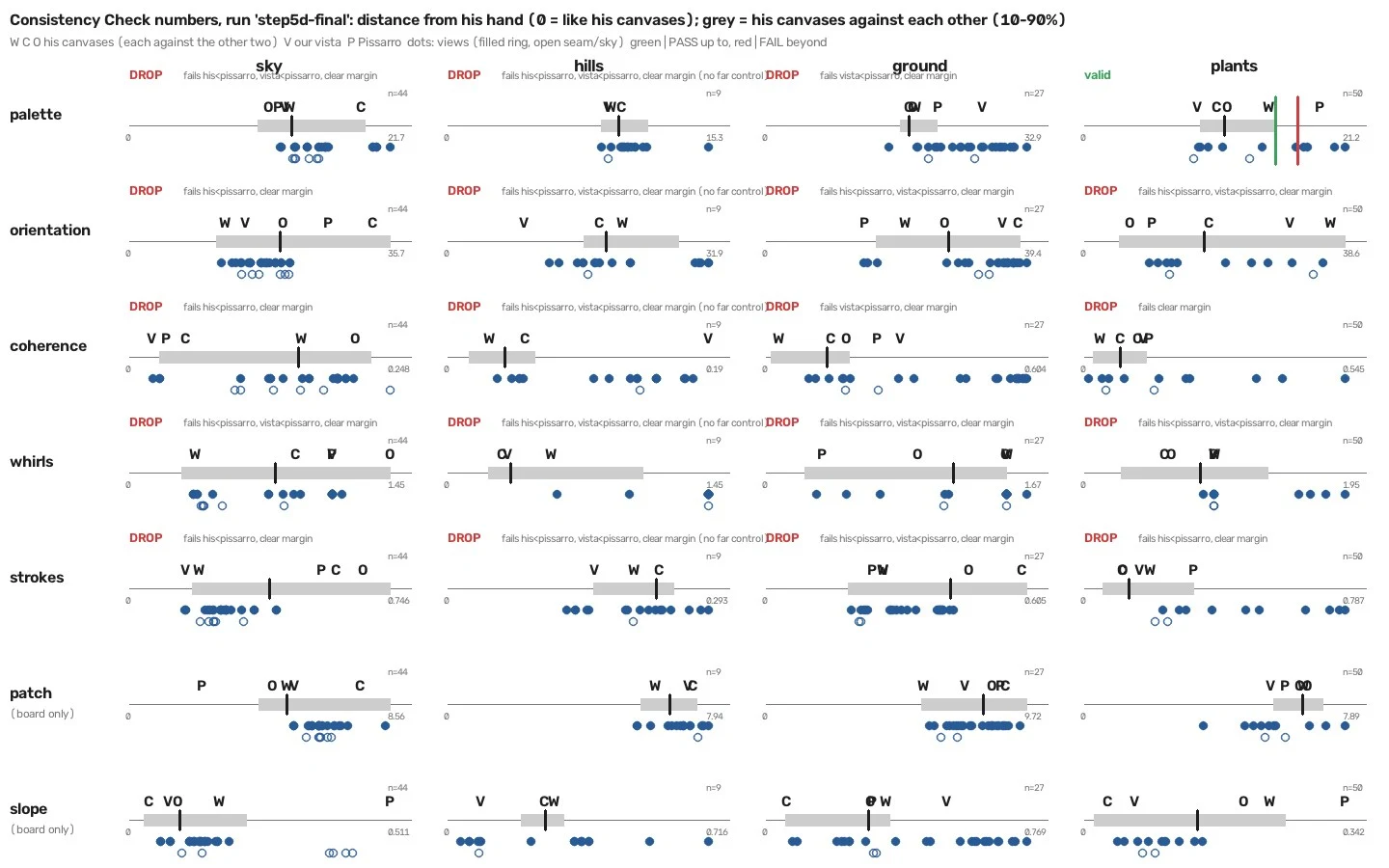
The Consistency Check renders 30 views of the browser World with his own camera, moved and turned: 23 round the vista at three distances in eight directions, two across the frame’s edges, four looking up, and his own view as a control. Each view is scored for colour, stroke direction, whirls and stroke size, as distances from his other Saint-Rémy canvases at the Met. His: Met 437980 Cypresses, 437998 Olive Trees. Not his: Pissarro, Met 437310. His canvases scored against each other show how far “his” can stray; a Pissarro shows what “not his” looks like.
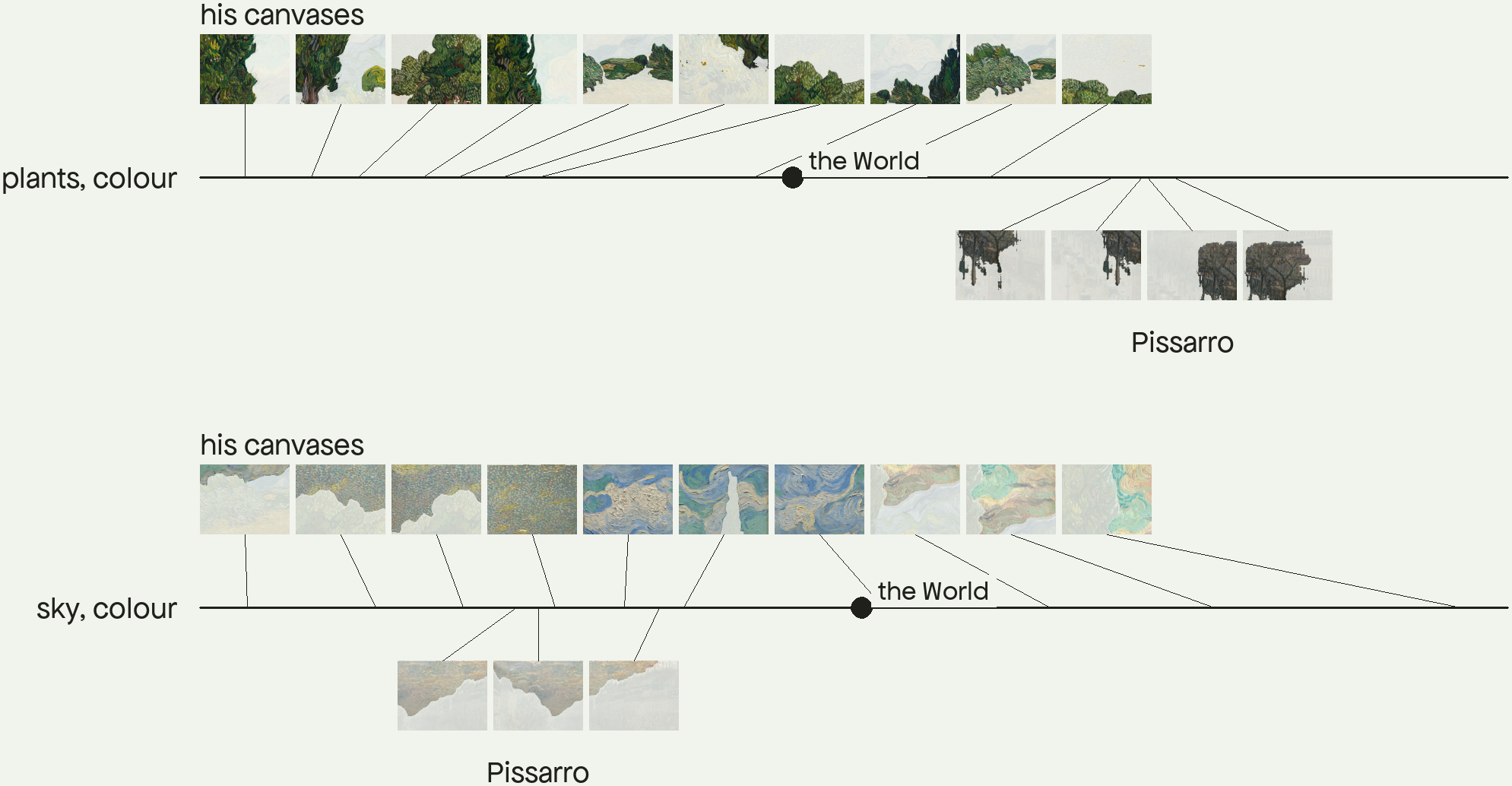
At first the numbers failed his own vista, because they measured photograph against render: canvas weave and glints, not the hand. Once that and a fault in the comparison pool were fixed, only one of the gated numbers, the colour of the plants, told his hand from Pissarro’s (Plate 7.1). On every other gated number his canvases differ more from each other; a board-only texture slope also separates them. On the colour of the sky, the Pissarro sits among his own canvases.
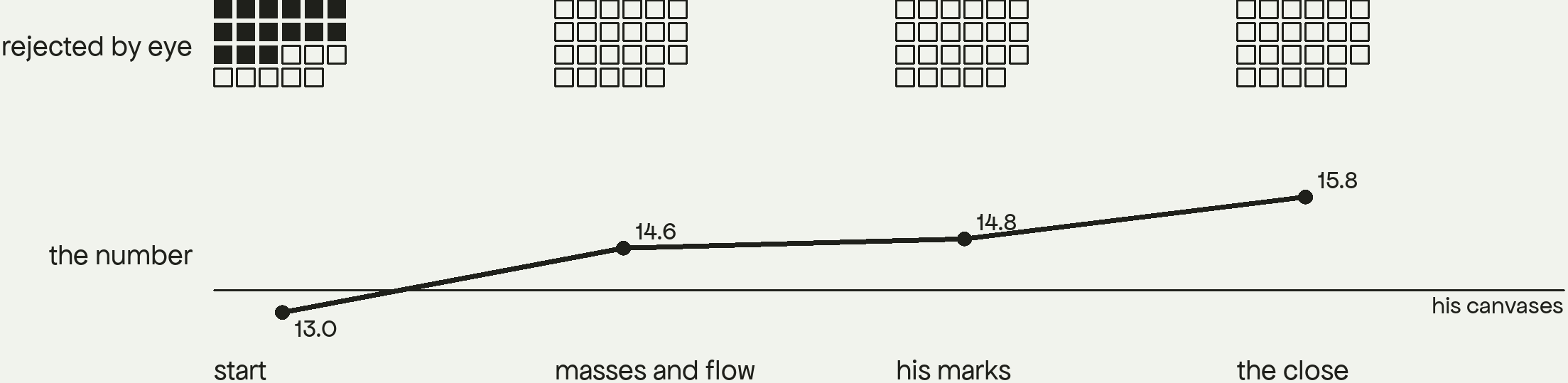
As the sky improved by eye, its median number grew worse (Plate 7.2). The numbers stayed as information and as guards at the vista; the eye judged.
The eye’s test is blind (Plate 7.3). Sixteen squares are mixed, eight from his canvases and eight from the World, all at his scale, and marked “his” or “not his” before the key is opened. On the first board, marked by the project’s author, 15 of 16 were right: the World read as not his. Proxy scores since: 14, 16, 15, 14, 14 of 16. Later boards were marked by an automated stand-in, shown only the image and nothing of the project; its scores are not a person’s.
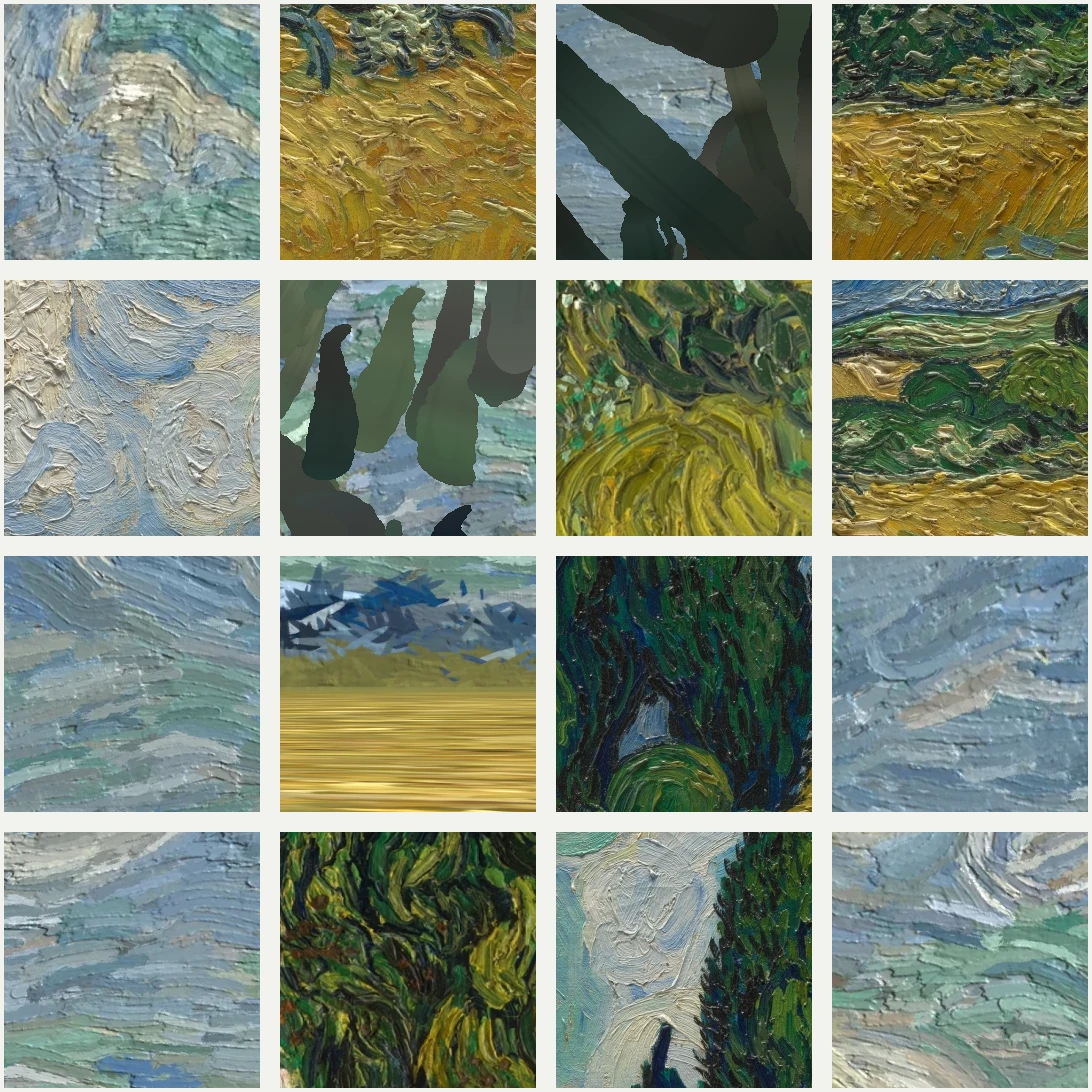
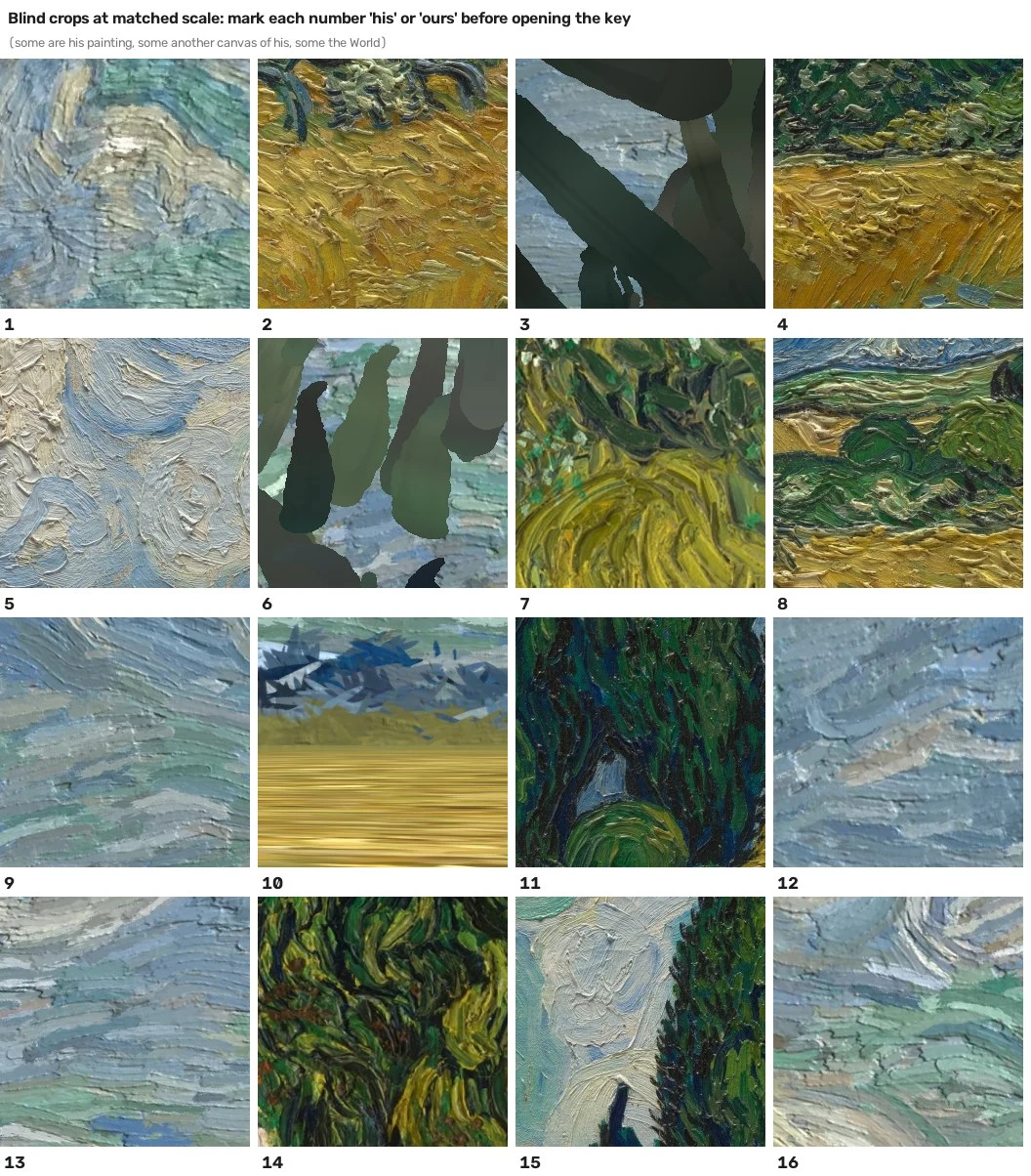
On the last board, the judge took two World squares for his. The top-left one looks straight ahead into his own repainted window, a flaw of the test: five of the eight World squares ever called his were such forward views. The other three were sky, from the 5d marks, masses and final rounds. The bottom-right one is sky, seen from 30 m out, 45° to the left of his view, praised for “crisp white ridges that cast shadows”. The closing notes call it the first World sky to pass as his; in fact two earlier rounds had already done so (Plate 7.4).

The same judge caught everything else. The sky gave itself away by sameness, “every dab the same size and height”. Crops 9, 12, 13 (sky); 3, 6 (cypresses); 10 (hills, ground). Up close the cypresses read as flat dark shapes, the hills as spikes, the near ground as a smear. The hills ring, built last, was put on a blind board that was never marked.
The record supports a modest claim. From his spot, the World stands close to his composition. Beyond it, in one square of sky, a blind judge once took the World for him. Up close, his hand is not yet there.
Method. Colour is scored as earth mover’s distance, the least work to turn one colour distribution into another (prototype/consistency/); the 31st ring view, 55 m straight behind, is the same spot as 30 m and was dropped. A code review found the World scored against a pool that held the Wheat Field itself. The sky number: 13.0 at the start, 14.60 in round 5c, when the art-director’s sky rejects fell from 15 of 23 views to none, 15.85 after round 5d and 15.14 after the hills. The vista’s hills guard caught a rise from 9.41 to 11.63, fixed to 10.50. A run takes 20–23 minutes against a 15-minute budget. Blind crops are 256 px, about 12 cm of canvas. Only the two misses of the last board were recorded; the other 14 marks follow from the score. Plate 7.1 shows ten of his tiles, one at every tenth of their spread, and four of the Pissarro’s, from the step 5d final scores, each with only its scored region in full. Plate 7.2’s rejections are the 5b and 5c sky verdicts; later rounds were judged as a whole and passed. Plate 7.4 replays each board’s crops from its saved seed; an assertion checks the replay against the key. Reviews along the way were automated; the author reviewed every result and made every final call.
8 Sources
Primary and museum sources
- 1The Metropolitan Museum of Art, Wheat Field with Cypresses, 1993.132, collection record and catalogue entry: https://www.metmuseum.org/art/collection/search/436535
- 2The National Gallery, London, A Wheatfield, with Cypresses (F615): https://www.nationalgallery.org.uk/paintings/vincent-van-gogh-a-wheatfield-with-cypresses
- 3Leighton, Reeve, Roy and White, National Gallery Technical Bulletin 11 (1987), pp. 42–45 (fig. 3, p. 43): https://www.nationalgallery.org.uk/upload/pdf/leighton_reeve_roy_white1987.pdf
- 4Vincent van Gogh, The Letters, ed. Jansen, Luijten and Bakker (Van Gogh Museum and Huygens ING, 2009), read through 2023 web archive copies: letters 698, 772, 780, 783, 784, 787, 805, 806, 810
- 5Gedzelman, Leonardo 23/1 (1990), pp. 107–116, paywalled and cited through the Met’s summary only: https://muse.jhu.edu/article/601801
- 6ColourLex, A Wheatfield, with Cypresses (NG 3861): https://colourlex.com/project/van-gogh-wheatfield-cypresses/
Places and data
- 7EU-DEM v1.1, 25 m elevation model: European Union’s Copernicus Land Monitoring Service information, via OpenTopoData, resampled and reshaped here: https://www.opentopodata.org/datasets/eudem/
- 8OpenStreetMap contributors, map data (ODbL): https://www.openstreetmap.org/copyright
- 9Wikipedia, “Alpilles”: https://en.wikipedia.org/wiki/Alpilles
- 10Wikipedia, “Mistral (wind)”: https://en.wikipedia.org/wiki/Mistral_(wind)
- 11J. W. Spencer, “Fourier series representation of the position of the sun”, Search 2/5 (1971), p. 172
Methods
- 12A. Hertzmann, “Painterly Rendering with Curved Brush Strokes of Multiple Sizes”, SIGGRAPH 1998: https://www.cs.princeton.edu/courses/archive/fall00/cs597b/papers/hertzmann98.pdf
- 13J. Li et al., “Rhythmic Brushstrokes Distinguish van Gogh from His Contemporaries”, IEEE TPAMI 2012: https://doi.org/10.1109/TPAMI.2011.203
- 14P. F. Felzenszwalb and D. P. Huttenlocher, “Efficient Graph-Based Image Segmentation”, IJCV 59 (2004): https://cs.brown.edu/people/pfelzens/segment/
- 15A. Kirillov et al., “Segment Anything”, 2023: https://arxiv.org/abs/2304.02643
- 16C. Barnes et al., “PatchMatch”, SIGGRAPH 2009: https://gfx.cs.princeton.edu/pubs/Barnes_2009_PAR/
- 17A. Runions, B. Lane and P. Prusinkiewicz, “Modeling Trees with a Space Colonization Algorithm”, 2007: https://www.algorithmicbotany.org/papers/colonization.egwnp2007.pdf
- 18W. Elkhuizen et al. (TU Delft), “Gloss, Color and Topography Scanning for Reproducing a Painting’s Appearance using 3D printing”, 2019: https://arxiv.org/abs/1910.10836
- Cited by name in the project’s research notes, without links here: Baxter et al. 2004 (paint relief); Kopf et al. 2007 (histogram matching in synthesis); Bratkova et al. 2009 (panorama colour by lightness); Im2Oil 2022 (stroke tracing).
Tools
- 19libmypaint, the MyPaint brush engine: https://github.com/mypaint/libmypaint
- 20Krita, the open-source painting program: https://krita.org
- 21OpenCV: https://opencv.org
- 22Blender: https://www.blender.org
- 23three.js: https://threejs.org
- Project records:
docs/paintings/wheatfield/(context, World Plan, verdicts, retrospective),docs/adr/0001,0004,0005,learn/journal/.
Facts held loosely
- The third version’s size. 51.5 × 65 cm in one table of the dossier, 52 × 65 cm in letter 806’s note, 51.4 × 64.8 cm at the Met.
- The date. “Late June” is the National Gallery’s web page; its 1987 Technical Bulletin says “early July”; the Met gives only “before 2 July”. Gedzelman’s dates are unread at source.
- The cypress quotes. Letter 783 describes cypresses in general, not this canvas. No letter describes this canvas in words.
- The wind. The 1901 title “temps de mistral” was Schuffenecker’s, not his. Gedzelman reads a south or south-west wind; the World uses the mistral by choice.
- The third version. F743’s date rests on letter 806 note 12, and its different sky on a small black-and-white plate.
- The viewpoint. Where he stood is unknown. The 132° bearing fits his central hump; 128–134° fit equally well, and spots near the hills scatter widely.
- The terrain model. EU-DEM may be a surface model (including trees and buildings) rather than bare ground; the dossier says bare ground. Unverified.
- The scene’s depth. Distances depend on a chosen 60° lens (±25% across 50–70°); the tall cypress’s 20 m exceeds its prior.
- The repaint shown. Plate 5.1 is most likely the first 71,334-stroke render (ΔE 1.7), but its file may be a later re-render.
- The vista. Plate 5.5’s cypress sits about 15 px right of his at 2000 px wide: close, not exact.
- The cypress counts. The third build had 5,665 strokes, 351 of his; the final build on disk has 4,235, 329 of his.
- The blind marks. Only the two misses on the last board were written down; the other 14 are inferred from the 14/16 score. The record’s claim that this board’s sky crop was the first to pass as his is contradicted by two earlier rounds.
- The judge. After the first board, every blind test was marked by an automated stand-in, not a person; the author reviewed each result.