The Fog Warning
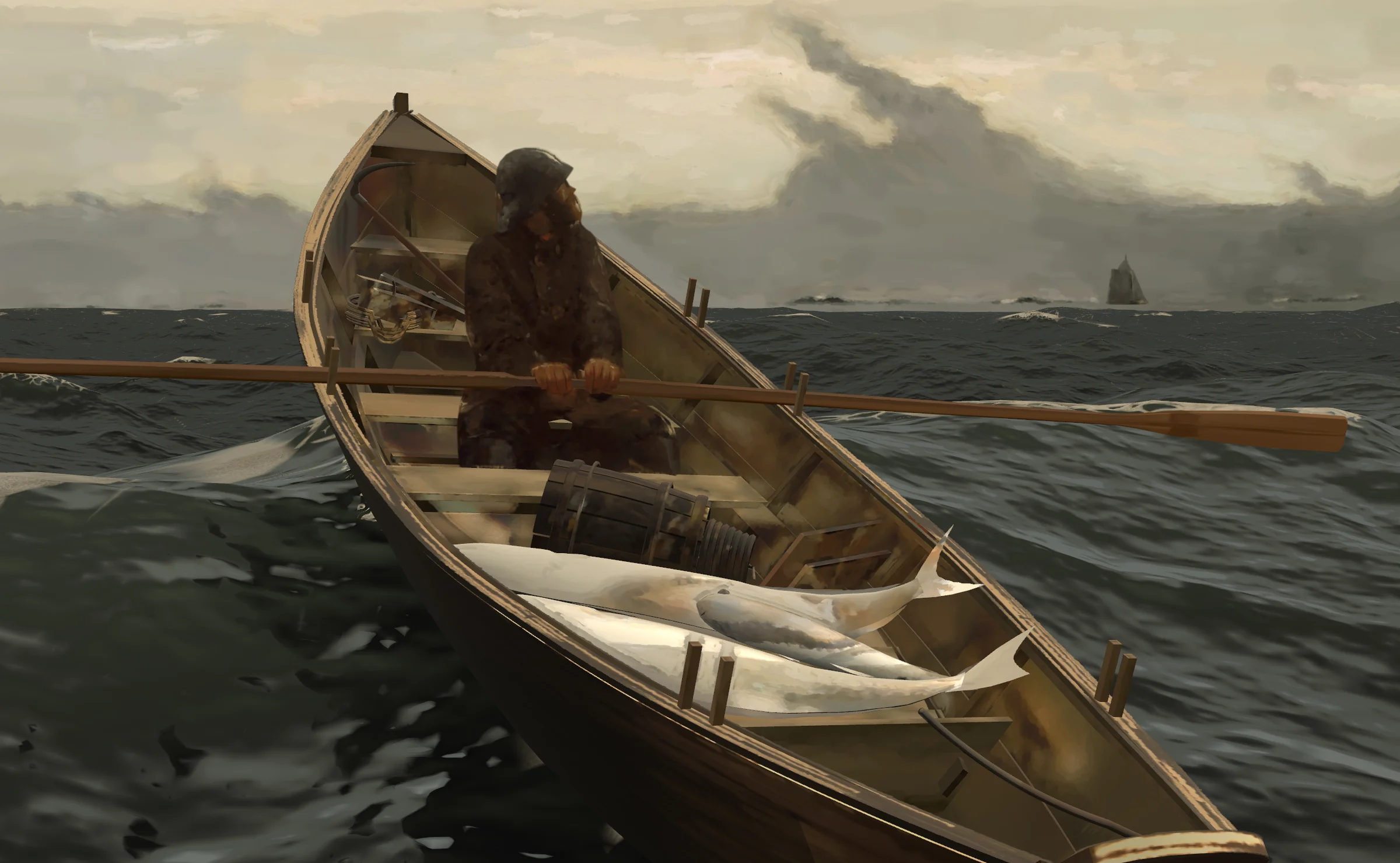
An 1885 painting of a fisherman just before the fog, made into a sea to row while the fog rolls in.
The Banks, 1885
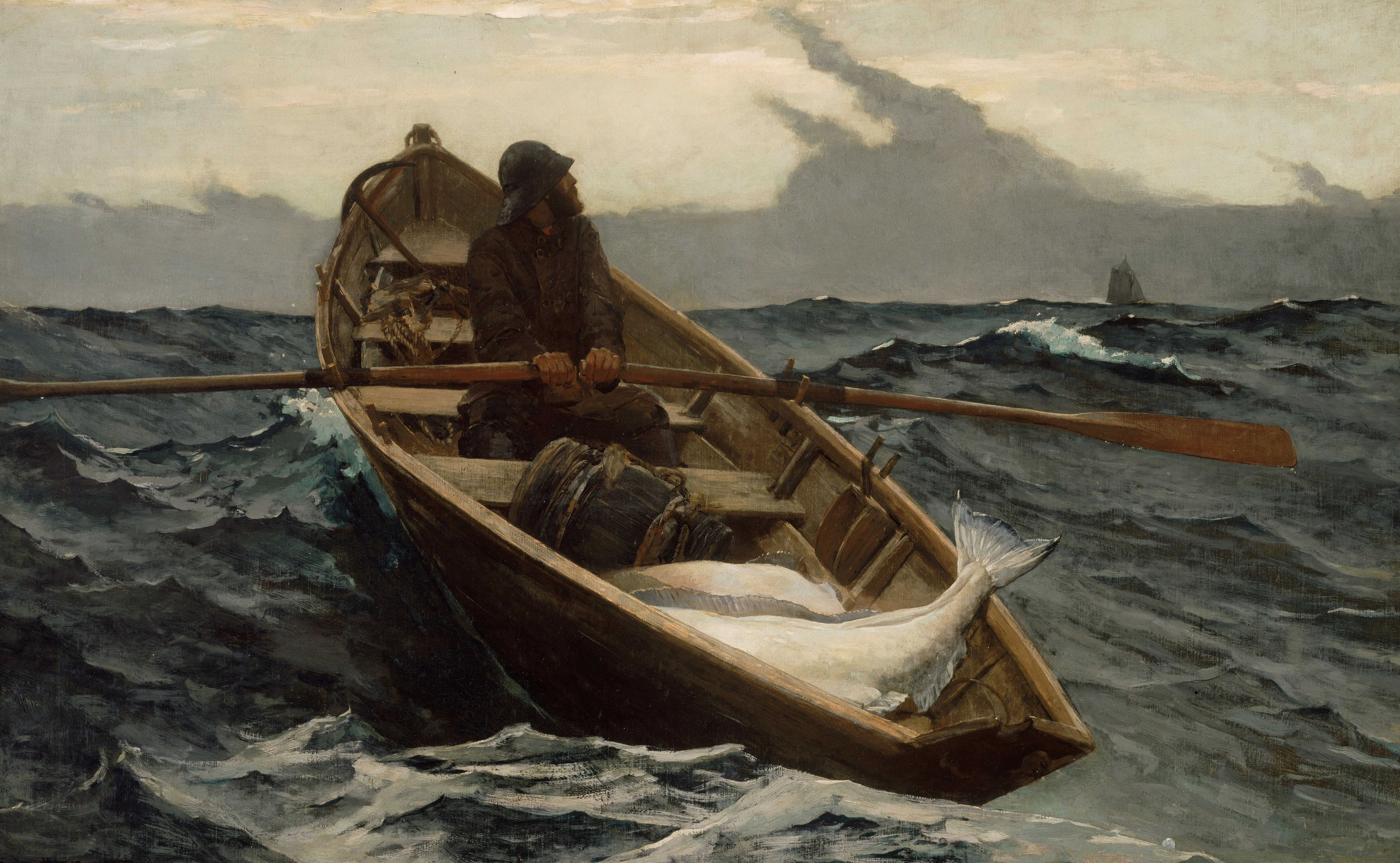
Prout’s Neck, Maine, 1885. Winslow Homer painted a doryman far out on the fishing banks, two halibut across his stern. He has paused at the oars to look over his shoulder at his schooner, small on the horizon, with a bank of fog rising behind her. In Boston early in 1886 it was shown as Halibut Fishing; that April a Boston paper noted that its real name was The Fog Warning.
Halibut were fished from dories set out from a schooner. In fog the ship blew a horn to call them back, and some never found her. So the danger here is the distance, and the fog about to close it. In the museum’s words, “the hardest task of the day, the return to the main ship, is still ahead”.
Details
His values and colours
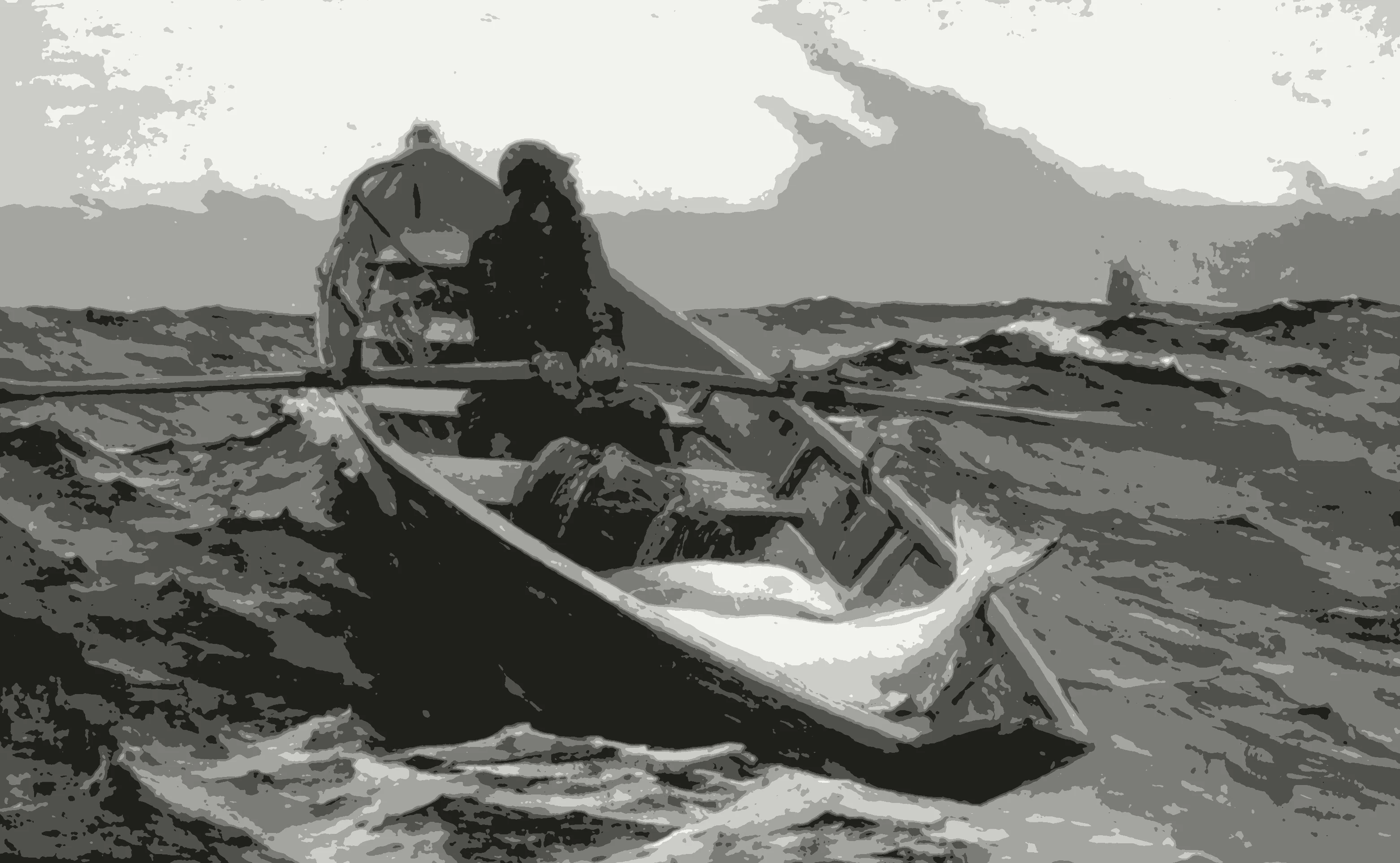
Cut into six bands of lightness, the canvas falls into two halves: a pale sky above, and below it the sea, the boat and the man, with very little between. The sea’s middle tones sit around 25 on a scale of 0 to 100, the sky near 80, and the troughs come near black.
Details
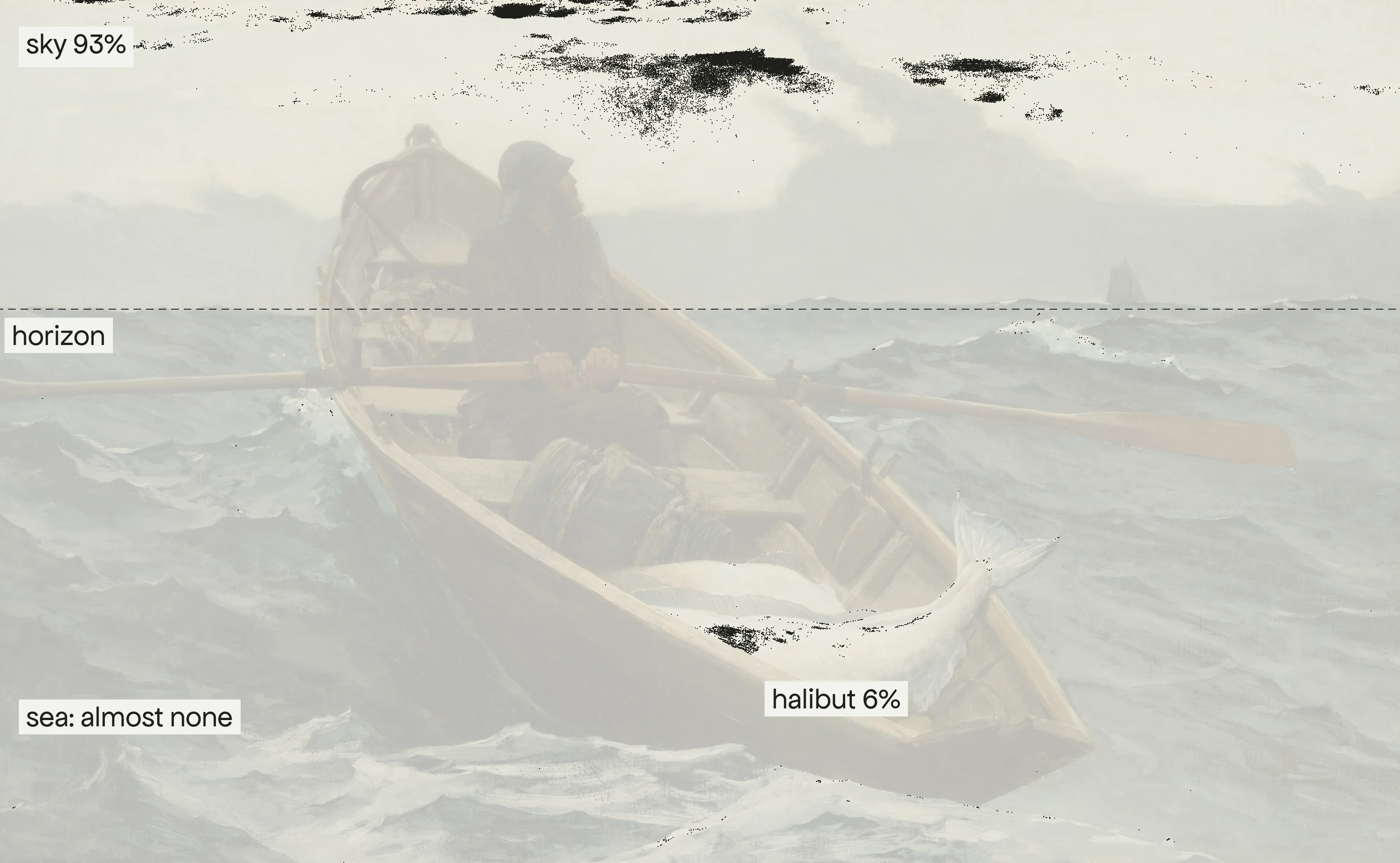
The lightest lights are in the torn gaps of the sky and on the halibut. The foam never reaches them: it is a warm grey. That became the World’s first rule. Nothing on its sea may be lighter than his sky or his fish.
Details
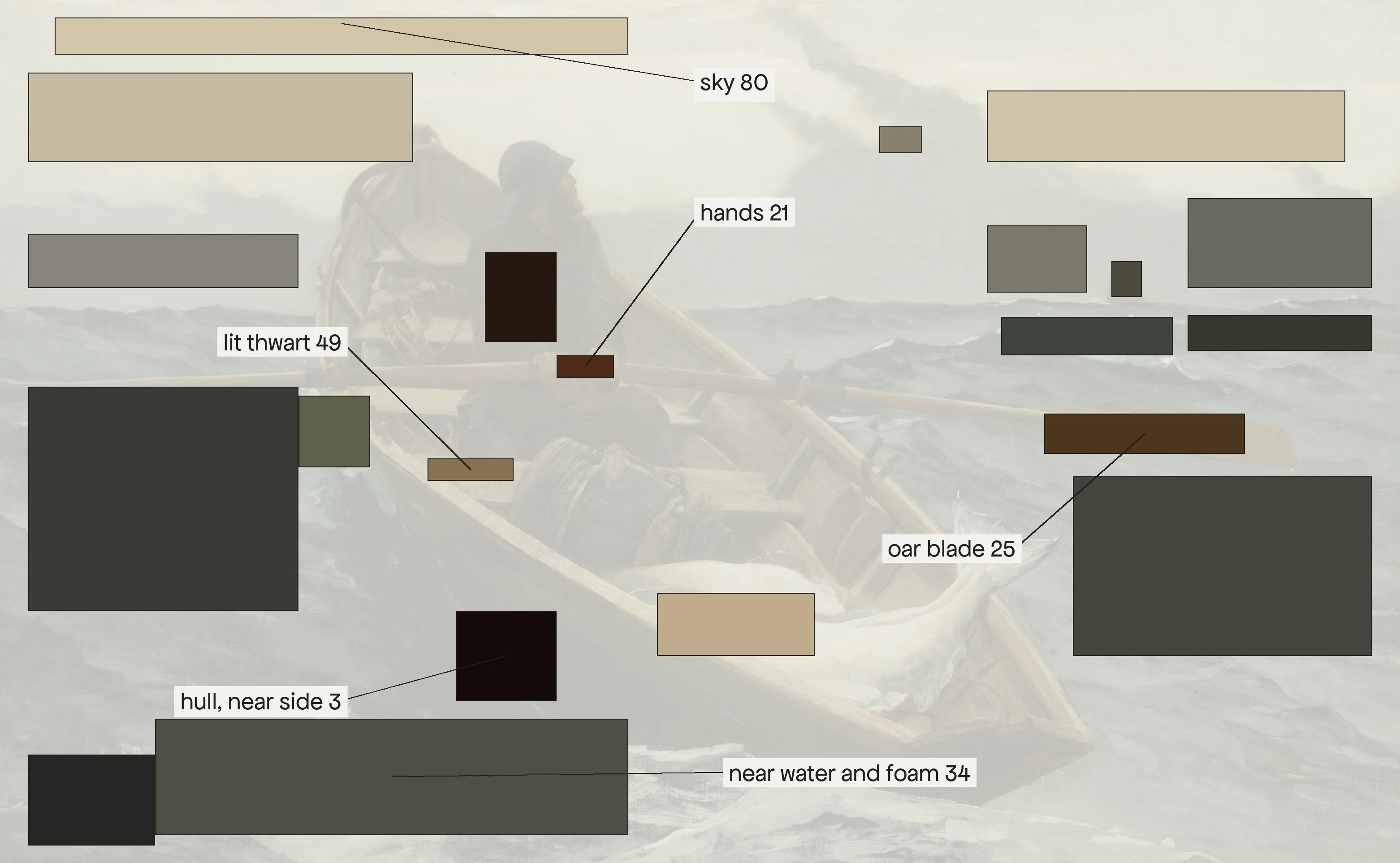
His colours, sampled in twenty-one places, are as narrow as his values. The sea is a green slate close to grey, the sky a warm cream. The only strong colours are small and warm: the oar blade, the lit thwart, and the man’s hands.
Details
How his strokes work
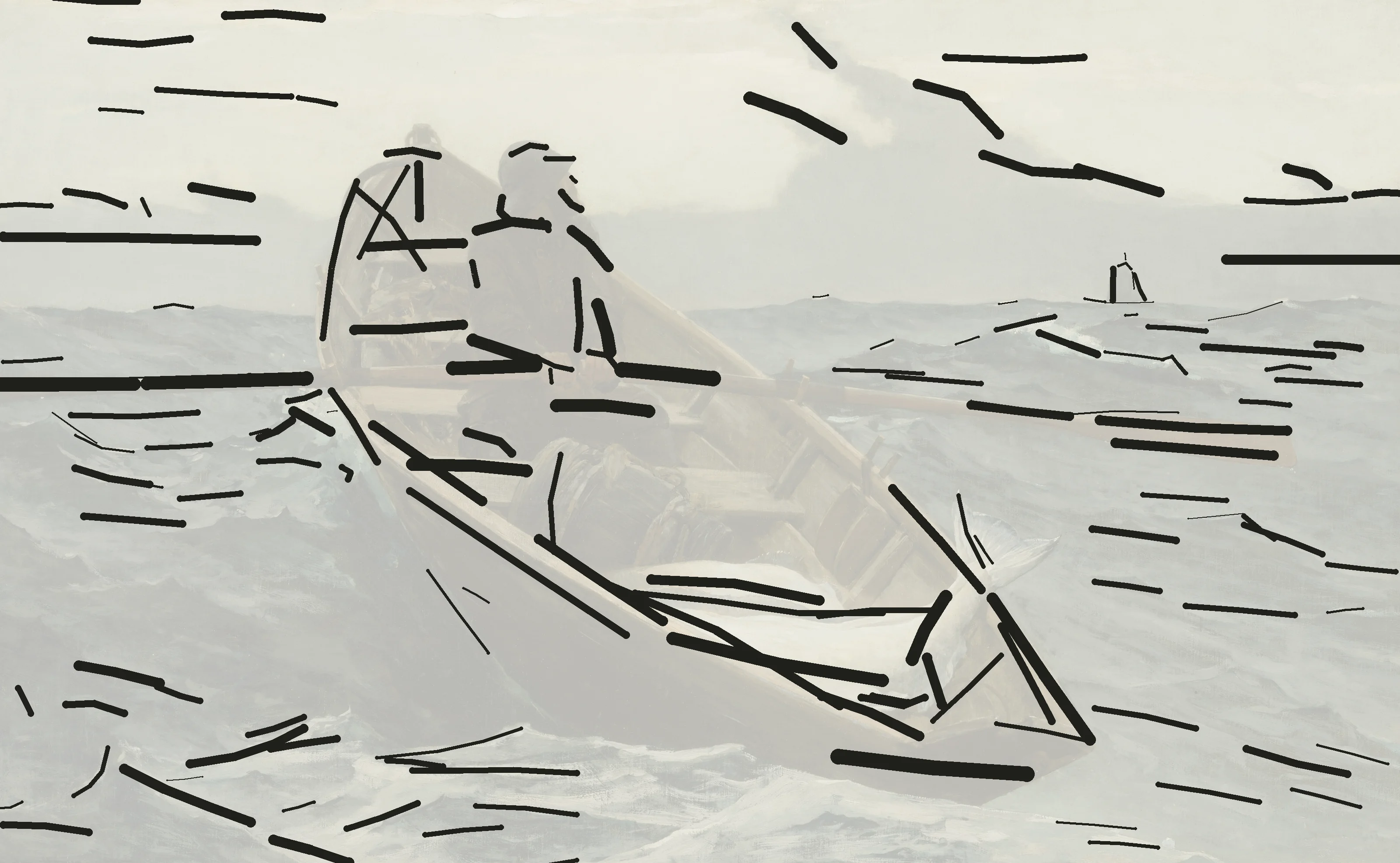
Before any program read the canvas, 164 of his strokes were marked by hand on gridded crops of the photograph. The rail, the oars and the fish are his longest pulls, up to 22 cm in one go. The man and the ship are short touches of 2 or 3 cm.
Details
Close up, the near foam is dragged dry over the dark, so the trough shows through the bristle tracks. In the troughs a warm brown layer shows under the cool grey-green.
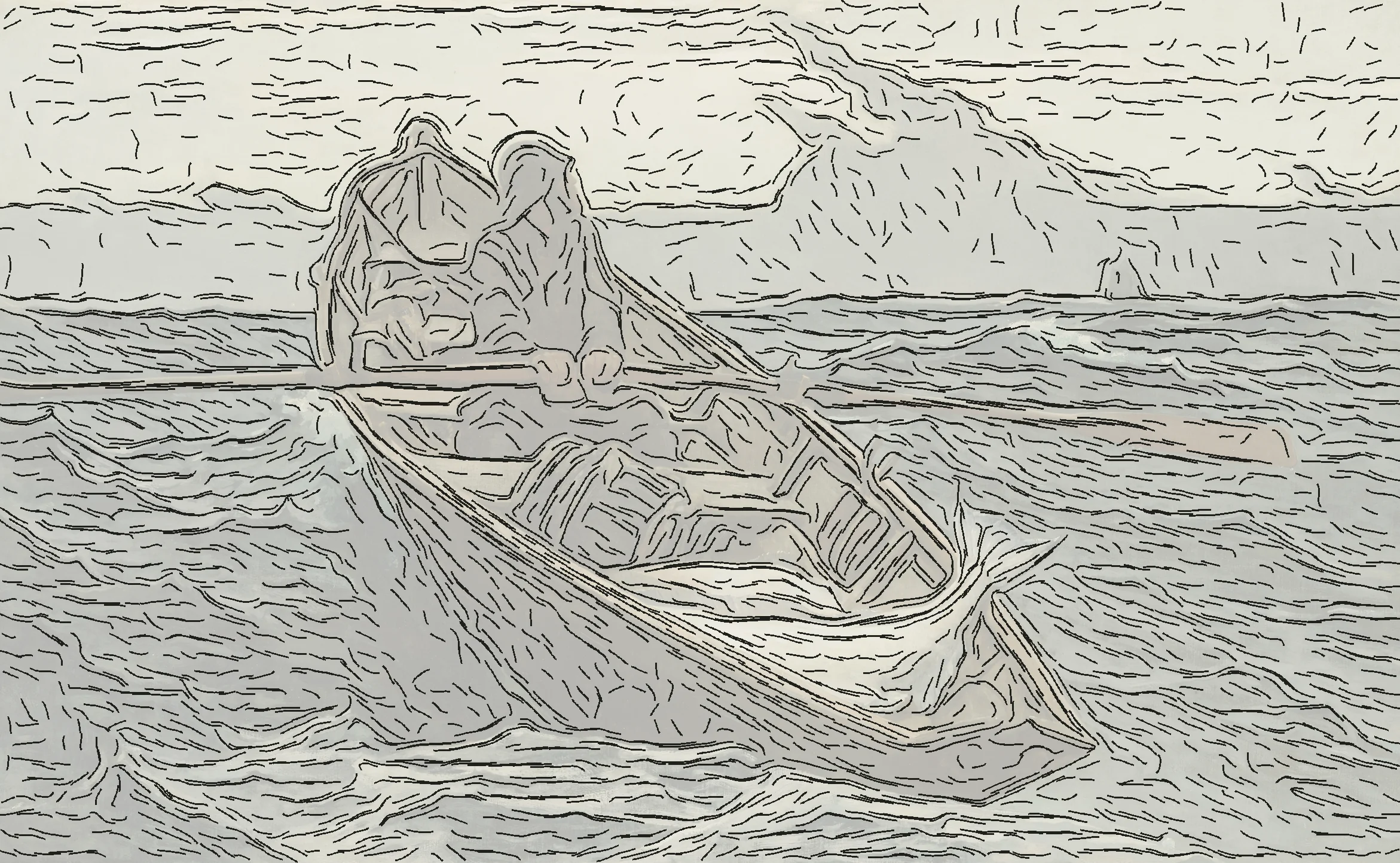
Read across the whole canvas, his marks lie along the crests, run with the planks, and rise with the streamer. And they barely shrink with distance: his far marks keep about two thirds of the size of his near ones, where perspective would leave a tenth.
Details
Where he stood
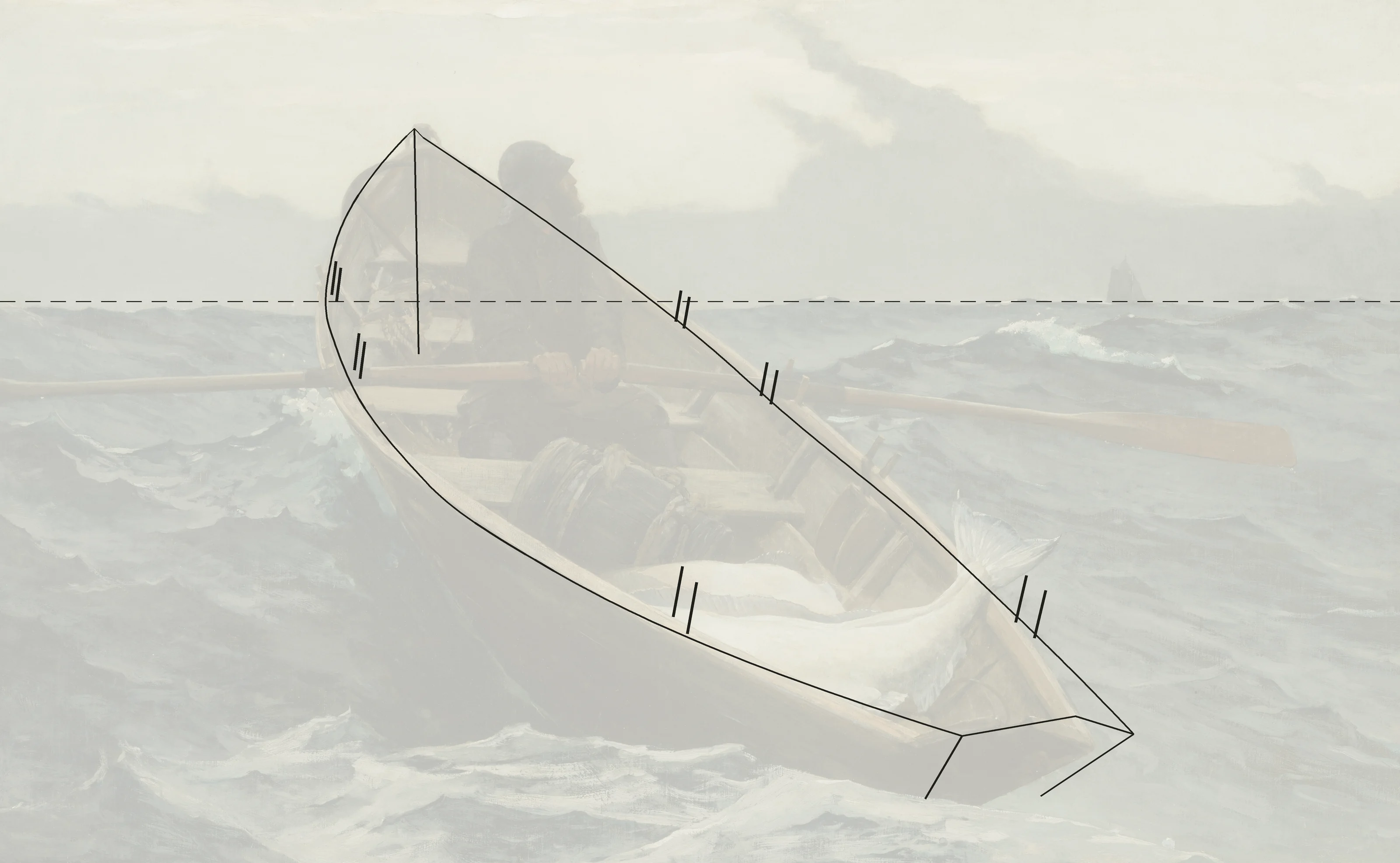
Homer’s viewpoint was worked out by fitting a real dory to the canvas. A Banks dory, built from offsets drawn at the Portsmouth Navy Yard in 1884, was moved with a virtual camera until its stem, stern, thole pins, gunwales and the horizon fell as close as possible to where he painted them. The eye sits about 7 m from the boat, low over the water, the bow lifted 15.5° on a wave.
Details
A sea that moves
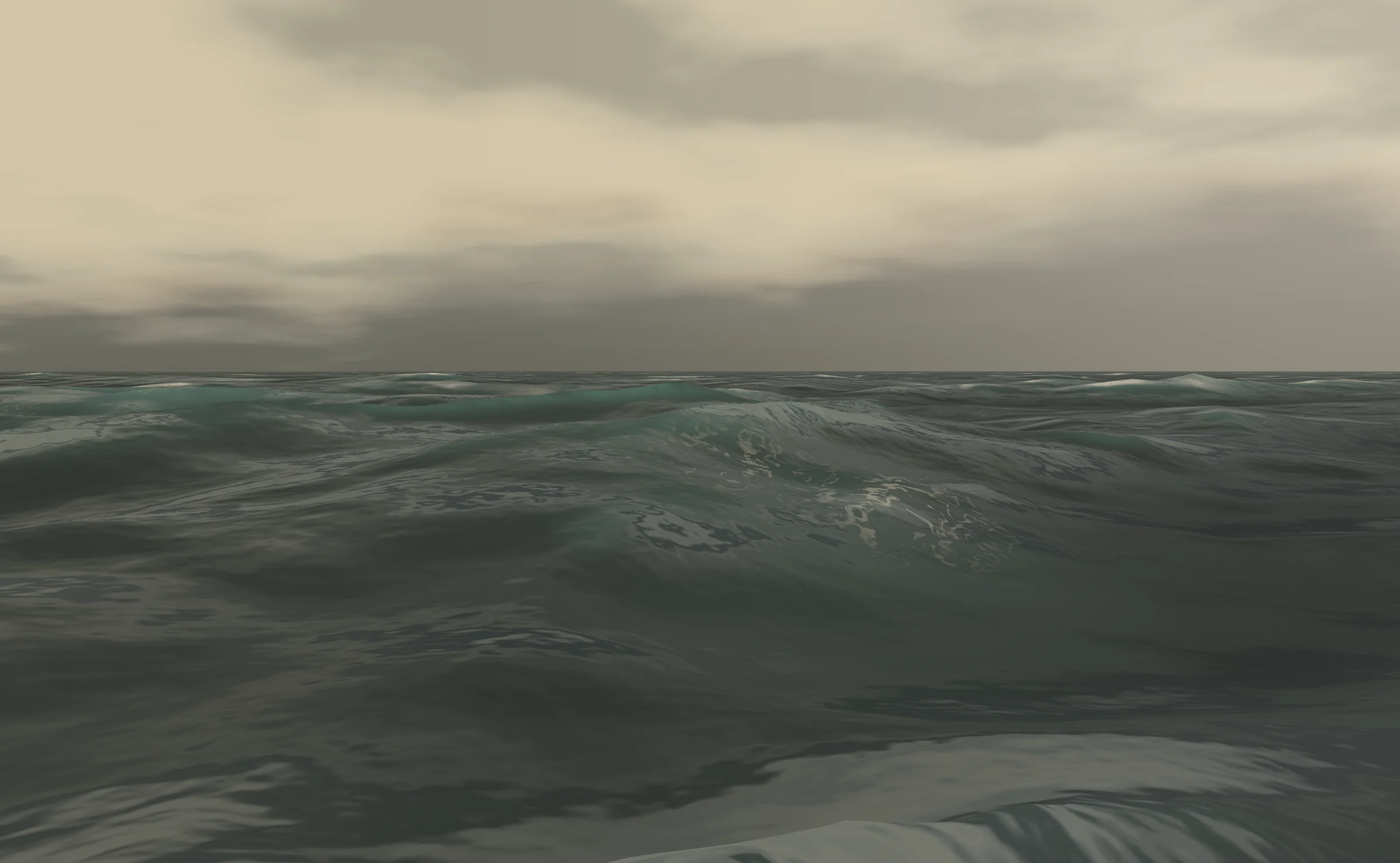
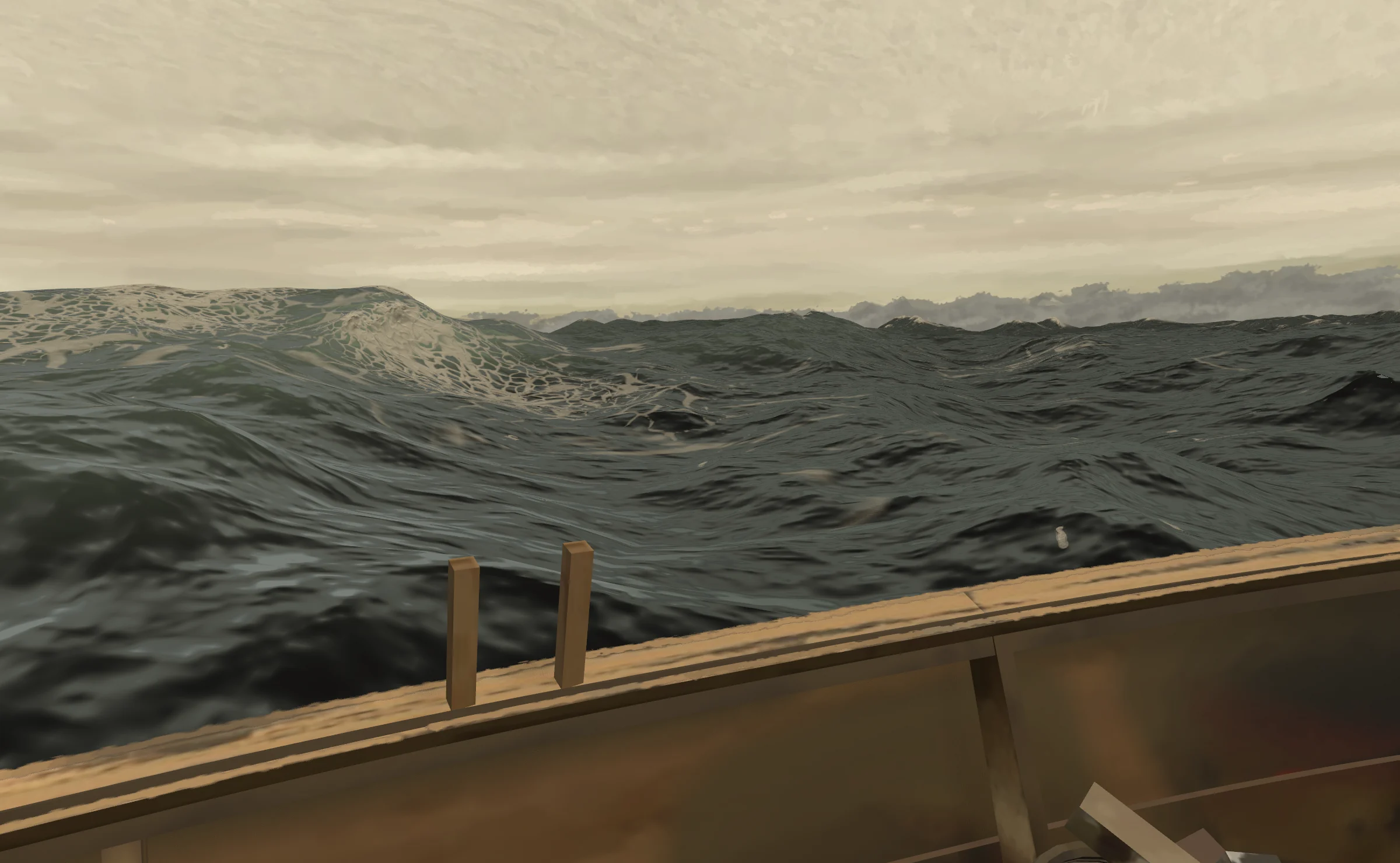
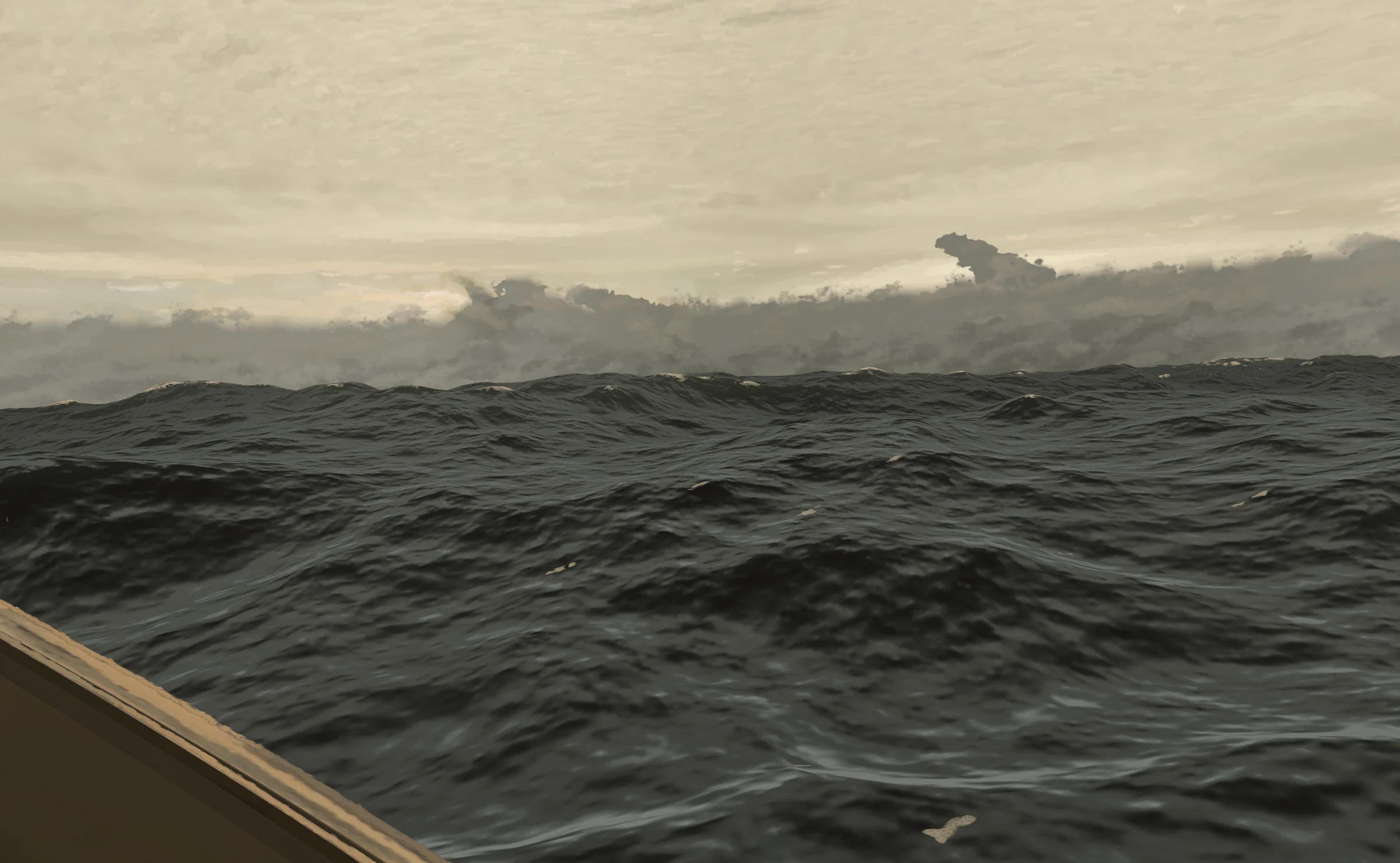
A painted sea cannot move, so the water is computed: thousands of waves summed from a measured spectrum, every frame, on the graphics card. The first seas read as “a texture” with waves laid on top. This one, tuned toward his picture over seven rounds, was turned back the next morning.
Details
The sea was restarted, based on the published methods of Sea of Thieves: one sea from one wind, its waves doubled by eye toward his crests. Then the goal changed from matching the game to looking like real water. The restarted sea already did; only its foam was redrawn, as a lace that wears to threads. It is kept in his greys, without his marks.
Details
Painted stroke by stroke
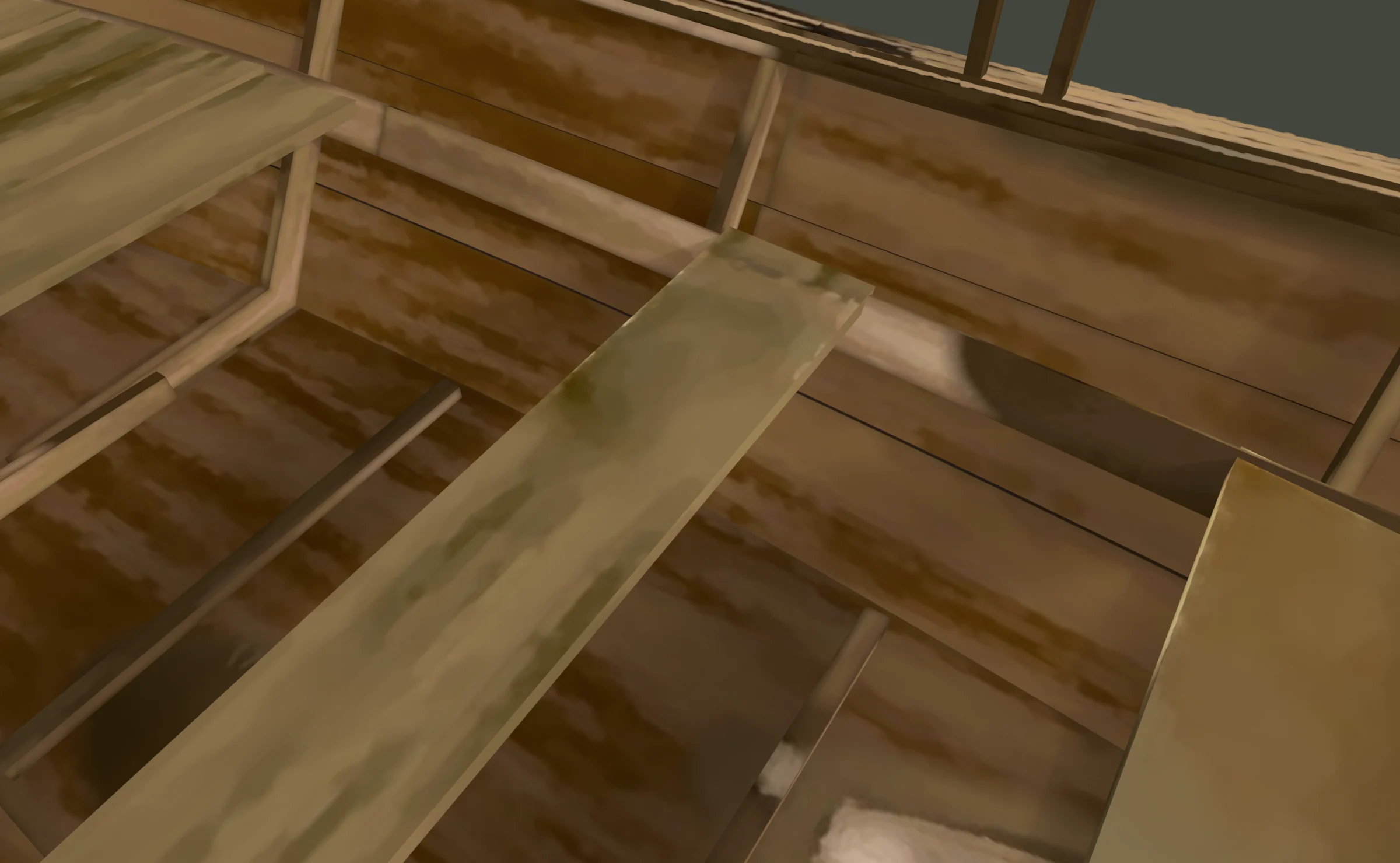
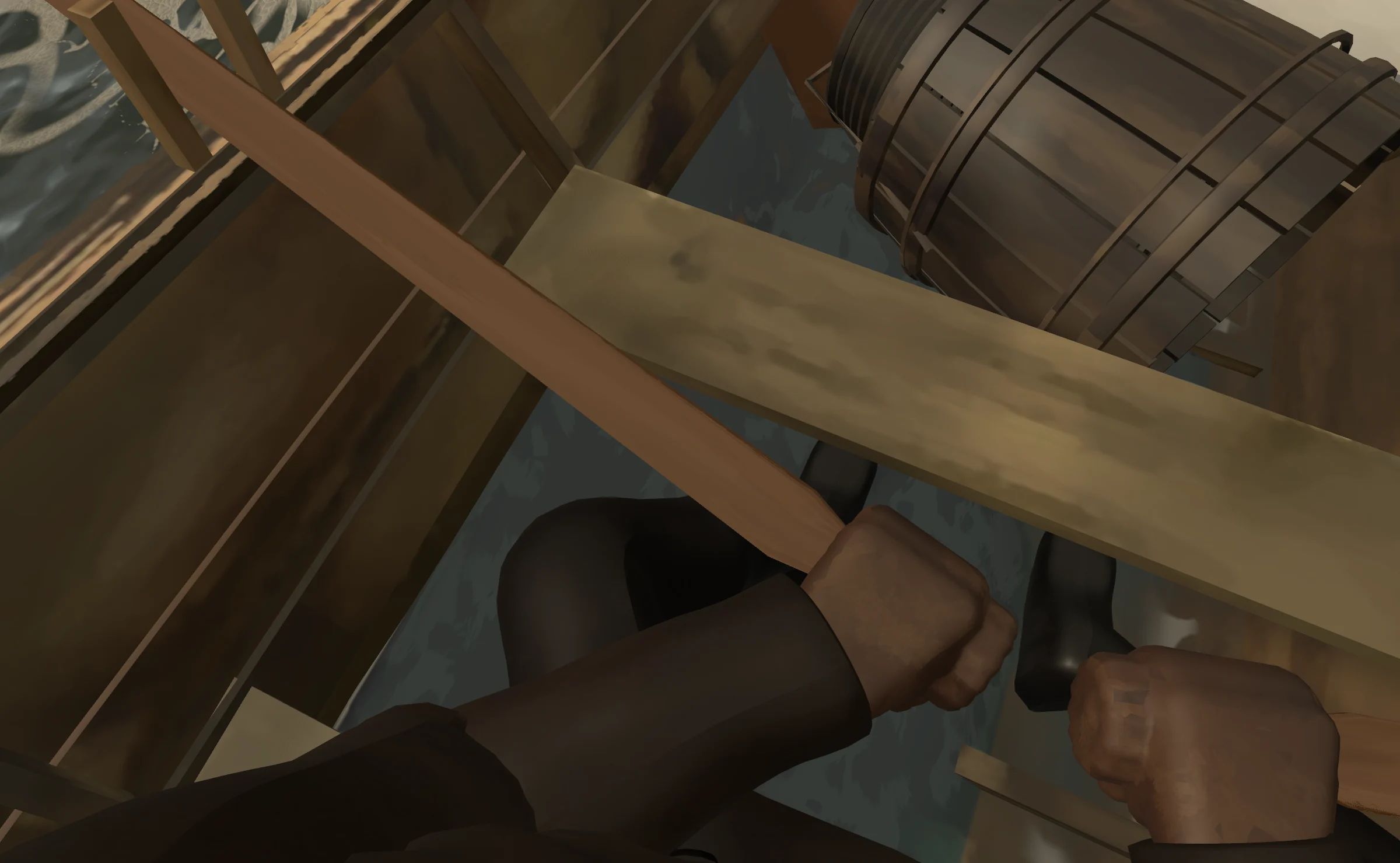
Everything the sea does not move is painted by a real brush engine, stroke by stroke. The dory’s planks carry two brushes, picked against his boat: a soft one for the dark, a dry one for the lit thwarts and rails.
Details
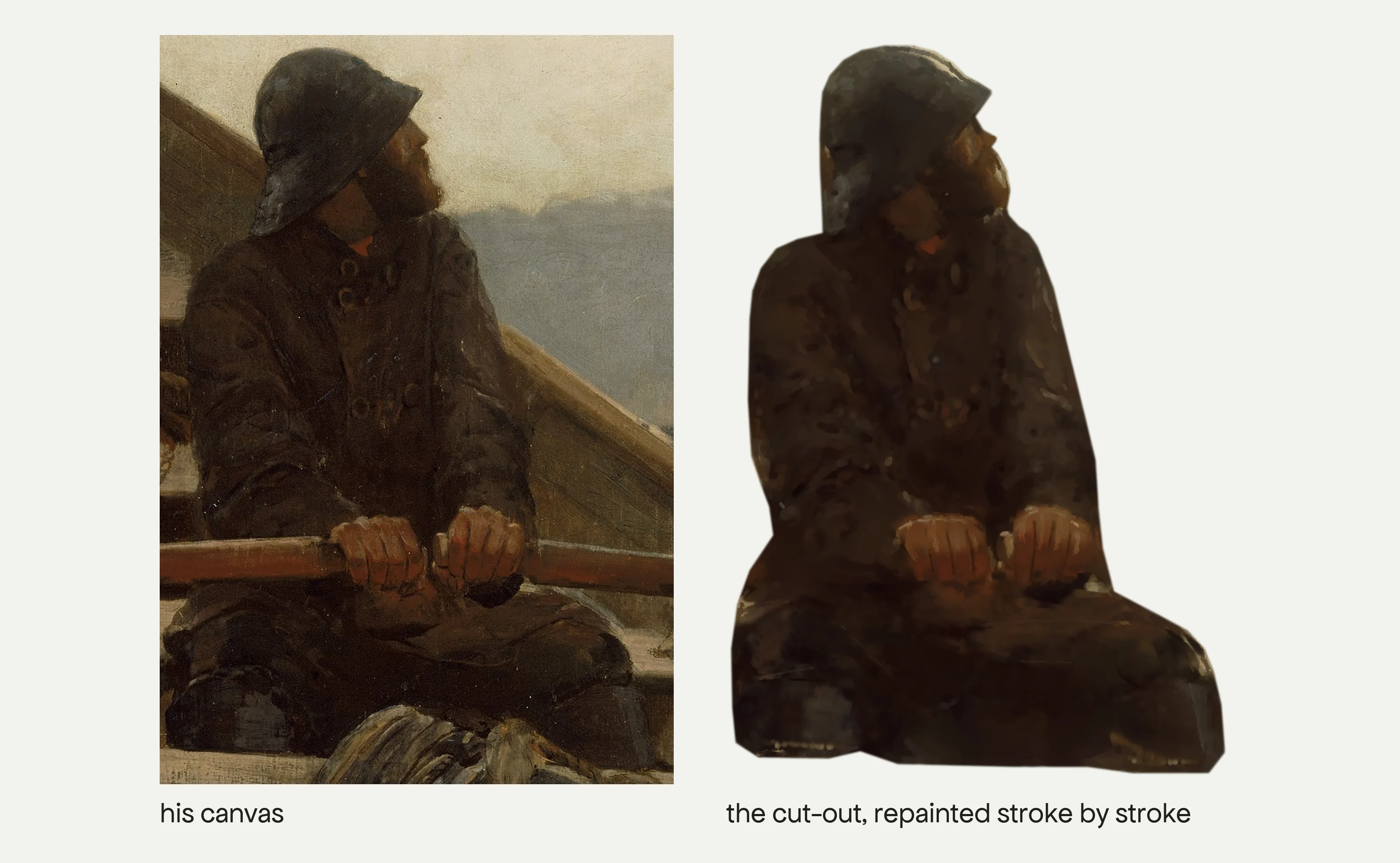
tanda/oil-06-paint and tanda/oil-03-paint. Every colour sampled from his canvas; no pixel of the photograph kept.The man took longest. Bodies modelled to stand in for him never looked like him, so at Homer’s view he is a flat cut-out, like a stage flat, repainted in 39,342 strokes with every colour sampled from the canvas.
Details
From his spot the World stands close to his picture. The sky dome is painted dab by dab, his fog edge carried round beyond the frame, and its cream, streamer and bank land close to his lightness.
Details
In the seat
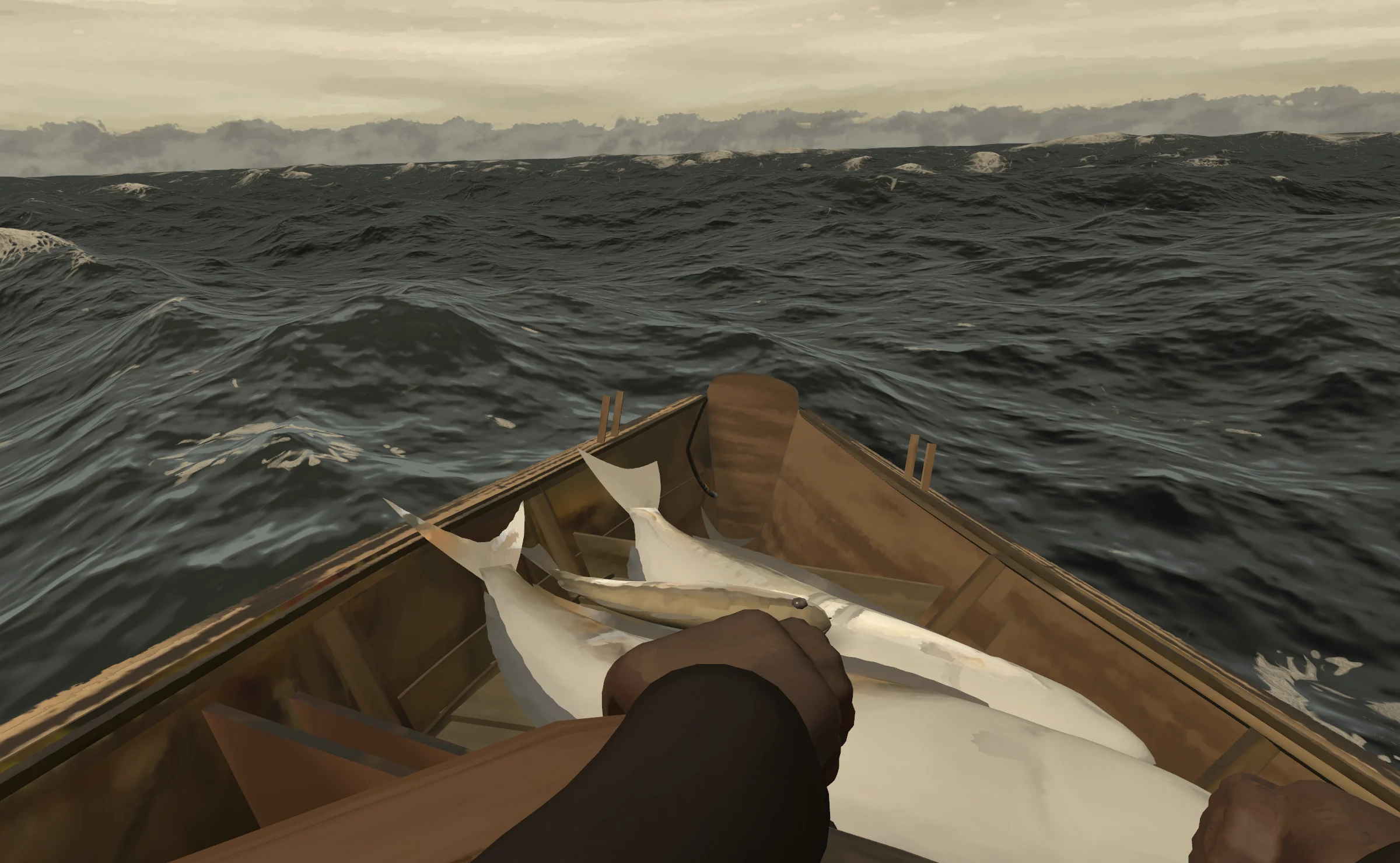
In the seat the painting is behind you. The view faces the stern, as a doryman’s does, over arms in a wet wool coat and the hands on the looms. The stroke flows at 24 a minute, the waves turn the boat as well as lift it, and to find the ship the head has to turn.
Details
His canvas shows no water in the boat, and from the seat the boat felt dry. So the World adds a few things he left out, kept in his greys: water sloshing in the bottom, spray from the real contact of hull and wave, water in the eyes that blurs the view until a few blinks clear it, and the hull’s dark in the water beside it.
Details
The fog comes and goes
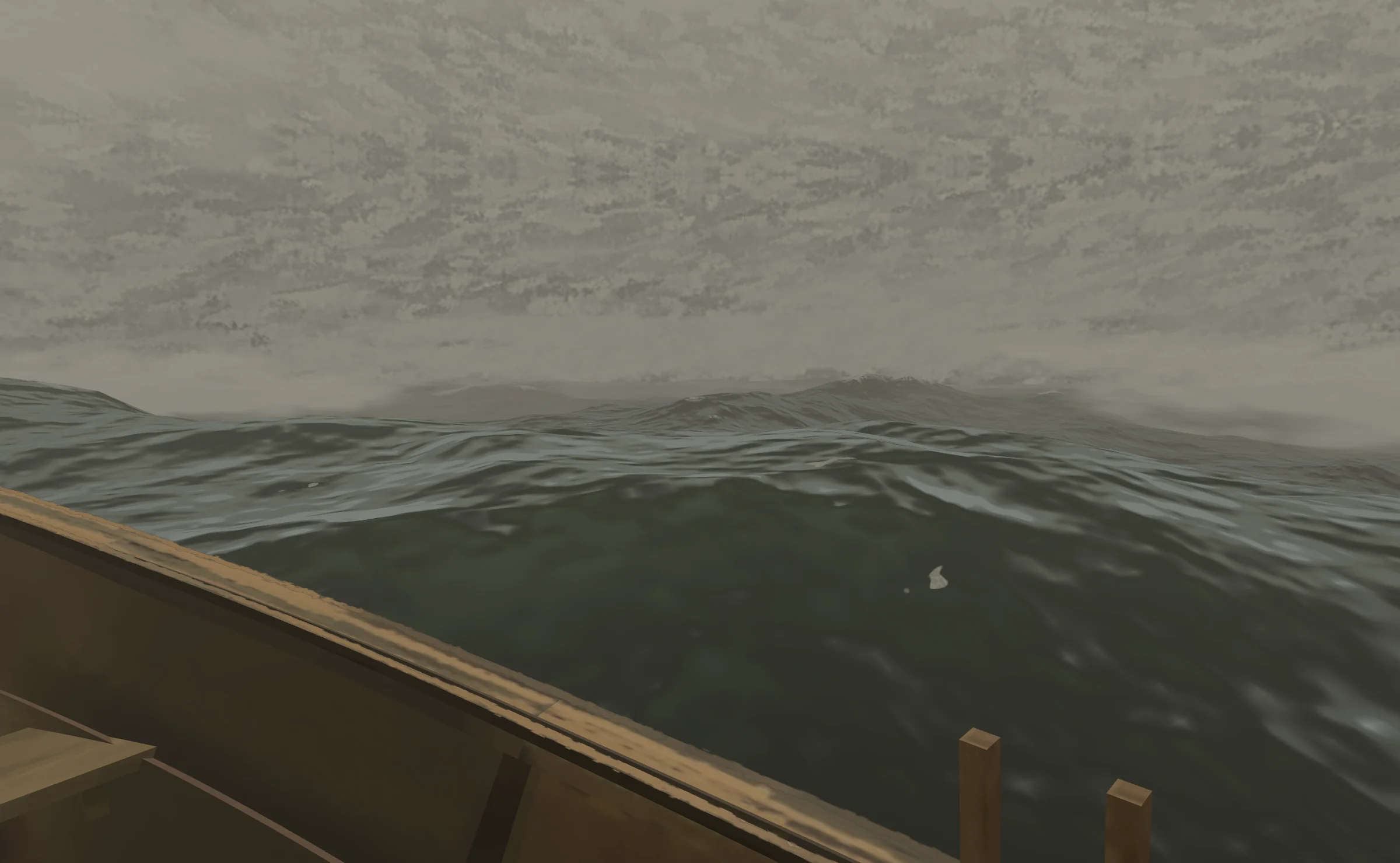
The canvas stops just before the fog. In the World it comes: the bank rises and spreads, and the ship goes first. She sounds her horn and bell. Any cello piece playing fades out, and then one called Closing thins to a held tone on the horn’s own note.
Details
In the thick of it the visitor sees between 100 and 180 metres, the bell rings, and there is no music. Then the fog thins, the ship returns, and when the calm ahead allows, a piece called Clearing closes. After a pause of one to three minutes the fog comes again, never quite the same.
Details
Past the frame
Inside the frame the boat, the man and the ship sit where he left them, a moment before the fog.
Past its edges the sea goes on with no shore. Row out, and turn back to find his view.