 On the Motif
Contents
1 · The Grand Banks, 18852 · His values and colours3 · How his strokes work4 · Where he stood5 · A sea that moves6 · Painted stroke by stroke7 · In the seat8 · What he left out9 · The fog comes and goes10 · Against his hand11 · SourcesThe Fog Warning
The case study
How a painting of the moment before the fog was read, and how a place was built from it where the fog arrives, with pictures, measurements and the failures along the way.
Pictures of the painting are the museum's photograph or drawings made by measuring it. Pictures of the World are renders and screenshots, not retouched.
1 The Grand Banks, 1885
A man in a dark sou’wester rows a small flat-bottomed boat, a dory, across a grey swell. Two halibut lie across the stern behind him. He has paused at the oars to look over his shoulder at a schooner on the horizon. Above her a bank of fog has risen, with one long streamer reaching out of it.
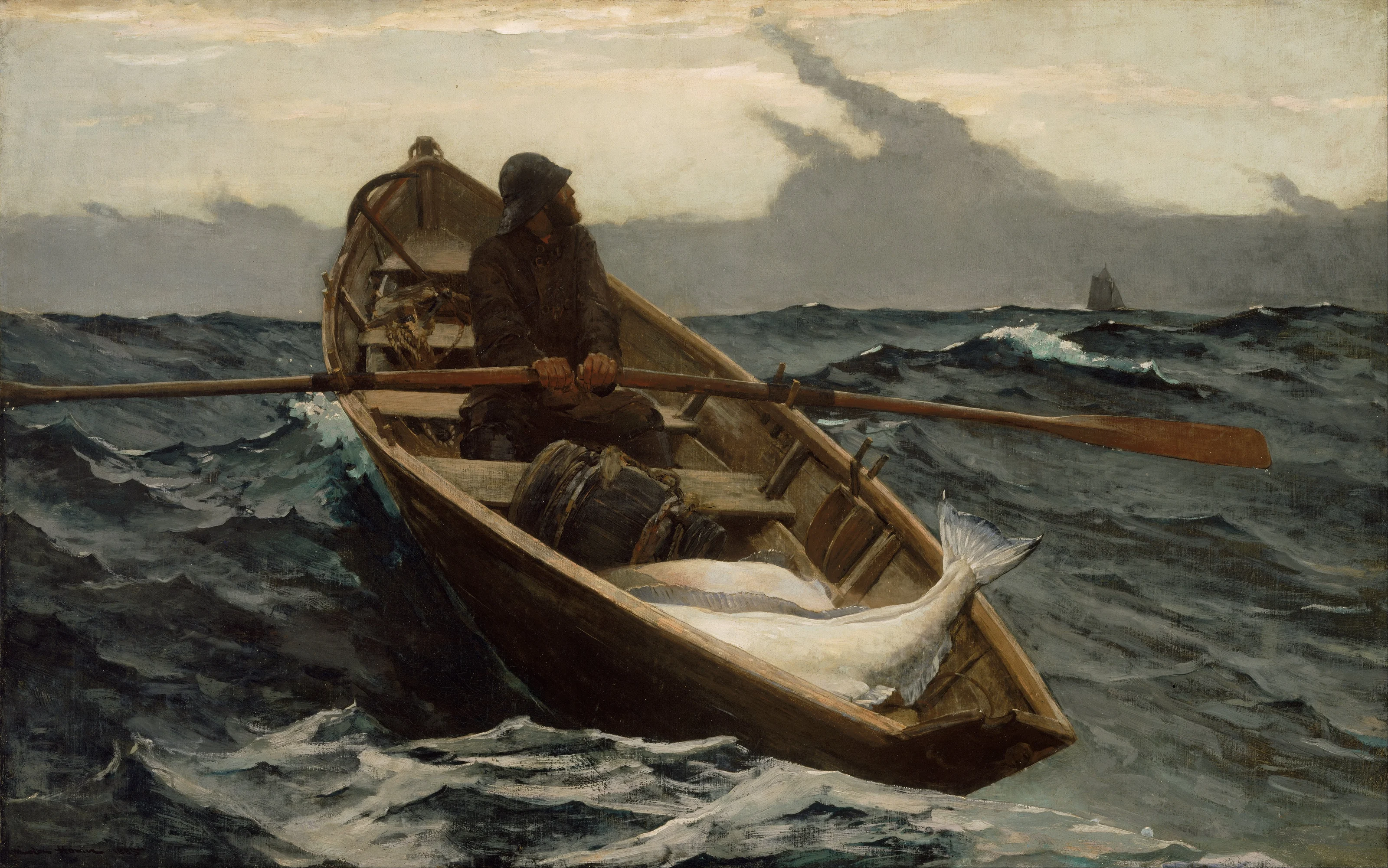
Winslow Homer painted the canvas in 1885 at Prout’s Neck, on the coast of Maine.2 It was shown in Boston early in 1886 as Halibut Fishing. That April a Boston paper noted that this title was “not given by its original sponsor. The real name is ‘The Fog Warning’”. Boston Evening Transcript, 7 April 1886, quoted by Kelly. The Museum of Fine Arts in Boston, which holds it, keeps both names.1
The work in the picture had a fixed pattern. Halibut were caught far offshore, on the Grand Banks, from dories that schooners set out to work the lines.5 The men rowed back to the ship with the catch. When fog came down, the ship blew a horn to call them in.4 Not every dory found her. In June and July, fog lies on the Banks about 40% of the time.10 Goode: 52 men “reported to have gone astray” in about two months of 1883.
So the danger here is the distance between the boat and the ship, and the fog that is about to close it. In the museum’s words, the catch is a success, but “the hardest task of the day, the return to the main ship, is still ahead”. Homer’s first biographer called the picture “a suggestion of peril in terms of studied restraint”.3
That reading shaped the World, the place on this site where the painting can be rowed through, before anything in it was built. The visitor sits in the rower’s seat and faces the stern, as a doryman does, with the fish in front and the open sea behind. To see the ship, the head has to turn, as the man’s does. The sea has no edge, and the ship stays far away. The fog Homer only hints at really arrives. The remarks quoted on these pages are the maker’s own, written down while the World was being tested.
Homer shows the danger quietly, mostly through light and dark.
Method
Dates and titles from the museum’s record and Cikovsky and Kelly, 1995. The canvas was shown twice in December 1885 with no title recorded; Halibut Fishing is documented for the Boston showing of February and March 1886. Downes (1911) reports that the picture was staged on the beach, with a man posing in a propped-up dory; he names no witness. The photograph measured is the Google Art Project copy on Wikimedia Commons, public domain, 5675 × 3550 pixels, about 46 pixels to a centimetre of canvas.6 The World shows no pixel of it.
2 His values and colours
Seen from across a room, the canvas is two pictures. Above the horizon a pale, warm sky. Below it a dark sea, a darker boat and a man darker still. Little sits between them.
That impression can be measured. Value is how light or dark a colour is, whatever its hue. It was read in CIELAB, a colour space built so that equal distances look roughly equally different to the eye. Its lightness, L*, runs from 0 for black to 100 for white, and differences below are given in points of L*. The photograph’s lightness was softened past the weave of the canvas and cut into six bands (Plate 2.1).
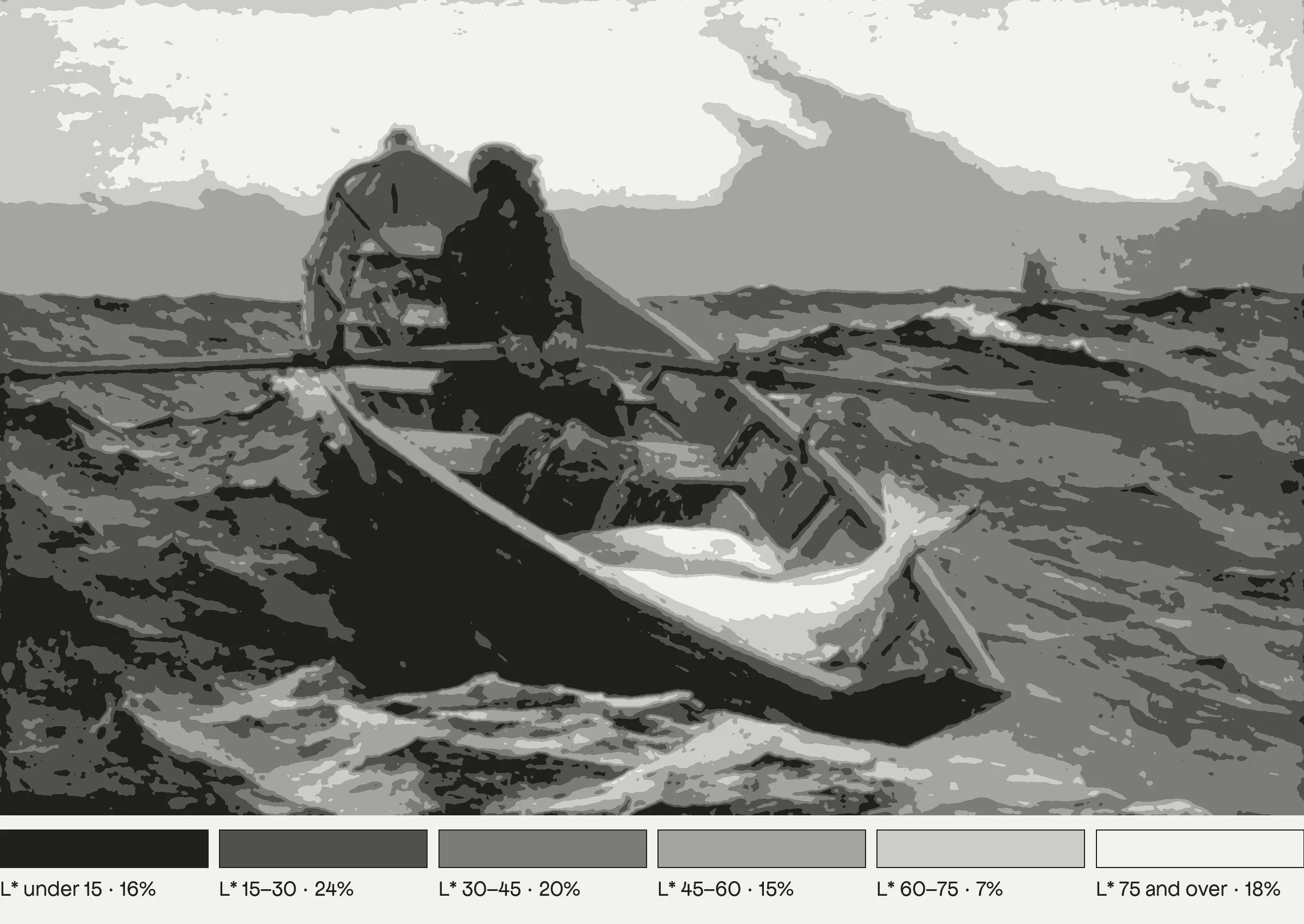
The sky sits at L* 75 to 80. The fog bank is a middle grey, lighter on the left and darker toward the water right of the ship. The sea’s middle tones sit between 23 and 34, and its troughs come close to black. The band between 60 and 75 holds only 7% of the canvas. The six bands, darkest first: 16, 24, 20, 15, 7 and 18% of the canvas.
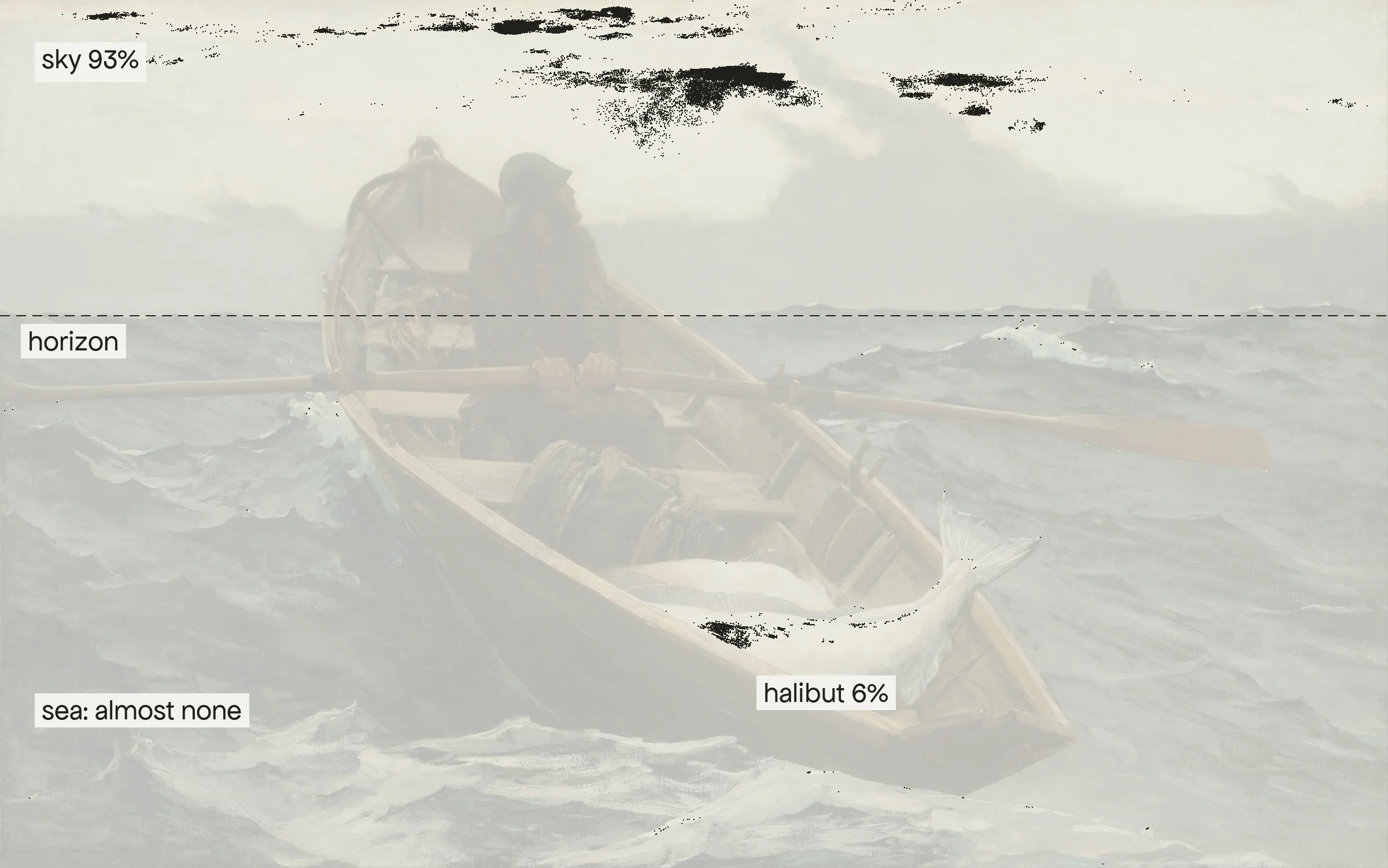
The brightest spots are not where a sea painting usually puts them (Plate 2.2). Of the brightest half-percent of the canvas, about 93% lies in the torn bright gaps of the sky and 6% on the halibut. Almost none of it lies on the water. Homer’s foam is a warm grey that never reaches white.
Colour follows the same restraint (Plate 2.3). Chroma measures how far a colour stands from a grey of the same lightness. The sea is a green slate with a chroma of only 4 to 7, close to grey. A true turquoise appears in under one percent of it, under the one breaking crest and in the splash at the bow. The only strong colours are small and warm: the oar blade, the lit thwart (the plank seat across the boat) and the man’s hands, the most saturated thing in the picture.
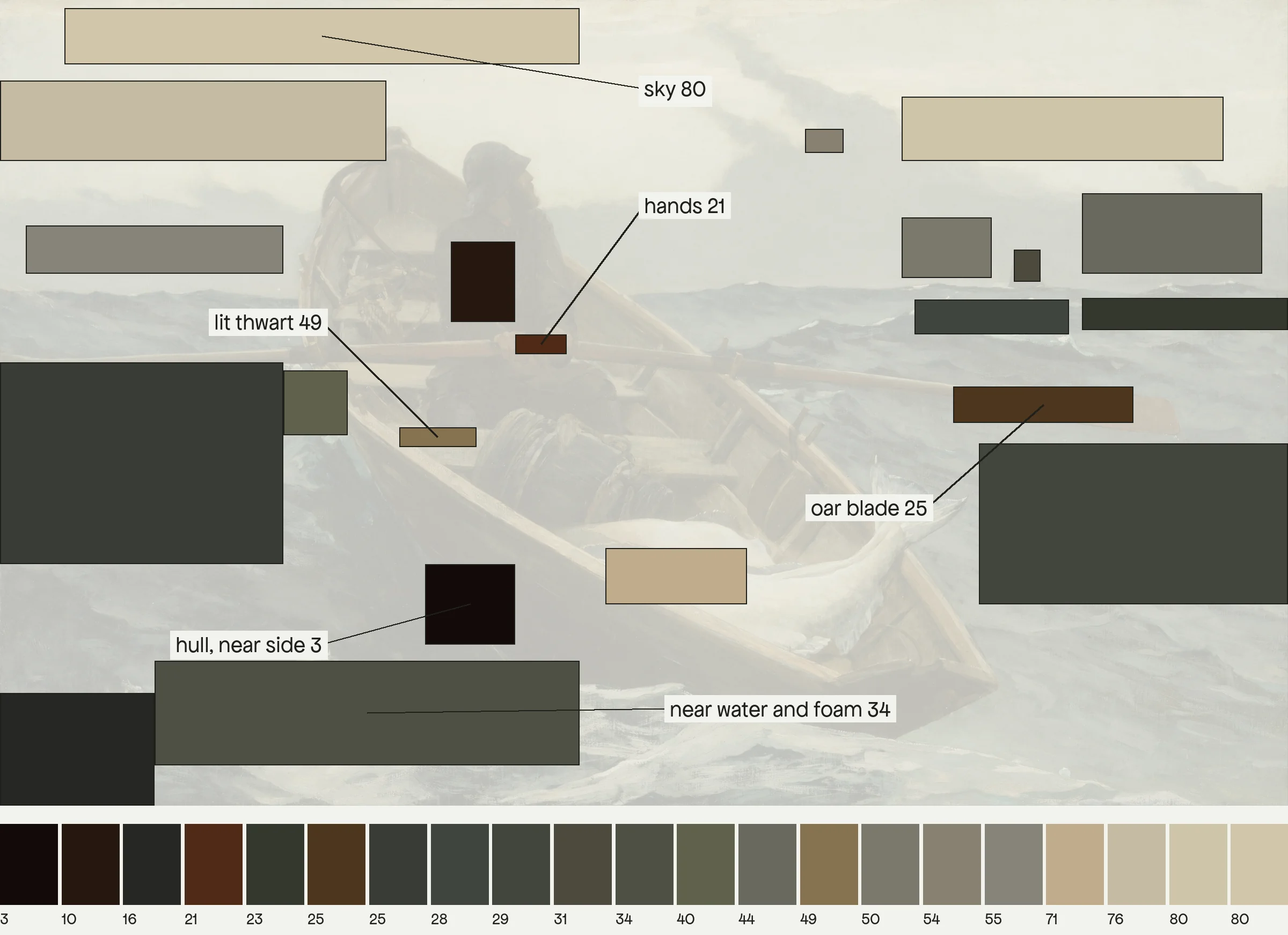
One reading is stranger than the rest. The near side of the boat measures L* 3.5, against 16 for the trough beside it, under an even, veiled sky. No real light does that. It is Homer’s paint, and later it decided how the boat was made.
These numbers gave the World its first rule. Nothing on its sea may be lighter than his sky or his fish, and the sea stays near grey.
Method
Medians per box, at about 46 pixels a centimetre. The horizon lies 35.6 to 36.7% down the canvas, rising slightly to the right. Plate 2.1: L* softened by 2.5 px at 2400 px wide. Plate 2.2: threshold L* 85.8. Sea hue 106 to 132°; chroma of the hands 25, the oar blade 22, the lit thwart 22; nothing else above 16. Turquoise: a* below −5, b* below 3, chroma above 6, 0.6% of the sea. Homer owned a copy of Chevreul’s book on colour contrast; ten predictions drawn from it were tested here, and some failed: the oar is a warm accent 55° of hue from the sea rather than its opposite, and the darkest water is a neutral black. Varnish and the photograph may warm everything, so the relations between colours count more than their exact values.
3 How his strokes work
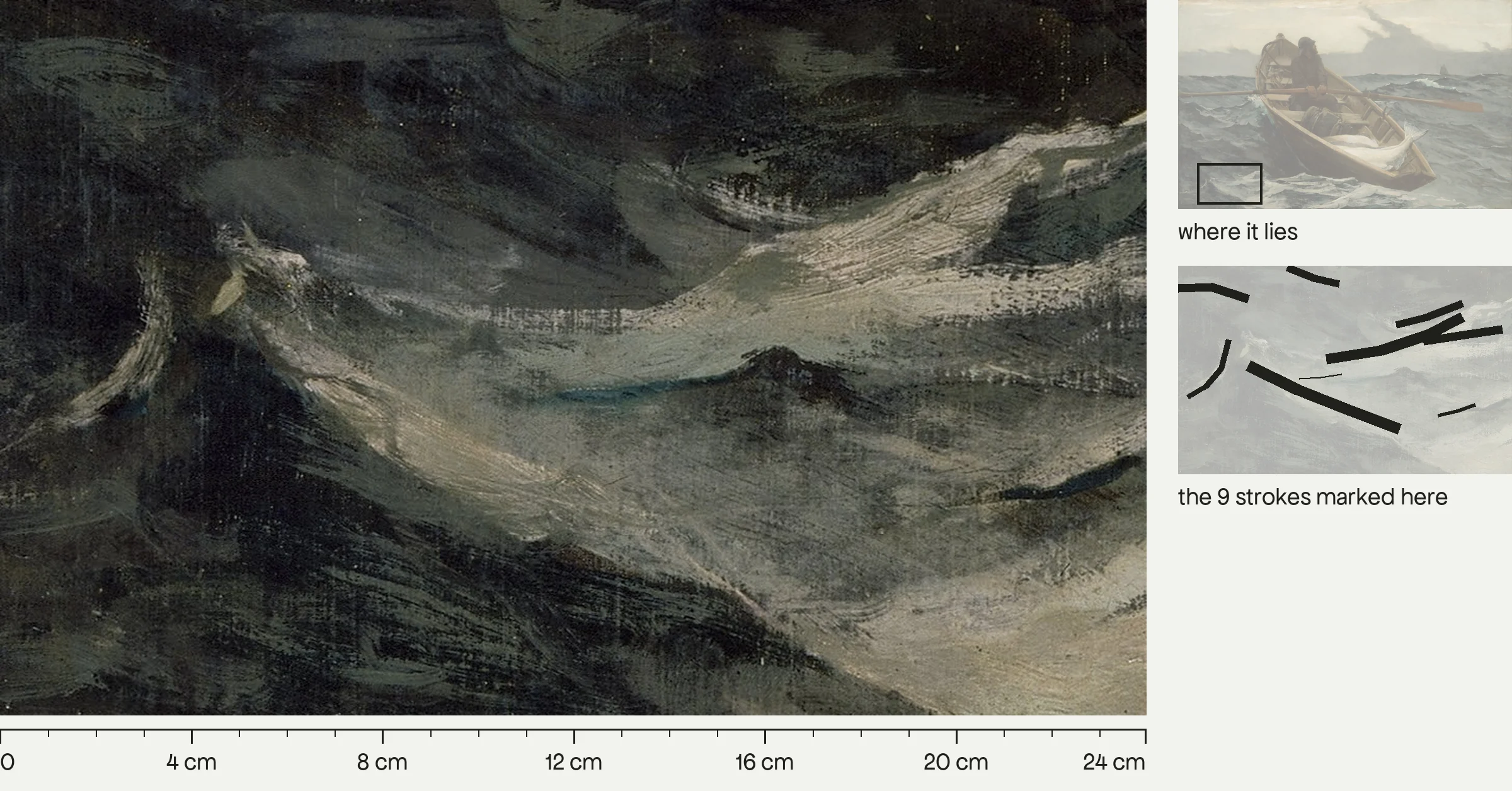
Up close the sea dissolves into marks: grey-green drags along the waves, a pale lip on a crest, a dark dash in a trough (Plate 3.2). To read Homer’s hand, those marks had to be counted before any program was allowed to guess at them.
So 164 strokes were marked by hand, point by point, on 21 full-size crops of the photograph laid over a centimetre grid (Plate 3.1). Each has a start, an end, a centre line, a width and a short description. They are a ground truth: a set of known answers that any later method is tested against.
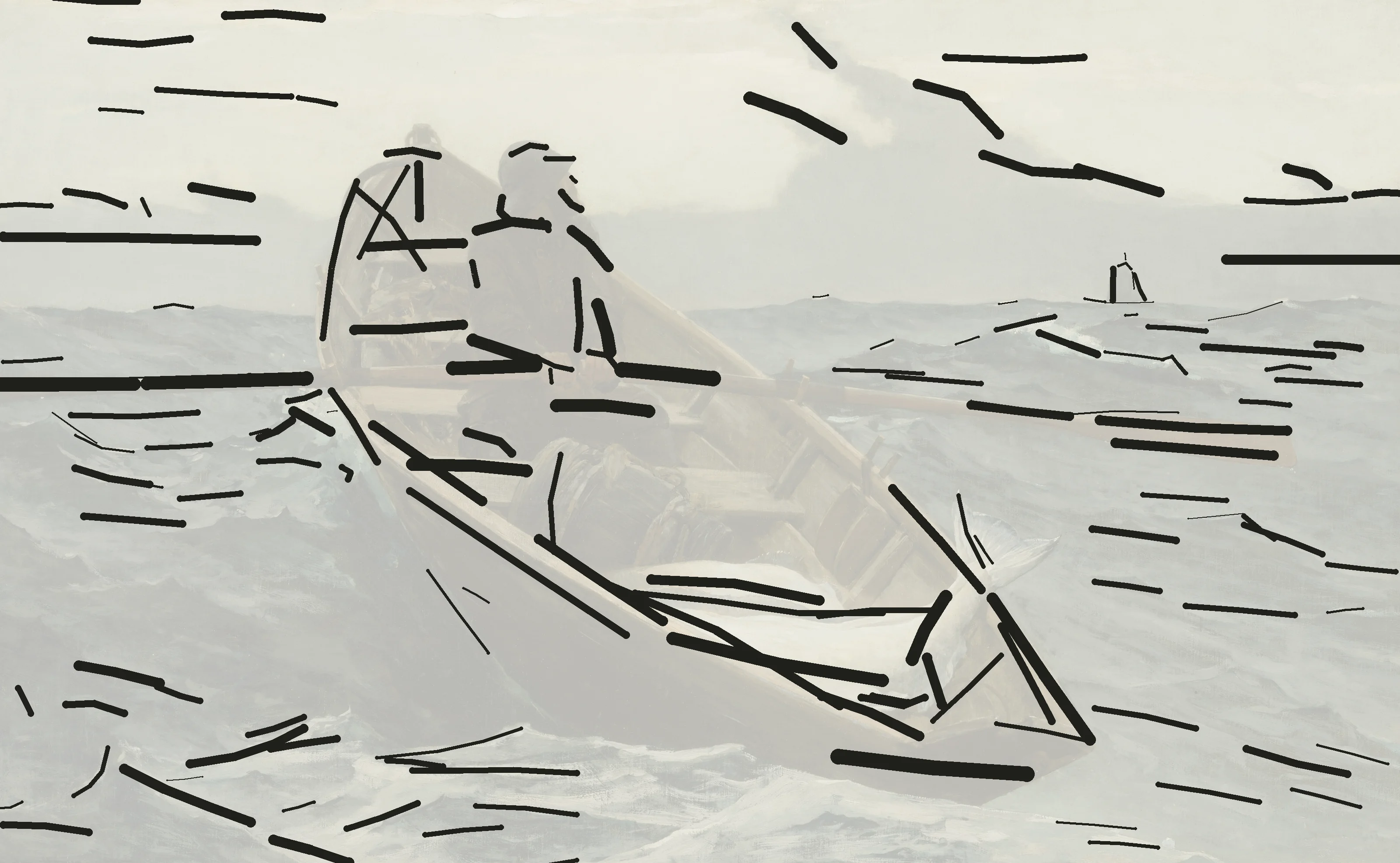
The marks sort themselves by what they describe. The rail, the oars, the halibut and the hull are his longest strokes, 9 to 12 cm at the median, some pulled 22 cm or more in one go. The man, the schooner and the crest lips are his shortest, 2 to 3 cm. The sea’s own drags sit between them, at 4 to 7 cm. In the dark troughs a warm brown layer shows through the thin grey-green above it.
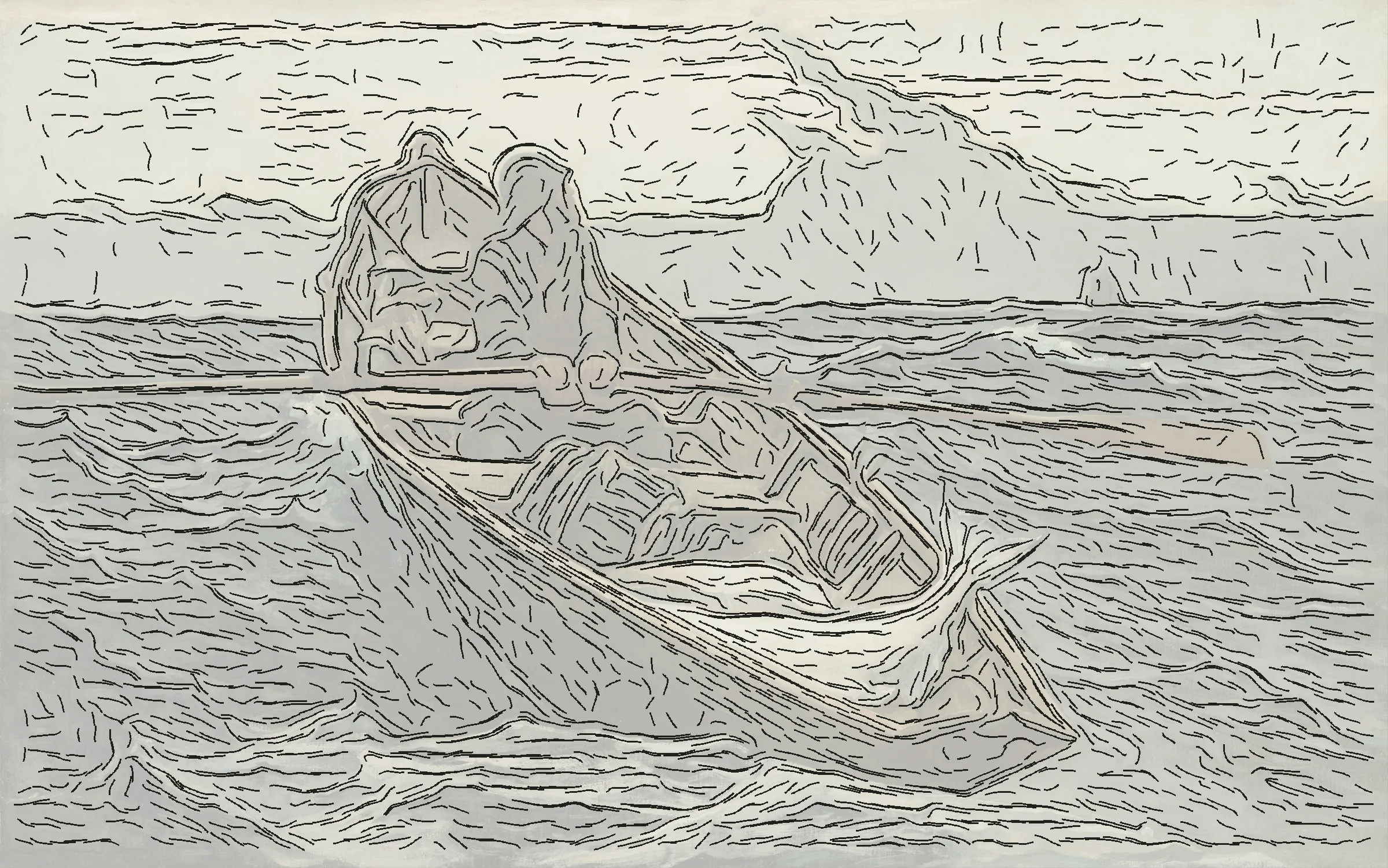
The direction of the paint was then measured across the whole photograph (Plate 3.3). At every point the method looks at how lightness changes nearby: sharply across a stroke, hardly at all along it. The direction of least change is taken as the direction of the brush. Against the hand-marked strokes it is right within 7° at the median. It follows the planks, the oars and the streamer. On the man it fails: the folds of his coat turn faster than the method can see. 87% of the marked strokes lie within 20° of the field; on the figure, 41%.
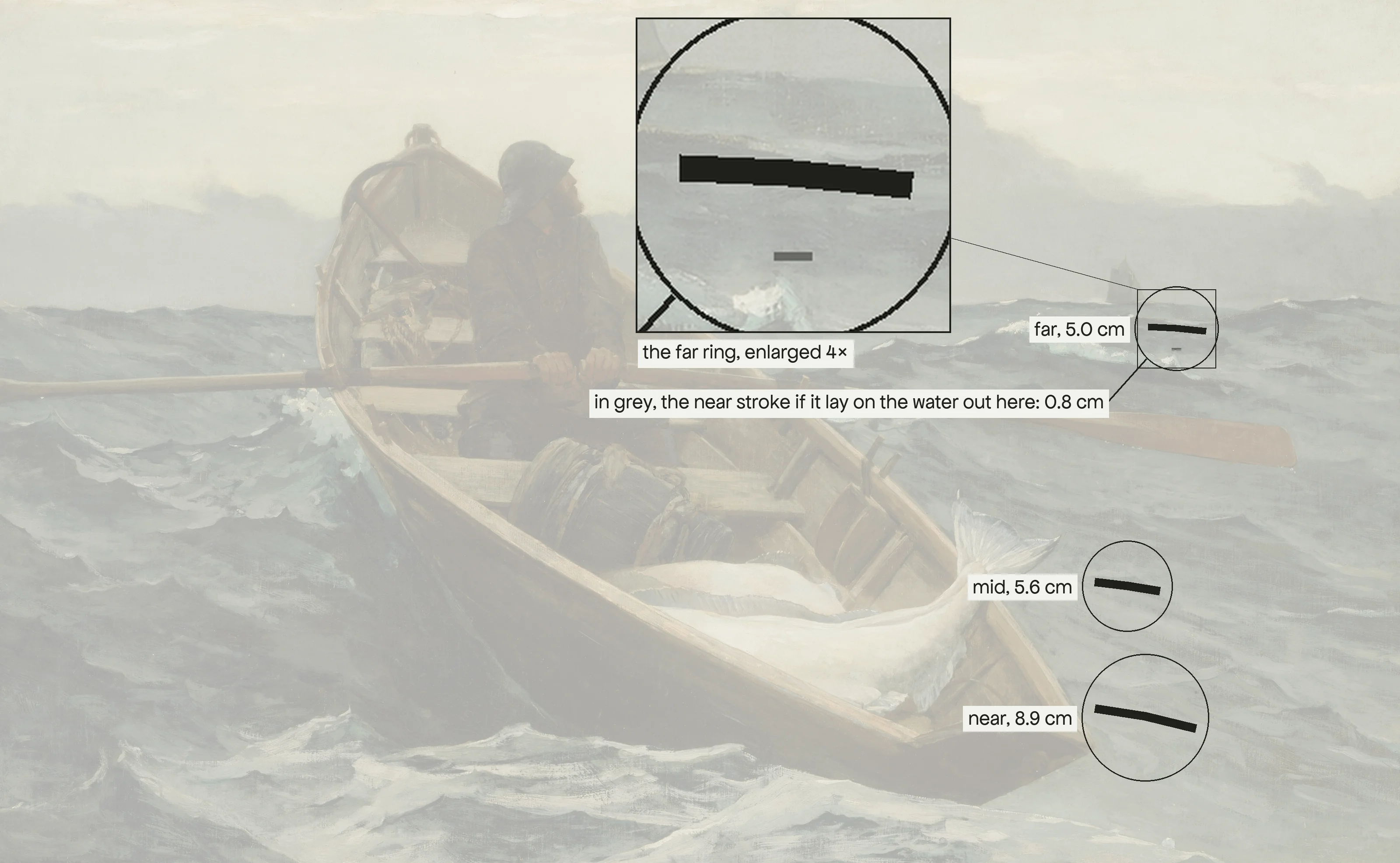
The measurement held one surprise. In a picture of a sea seen in depth, the marks on the far water should be far smaller than the near ones, as the waves are. They are not (Plate 3.4). Measured on the marked strokes, his far marks keep about two thirds of the length and width of his near ones. If they had been laid on the water at a fixed size, they would keep about a tenth. The likeliest reading is that he sized the sea’s marks to the canvas, and let the shapes of the waves carry the depth.
What he leaves out matters as much. There is no glitter of sun on the water, no reflection of the boat, no spray in the air, no rigging on the ship, no cast shadow and no outline. Edges come from value alone: the boat’s dark side melts into the dark trough beside it.
To row inside the picture, everything in it needs a position in space, starting with where Homer stood.
Method
Marks: 164 strokes on 21 crops at 1:1 with a grid, ends about ±2 mm, before any extractor was written. Medians by kind: sea near 6.5 cm long and 0.48 cm wide, middle 5.5 and 0.43, far 4.4 and 0.33; a profile across each stroke measures them about twice as wide, so his sea marks are likely 0.5 to 0.9 cm wide near and 0.3 to 0.55 far. An earlier estimate of 1.3 to 2.6 cm for the near foam measured bands of two to four drags. Shrink with depth, far against near: length 0.67, width 0.69 and 0.61, against 0.09 for marks fixed on a flat sea seen from his solved camera. Direction: a structure tensor on L* at half resolution, its scale set per kind of mark from the marked widths; median error 6.6°. The warm layer: olive-brown at hue 68 to 92°, 1.3 to 4.2% of the open sea, mostly in the dark trough drags. Tracing strokes along the field found about half of the marked sea strokes, as on Wheat Field, and merged neighbours, so the marked sizes are used.
4 Where he stood
The canvas gives two strong clues to its viewpoint. The horizon is a little over a third of the way down, so the eye is low. The dory’s bow rises high on the left and its stern comes close at the bottom right, so the boat is near and tilted on a wave.
The rest was solved. A virtual camera and a boat of true size were moved together until the boat’s stem (the upright timber at the bow), its stern post, its thole pins (the wooden pegs the oars swing on), both gunwales (the top edges of its sides) and the horizon fell as close as possible to where he painted them (Plate 4.1). The fit puts the eye about 7 m from the boat and less than a metre above the water. The bow is lifted 15.5° on a wave, and the boat rolls 4.5°. At the size he painted her, the schooner is about a kilometre off.
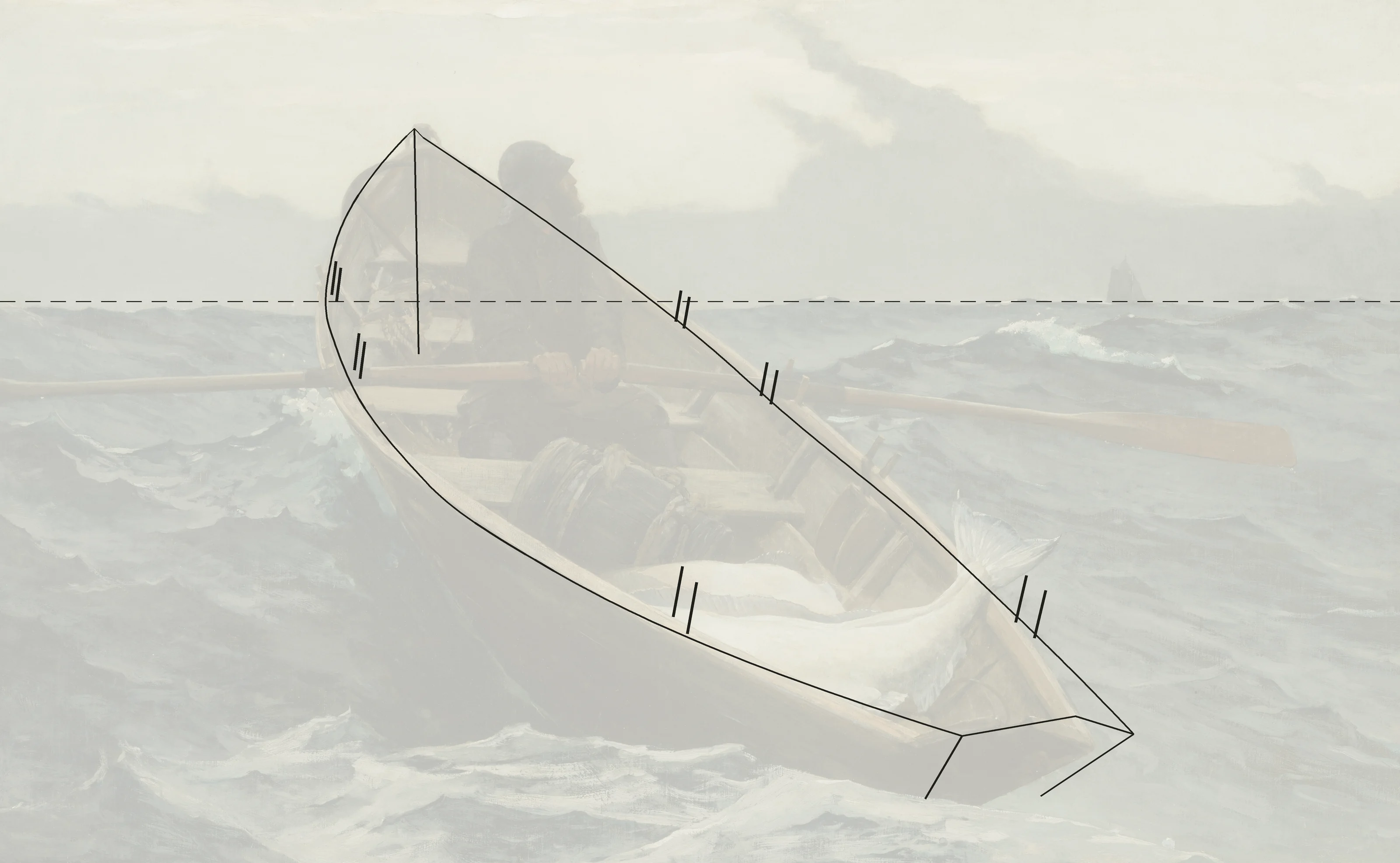
The boat in that fit is a real one. Its lines come from the offsets of a Banks dory, sixteen feet on the bottom, drawn at the Portsmouth Navy Yard in 1884.7 Offsets are a table of widths and heights taken at stations along the hull, the form in which builders record a boat’s shape. Built from them, she is 6.10 m overall, with a flat bottom and three overlapping planks a side: true size, which fits halibut of 1.5 m.
The rower was measured against that boat. Scaled from the spread of the thole pins, the man’s shoulders are about 0.45 m wide, 1.6 times the height of his head, where the ideal figure of the drawing manuals is 2⅓. He is slight. His pelvis sits square, his chest turns about 26° to his left and his head about 60° more, chin lifted toward the ship. Loomis, Figure Drawing for All It’s Worth, 1943. Homer painted the hands about 1.6 times life size.
With the view fixed, the boat, the man and the sky could be built. The sea needed another approach.
Method
Least squares on the stem, stern post, thole pins, both gunwales, the tub and the horizon. Final fit: camera 7.05 m off, bow up 15.5°, roll 4.5°, a vertical view of about 26°; the stern post lands 21 px from his at 1599 px wide, the stem 6 px. A first fit on guessed lines missed the stern post by 37 px. The ship’s distance assumes a 25 m rig; the fit gives 1.06 km, and the World holds her at 1.2 km. The offsets are those printed by Gardner, p. 147; Chapelle’s 1881 table was not found online. The stem is drawn straight, where his curves a little. The figure was measured following Loomis, Bridgman and Hampton.
5 A sea that moves
A painted sea cannot move, and this one has to carry a boat. Strokes fixed to moving water would swim across it, and strokes fixed to the screen would slide over the waves. So the water is computed, every frame, and everything that does not move by itself stays painted.
The method is the one used for film and game oceans, published by Jerry Tessendorf.12 A real sea is the sum of many waves of different lengths and directions. The method draws thousands of them from a spectrum, a measured description of how much energy a given wind puts into each wavelength, and adds them up on the graphics card with the fast Fourier transform (FFT), a quick way to sum many waves at once.
The first seas failed by looking like something else. An early sea, even with its waves steepened toward his, read as “more like a texture than real waves”. The cause was measured: ripples a few centimetres high held 43% of the surface’s slope, and the lighting turned slope into almost the whole range from dark to light. The work then turned to teams who had built whole games on water. Their talks, papers and open code were read for equations, constants and stated failures. The advice they gave was to copy one proven method exactly, and add style only where its makers had.
That advice did not hold at first. On 7 November, seven rounds of tuning brought the sea closer to his values, one layer of waves at a time, on a base made for a calm sea. The next morning it was turned back the same way: a texture with a wave laid on top (Plate 5.1).
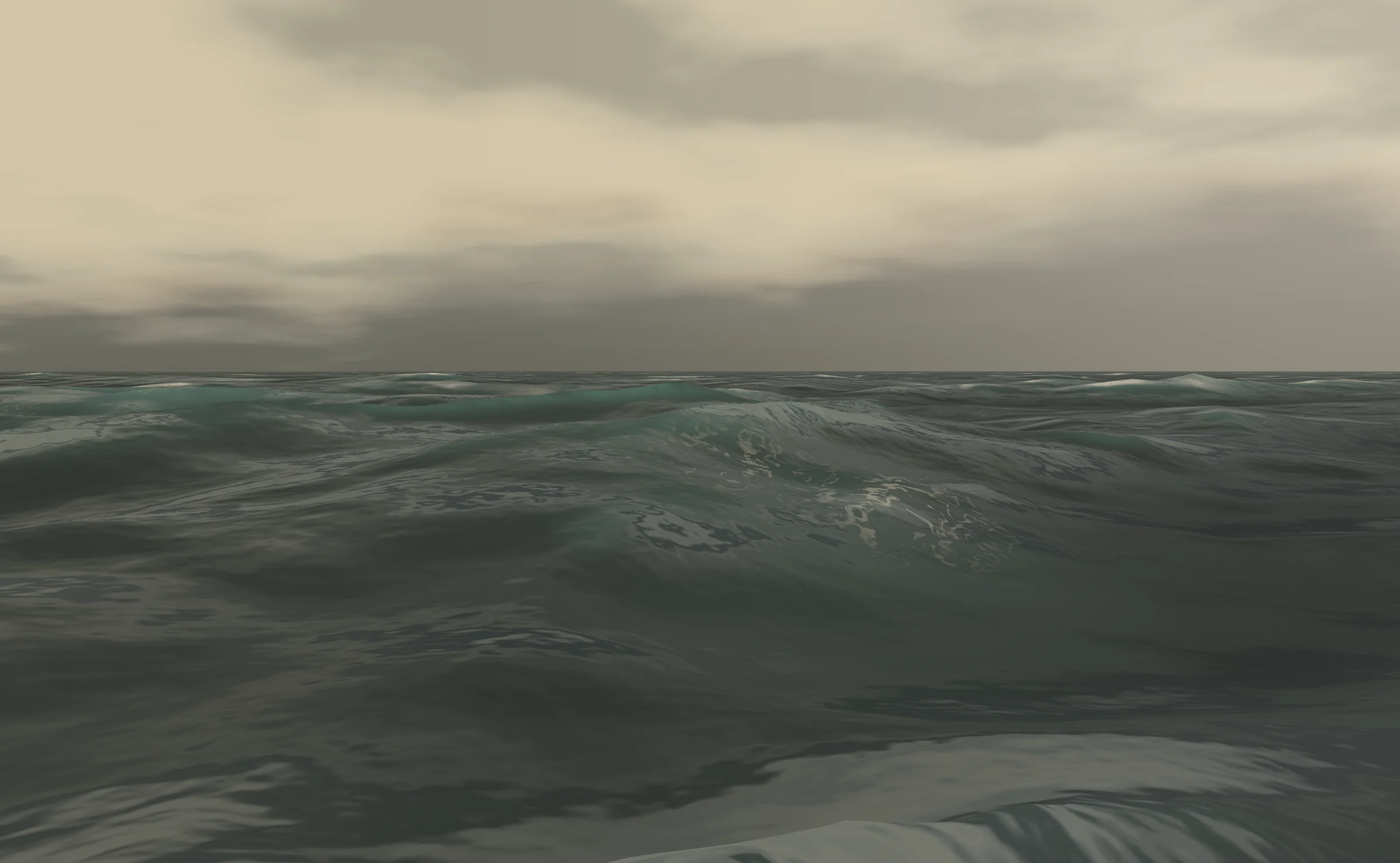
So the sea was started again, based on the published methods of Sea of Thieves, a game known for its sea.13 It is one sea from one wind, about 12 m/s over 20 km of open water, which gives the short spacing of his crests. Every wave was then doubled in height, by eye against his crests, to about 2 m. Its foam went wrong. Foam painted from Homer’s own marks was turned back with a plain instruction: “make real foam”, and leave the painting for later. Real foam, built following the game’s method, kept drawing as flat cream sheets with paper edges.
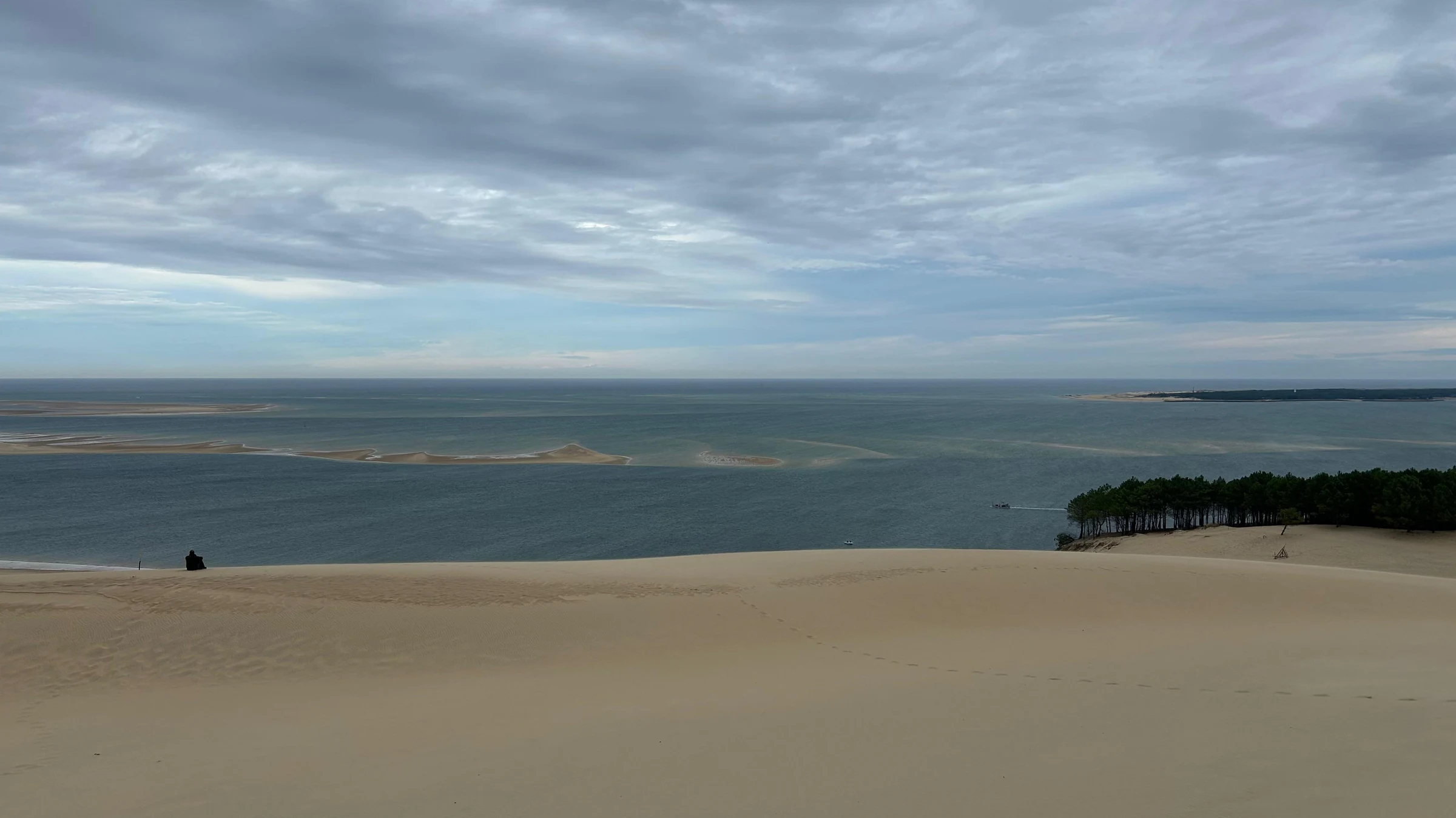
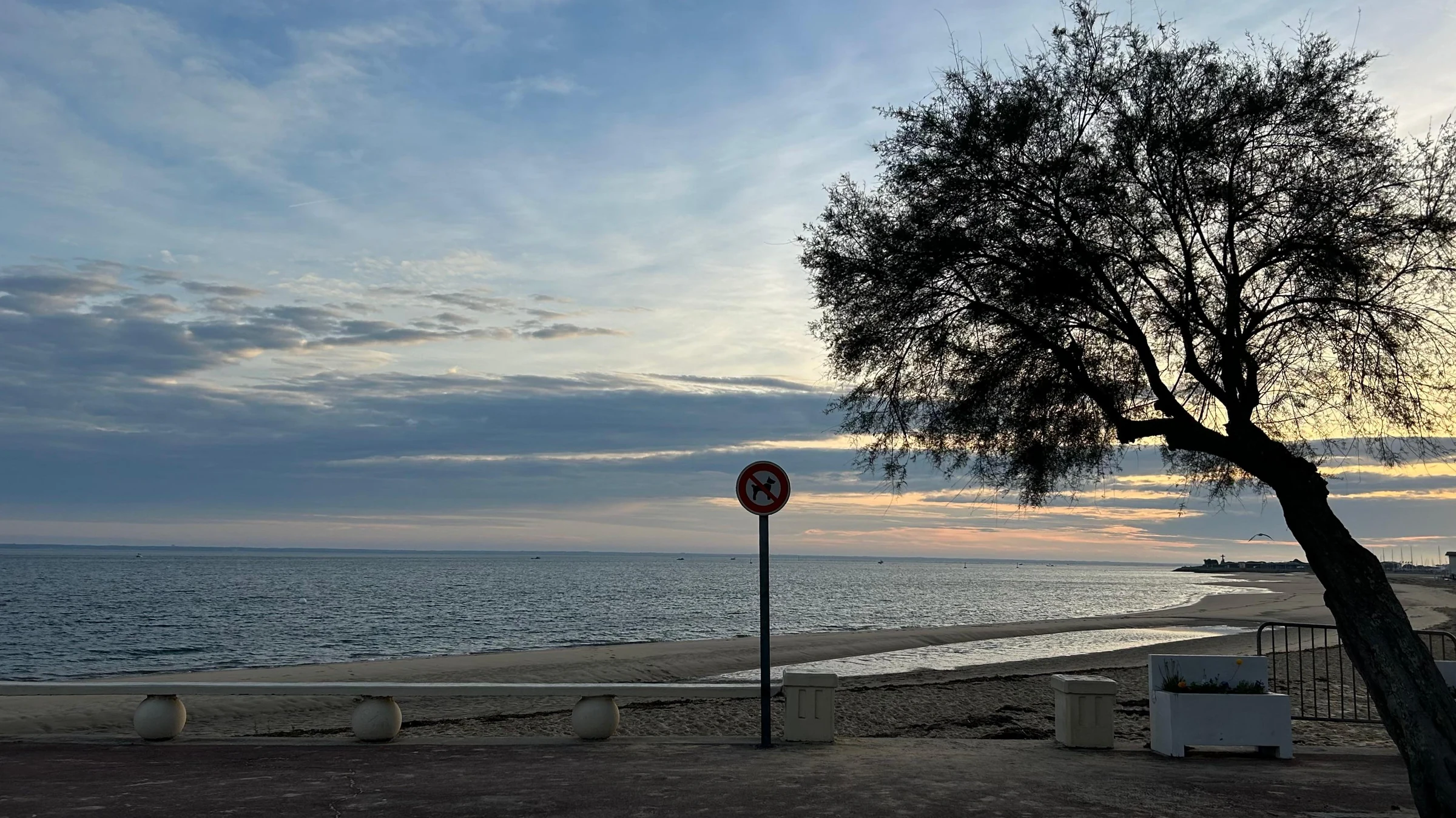
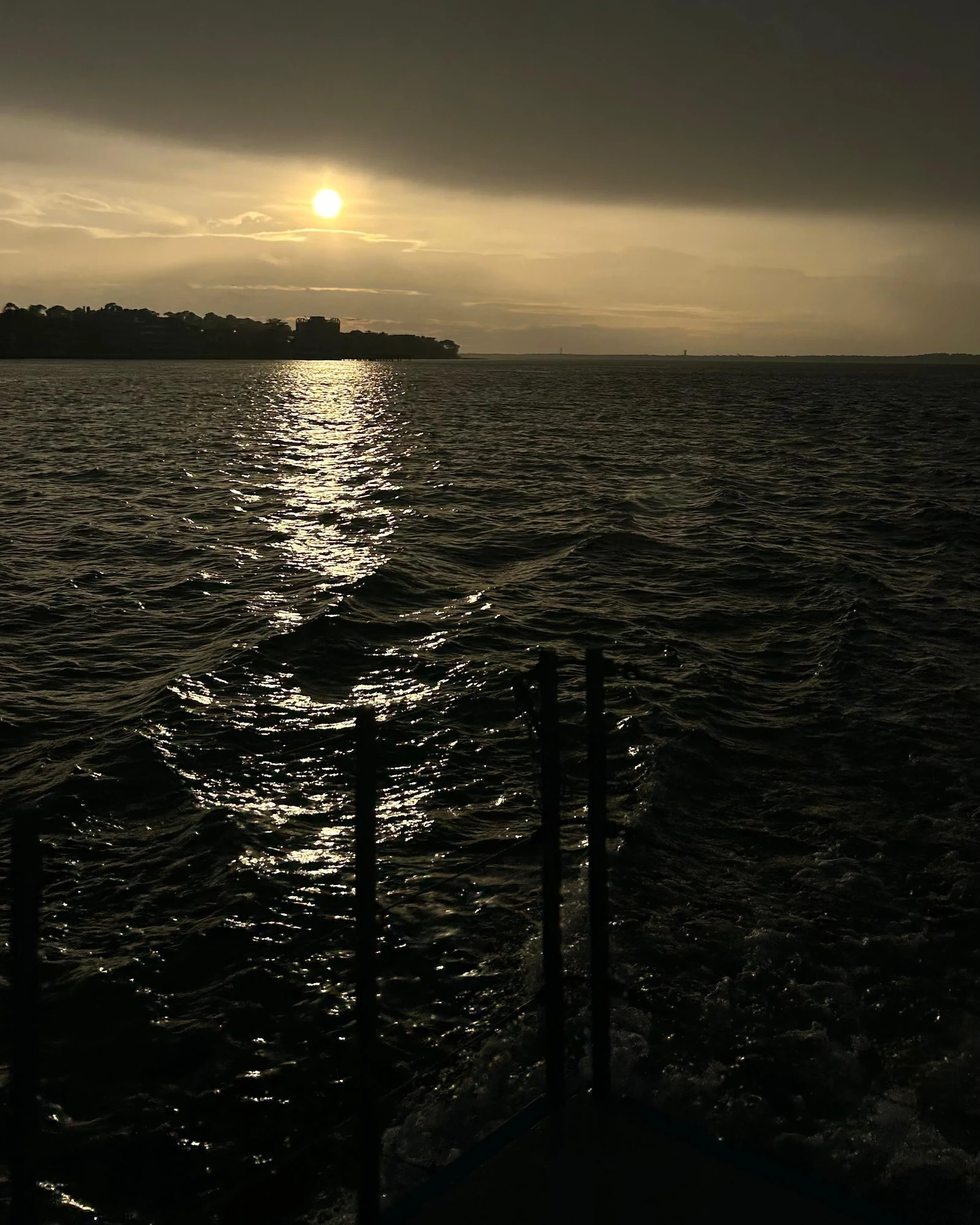
On 9 November my wife took me to the Dune du Pilat, at Arcachon, near Bordeaux. We went there to see the sea and the dune. By then I had tried one ocean library after another, and still could not say what was wrong with my waves. That morning in Arcachon was beyond dreamy, one of the best moments of my life, and I was simply glad to be there with her. And there it was, the real sea, close enough to watch wave by wave. Nothing I had built looked like it. I came home knowing how a sea should look. For that, and for the morning itself, I am grateful to her.
The search went on for two more days. A borrowed wave set was tried: an open-source ocean, rebuilt line by line and matched to its original frame for frame.16 From the seat its waves had weight, but its sea was far too big for a dory, and scaled down, its surface folded on itself. Rebuilt instead from published spectra, the sea came out as a flat plain with a crumpled, paper-like texture.
On 11 November the goal changed. The sea no longer had to match the game. It only had to be believable and good to look at. Judged that way, the sea restarted from one wind already passed: “only the foam was an issue”. It was kept, and its foam was redrawn as a lace born at the crests and worn into threads (Plates 5.3a and 5.3b).15
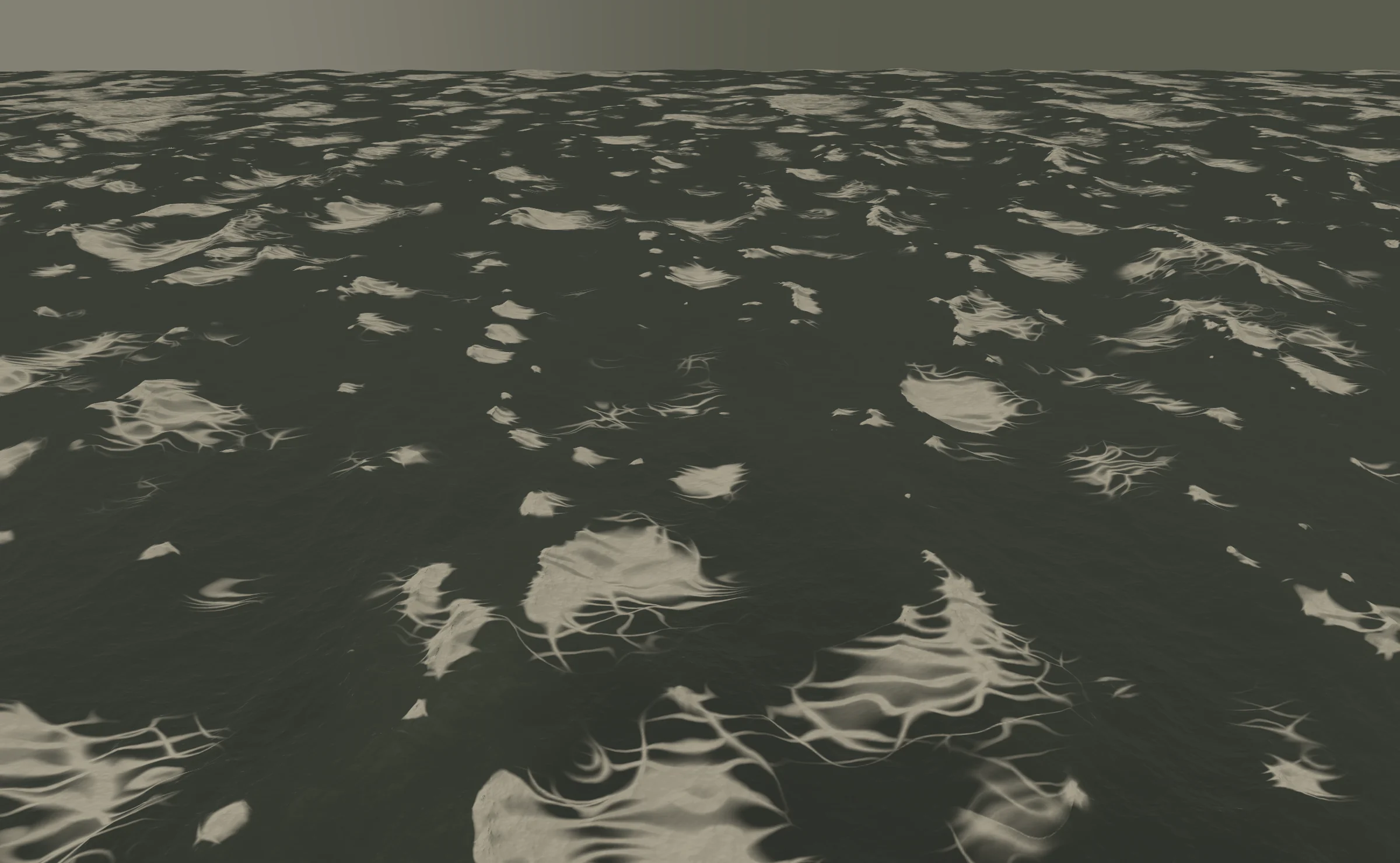
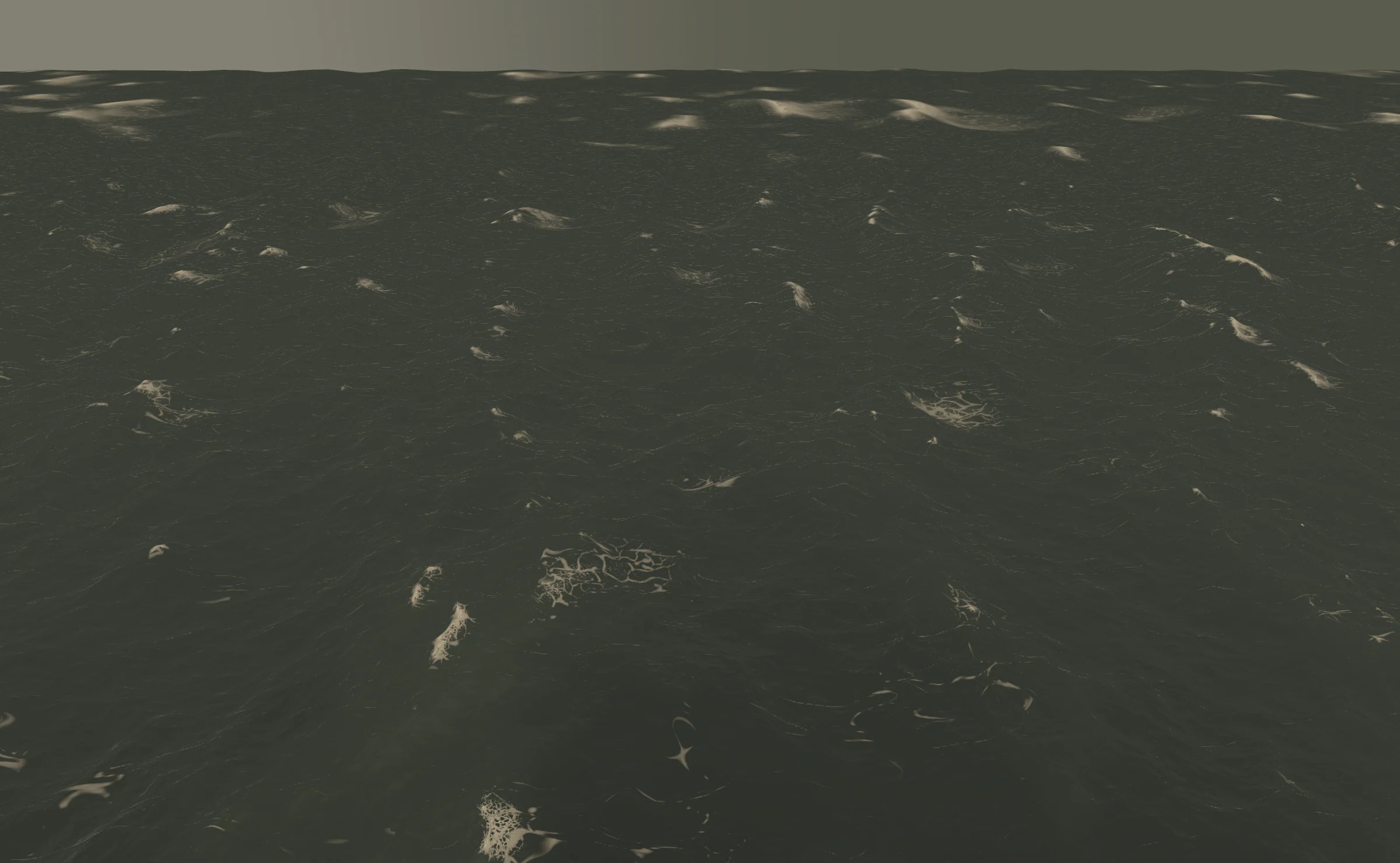
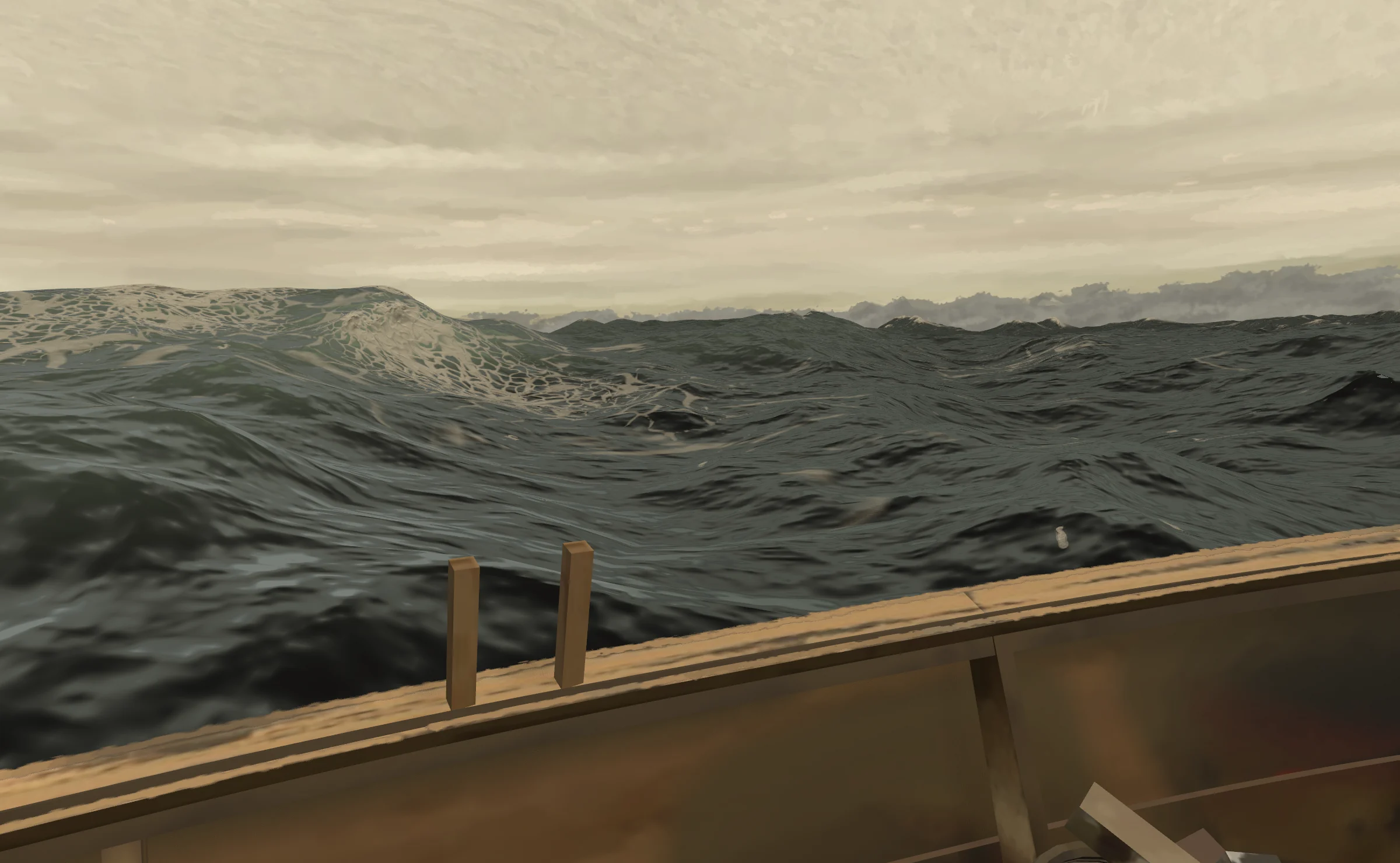
Its darks were matched to his values last. A grey haze added to fade the distant water was also lightening the near water, so it was kept to the reflected sky alone. Homer’s marks were left off the sea on purpose. Marks painted on the screen would stay there while the water moved under them, and the brushes tried on the sea did not suit it.
Method
Spectrum: JONSWAP (Hasselmann et al. 1973) with Hasselmann’s directional spreading, following the open GodotOceanWaves;14 light following GodotOceanWaves and the GDC talk on water in Atlas;17 foam injected where the surface is squeezed, kept and blurred, as in Rare’s talk, with its lace following Crest. A young sea from wind 12 m/s over 20 km is about 1 m high at true scale; doubled, about 2 m, steeper than real seas of its period. The foam fix also corrected three faults in the code; foam in view fell from 8 to 12% of the sea to 1.5 to 4%, near the 5% whitecap cover of a sea this rough. About 6 ms a frame on WebGPU, the browser’s newer interface to the graphics card, through three.js.21 The borrowed set is Poseidon, MIT licence; nothing of it ships. The darks at his view, his canvas against the World in the calm, in L*: the near water’s darks 9.5 and 13.3, open middle water 27.8 and 29.7 (Plates 10.1a and 10.1b).
6 Painted stroke by stroke
Everything in the World that the sea does not move is painted by a real brush engine. libmypaint, the open-source engine of the MyPaint program,19 lays every mark from a list of instructions: where a stroke starts, the path it follows, its pressure, its colour and its brush. No image-making model touches a pixel, and no pixel of Homer’s photograph is shipped.
The dory came first. A boat drawn on guessed curves was narrow, paper-thin and pointed at the stern. It was refused and rebuilt in Blender,20 plank by plank from the 1884 offsets, as a Banks dory is built: lapped strakes (the planks of the sides), frames, risers (the strips the thwarts rest on), thwarts and thole pins where the drawings put them (Plate 6.1a). It was judged “better than before”, and kept.
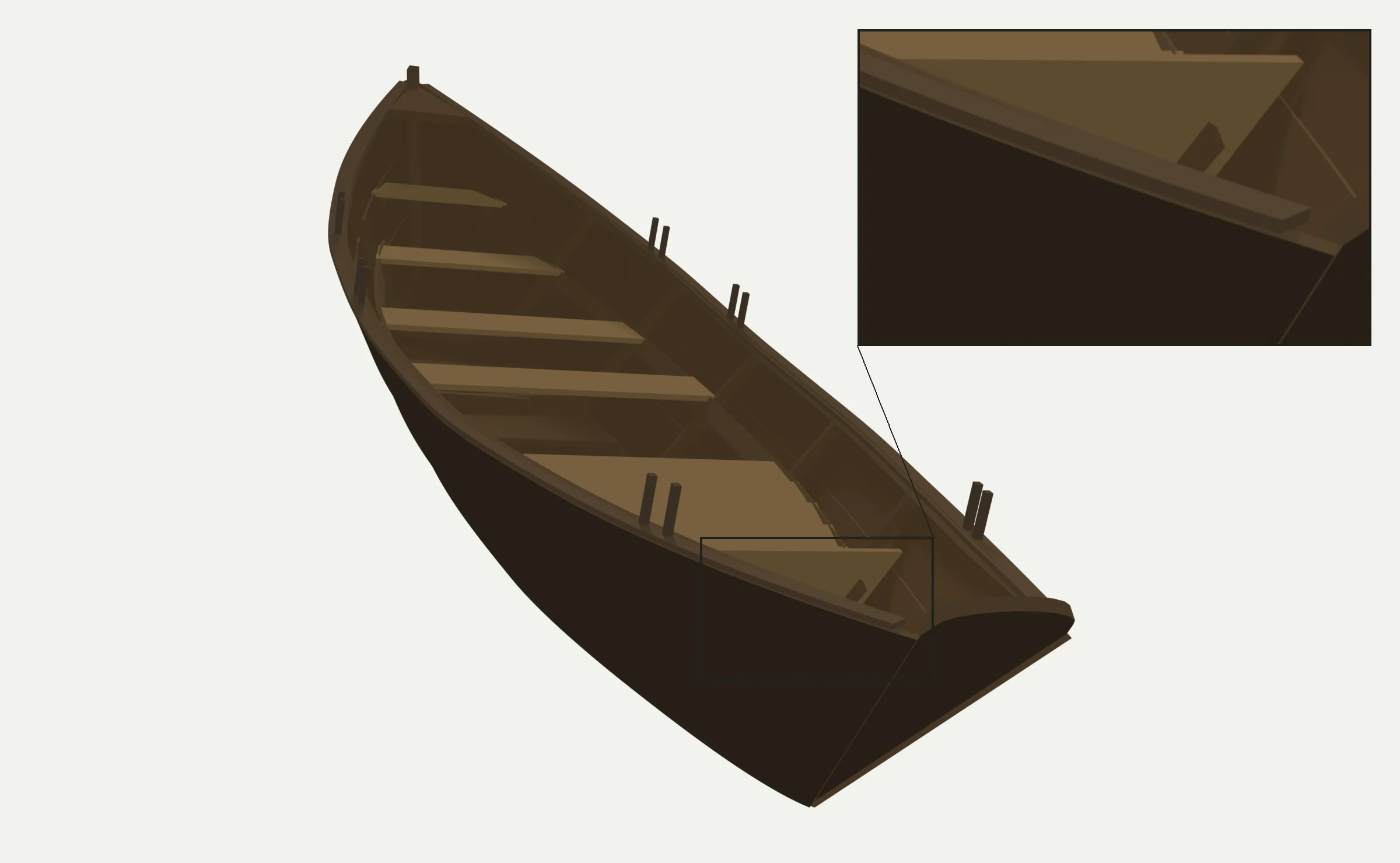
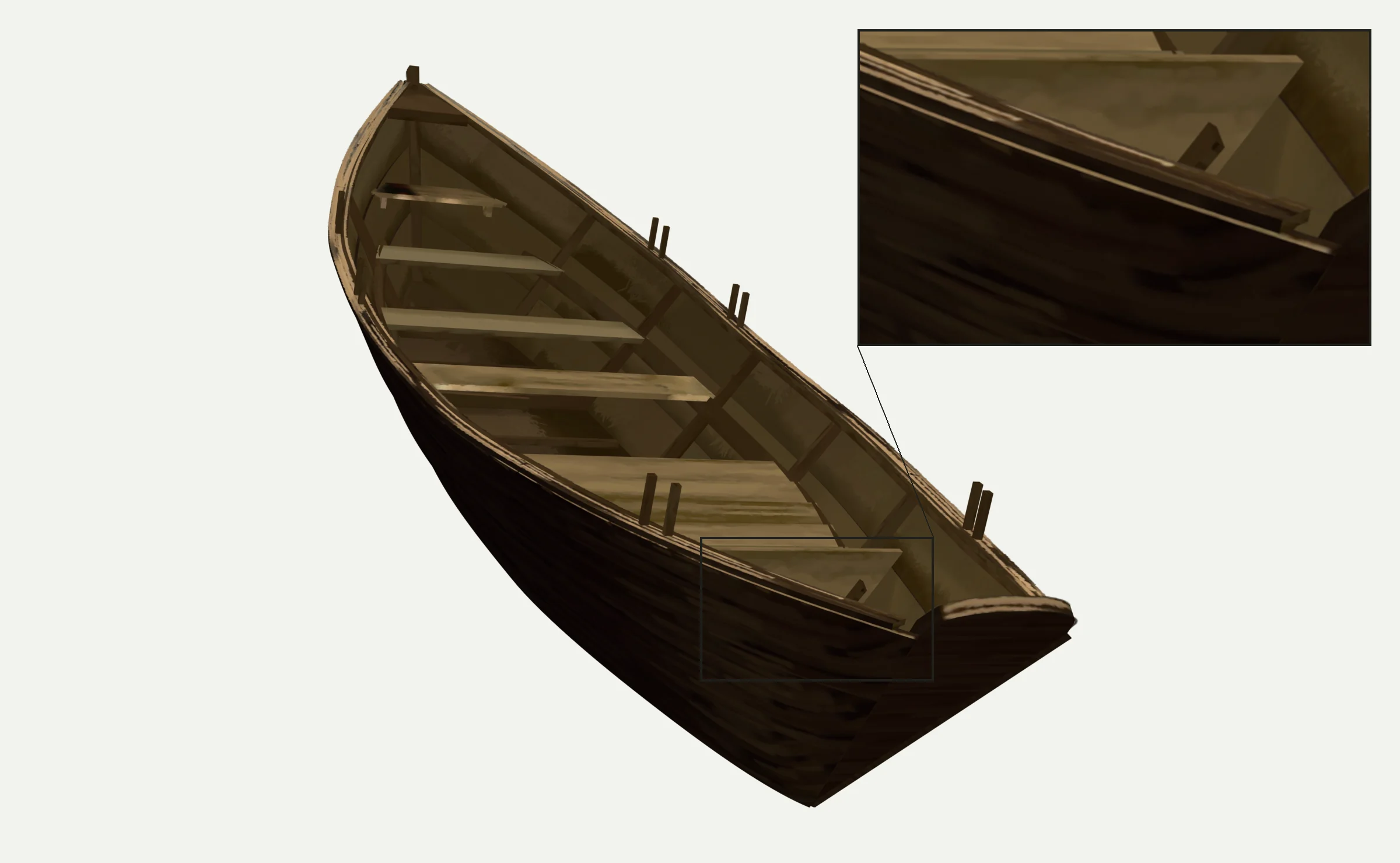
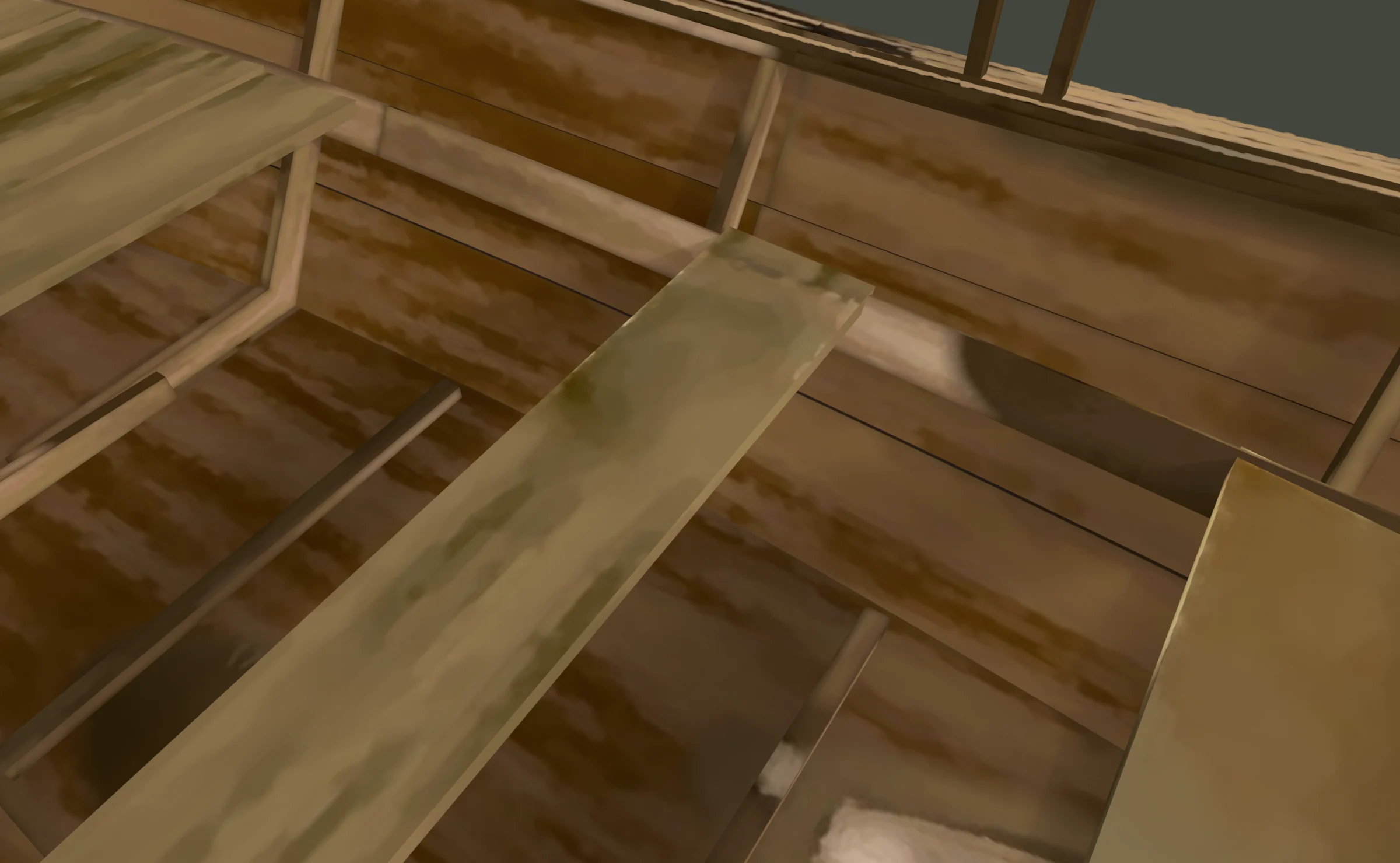
His hull is darker than the water around it, and no lighting could produce that. So its darkness is painted onto it. Each plank was unwrapped into one straight strip and painted along its grain, in colours measured on his boat. Two brushes were chosen from a board of thirteen: a soft one for the dark hull and the shaded inside, a dry one for the lit thwarts and rails (Plate 6.1b). At arm’s length the strokes read; closer, they soften (Plate 6.2).
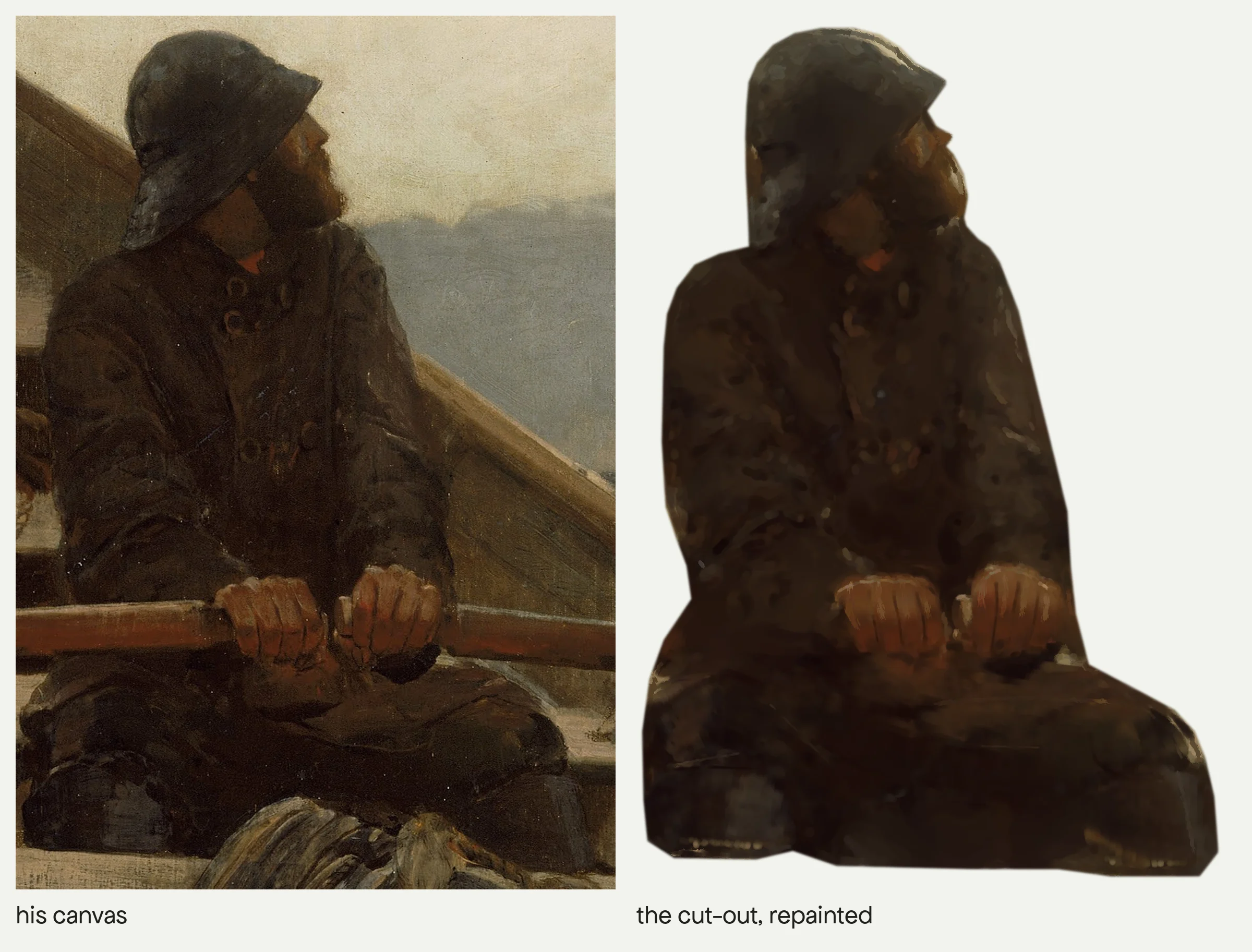
The man took longest. Bodies modelled to stand in for him were refused: the belly was “a potato-like thing”, the hat “like a police hat”. Rebuilt layer by layer from his measurements, the figure matched his outline and still did not look like him. So at Homer’s view the rower is a flat cut-out, like a stage flat, repainted by libmypaint in 39,342 strokes, every colour sampled from the canvas (Plate 6.3). Lightness, the painting’s and the cut-out’s: hat 22 and 23, face 31 and 30. As the view leaves that spot, the cut-out fades.
A schooner was modelled from the measured drawings of a fishing schooner of the period.8 At a kilometre she is what he painted, a flat grey shape with no rigging, so the World shows her as a cut-out of the same kind, repainted from the canvas.
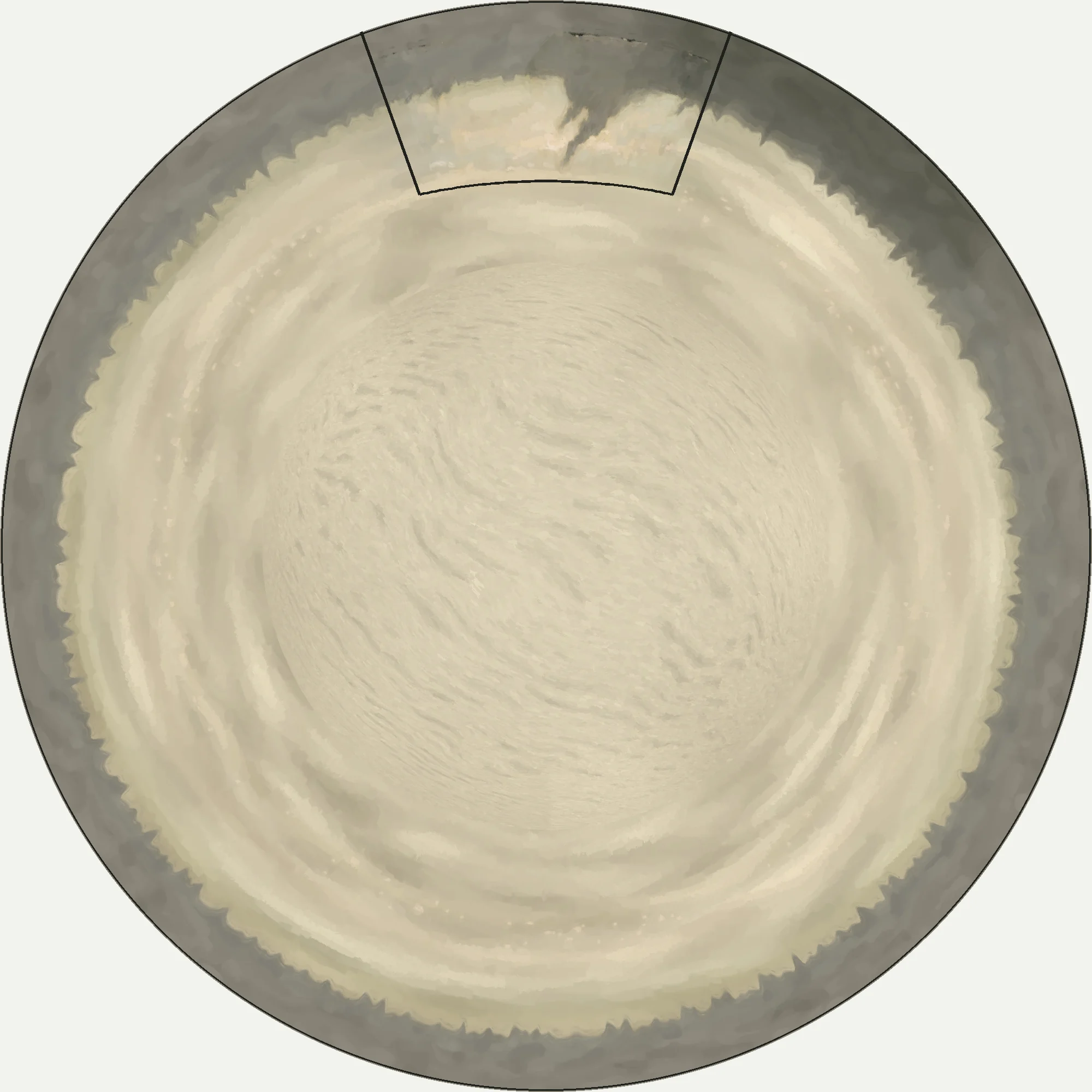
The sky is a dome, a great sphere painted on its inside and centred on the boat, so it never comes nearer (Plate 6.4). Where Homer’s view sees it, his strokes are repainted colour by colour and direction by direction. Beyond his frame, the fog bank’s torn edge is pieced together from stretches of his own. The top first “looked like a flat disk instead of being a dome”. It became a deck of cloud in perspective, its rolls shrinking toward the horizon, after three failed looks: evenly spaced bars, then swirls, then wood grain.
From his spot the World now stands close to his picture (Plates 6.5a and 6.5b). The sky’s cream, the streamer and the bank land within about a point of his lightness.
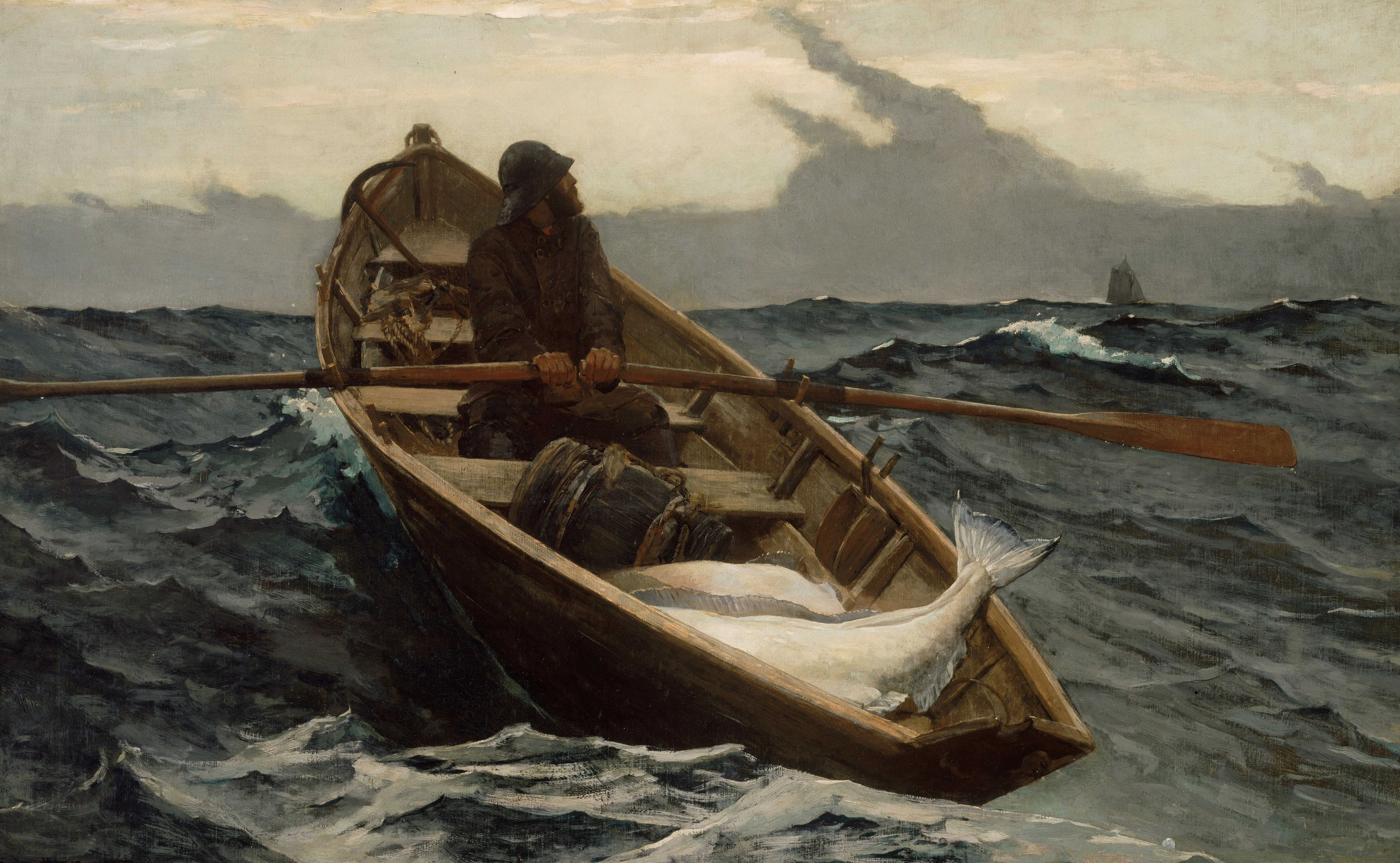
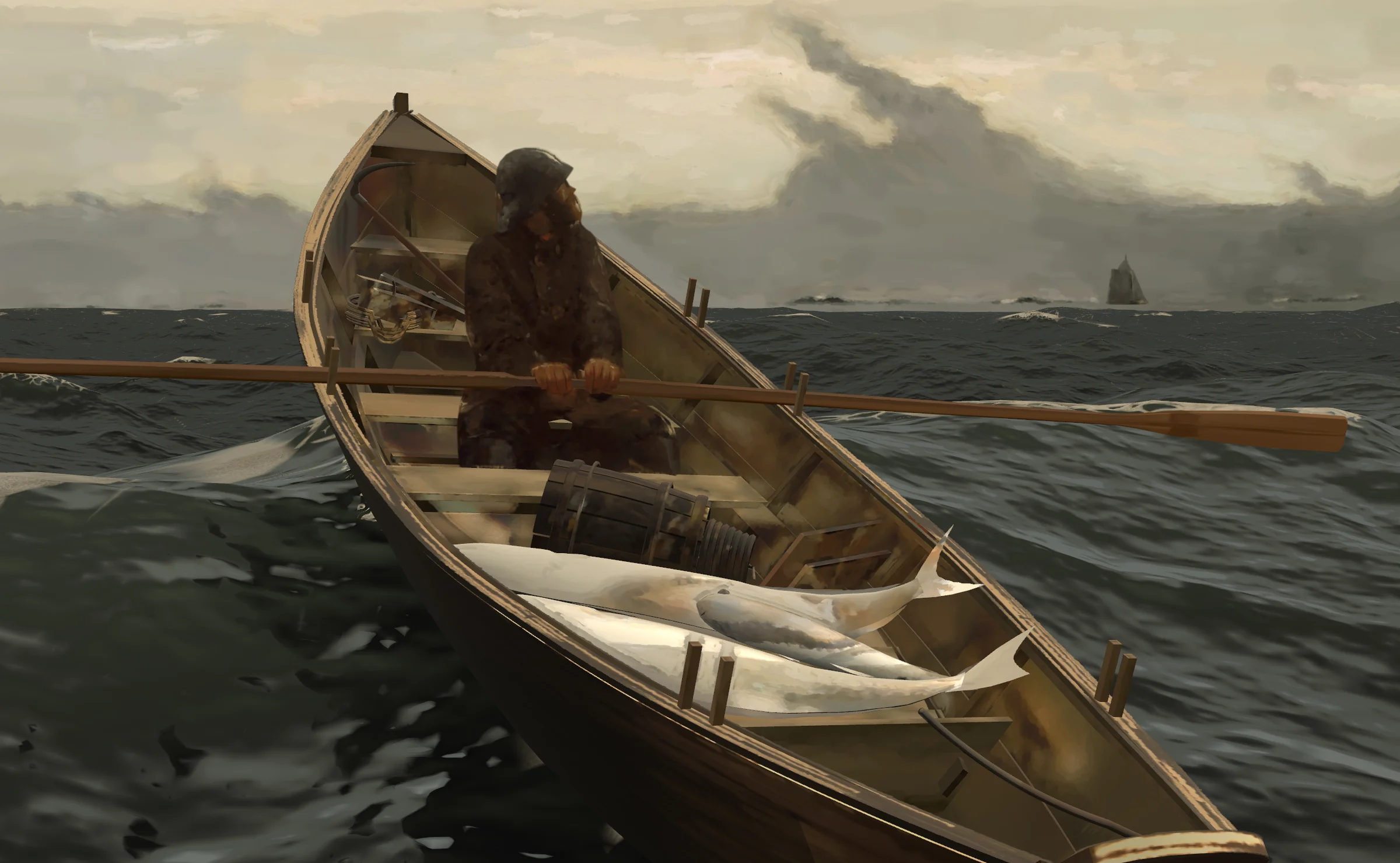
One pull on the oars, and the visitor is sitting in it.
Method
Dory: 6.10 m overall, floating 0.13 m deep at 370 kg. Skin: inside atlas 3.15 texels a centimetre, outside 4.35; brushes tanda/oil-06-paint (soft) and tanda/oil-03-paint (dry); edges as brushed ribbons in the surface’s own colours, no outline. The inside, tub and fish are painted through the solved view from his marks of the same kind. Rower cut-out: 39,342 strokes inside a hand-placed mask. Schooner cut-out: sails L* 29.6 against his 29.5. Dome: a band in two 8192 px halves and a zenith cap, about 1.06 MB. The streamer’s strokes lean 27.5° against his 34°. Only two clean stretches of his fog edge exist to draw from, so beyond his frame the edge repeats more than his does. At his view the sky’s cream, the streamer and the bank read L* 79.9, 56.6 and 47.5 in the World, against his 80.3, 55.9 and 48.7. Plate 6.5b is the moment of the held opening view, 32 seconds in, when the swell sets the rower’s hat within 7 px of his at 1600 px wide; the camera stands 0.83 m nearer than the solved one, the view the rower was painted for, so the boat sits a little larger and its stern runs nearer the frame’s lower edge.
7 In the seat
From the seat the painting is behind you. The view faces the stern, as a doryman’s does: the fish and the tub in front, a pair of arms in a wet wool coat, the hands on the oar looms (the shafts inside the boat), the stern rising and falling against the sea (Plate 7.1). The head can turn about 150°, far enough to find the ship over a shoulder, small and dark under the streamer (Plate 7.2).
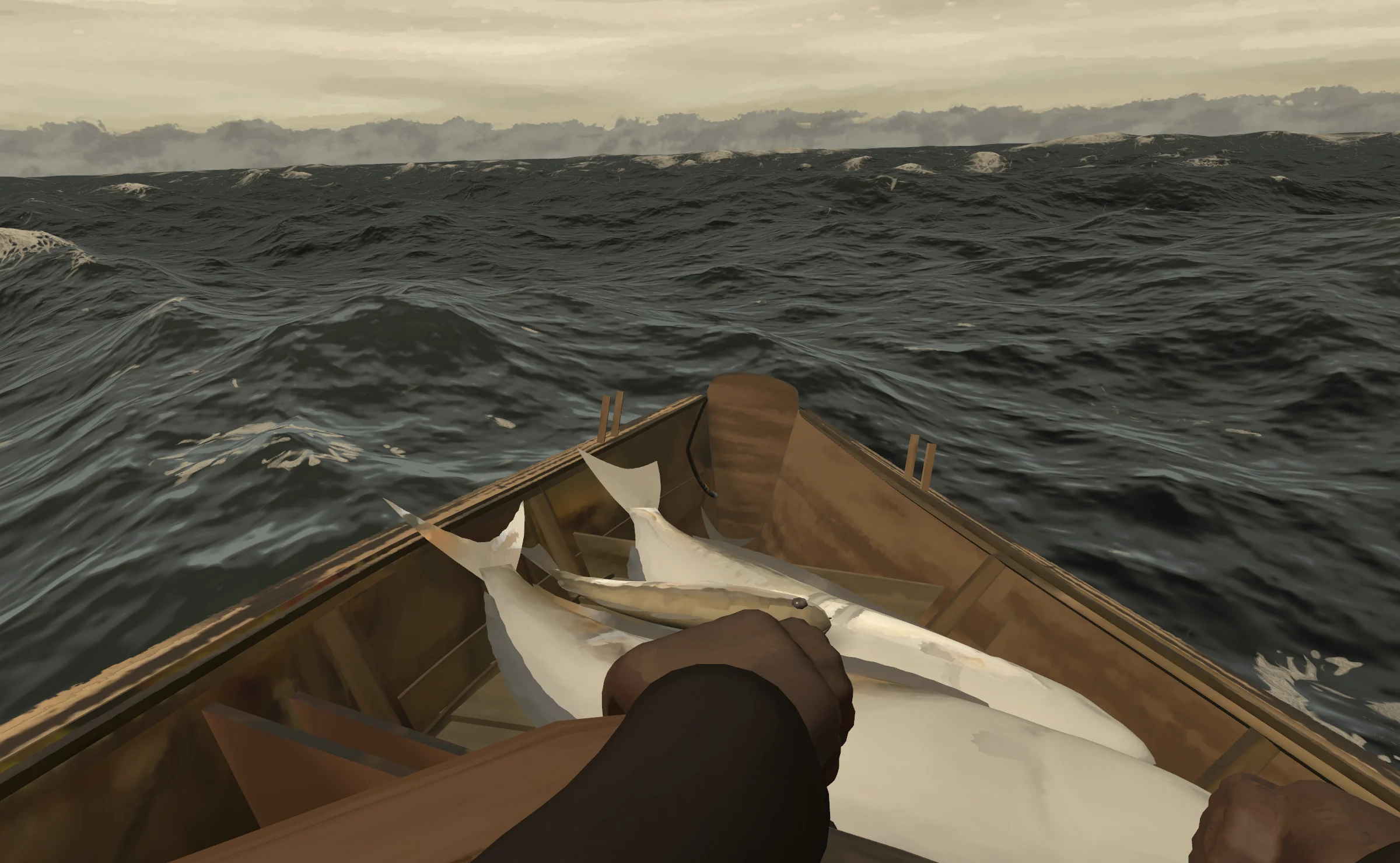
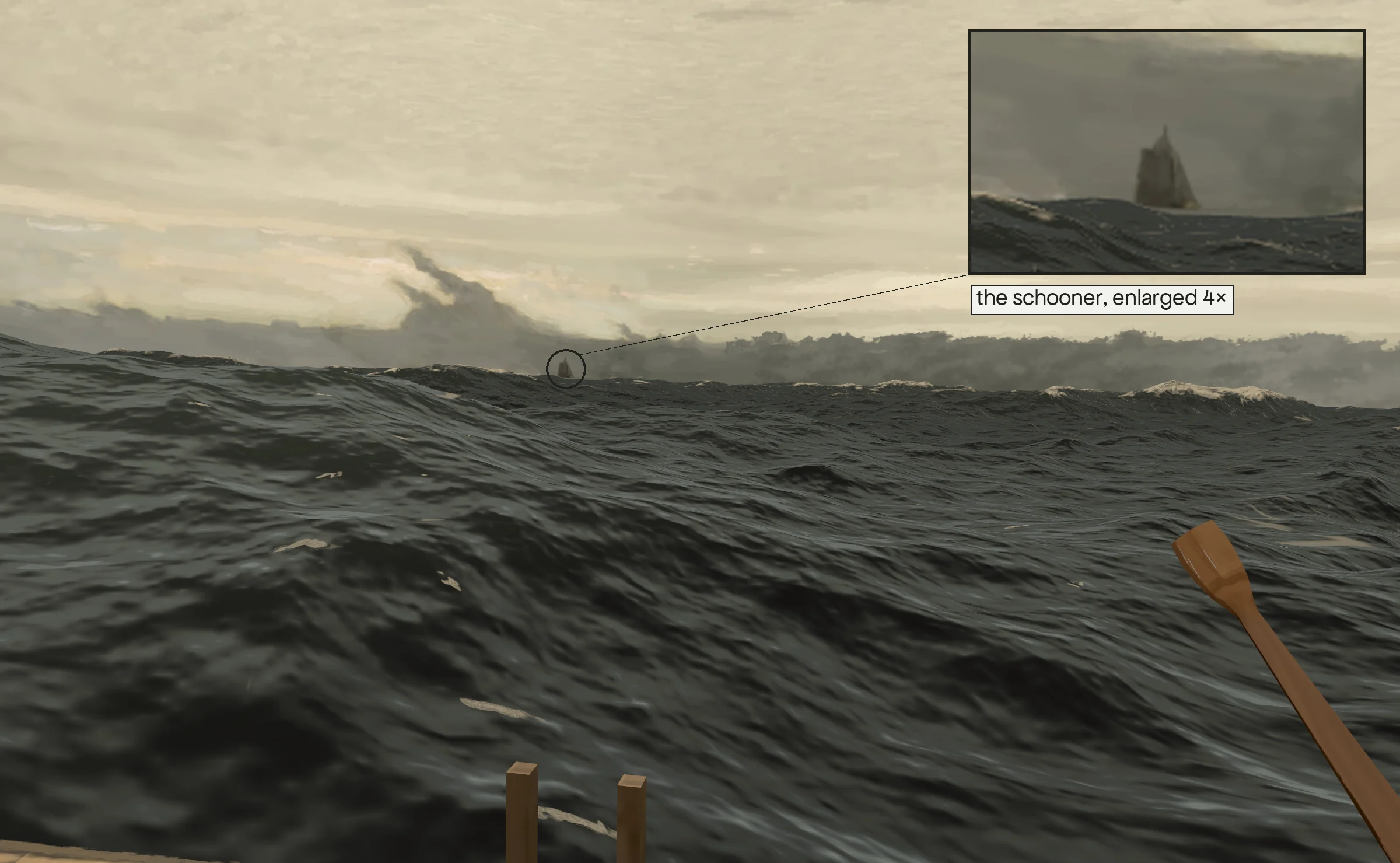
In the seat there is no need to look like Homer’s man. The visitor sees only arms, hands and knees. They belong to a free stock body with the head removed, since the view is the head, dressed in a coat of matte wet wool.22 An oilskin with a sheen was tried first and turned back: “more like cloth”, soaked and dull.
The boat itself first moved badly. It pivoted from side to side “like it’s not even touching the water”, light as a boat made of paper. It was rebuilt on physics. The oars push only while the blade is in the water. The water drags on the hull along it and across it. The roll needed care: the boat’s own rocking period sat just under the period of the waves, so it swung in step with them and rolled far more than the water did. Added drag, of the kind that grows with speed, brought it close to the water’s own roll.
The stroke came from rowing research.11 A stroke has a drive, when the blade is in the water and pulling, and a recovery, when it is lifted and carried back. The first oars dropped in and jumped out: “a jerking motion”. Now the stroke is one flowing cycle at 24 strokes a minute, the drive taking a third of it, and the boat surges with each pull about as much as real boats are measured to. The oar itself was remade to the long flare of his blade.
Footage of small boats in a seaway showed one more thing. A wave turns a boat as well as lifting it. The passing sea now swings the hull a few degrees, and a boat left alone turns side-on to the waves within half a minute.
Rowed like this, the boat moved like a boat and still felt dry. So a few things he left out were added.
Method
Field of view 56° (adjustable). Roll was 1.68 times the water’s, with the boat’s natural period of 2.3 s against waves of 2.7 to 3.3 s; with the added drag, 1.15 to 1.28 times. Top speed 1.40 m/s; the surge about ±11% a stroke against the ±10% published. The hull turns 3.8° on average while rowing, 9.2° at the 99th percentile; from 45° off it drifts side-on in 30 s. The eye rises and falls about 2 m over roughly 4 s.
8 What he left out
His canvas shows no water in the boat, almost no spray and no shadow of the hull on the sea. From his distance, none is needed. In the seat, their absence was felt. Four things he does not paint were added for the person in the seat. None is in his painting; all are kept in his greys.
Water now lies in the bottom of the boat, about 40 litres at the start, rising as waves come aboard (Plate 8.1). It is shaded with the sea’s own method, a little darker. At first it moved “more like jelly instead of water”, clinging to the sides. Thin films now drain off the planks in a fraction of a second, and the ripples run faster and break, as real ones do.
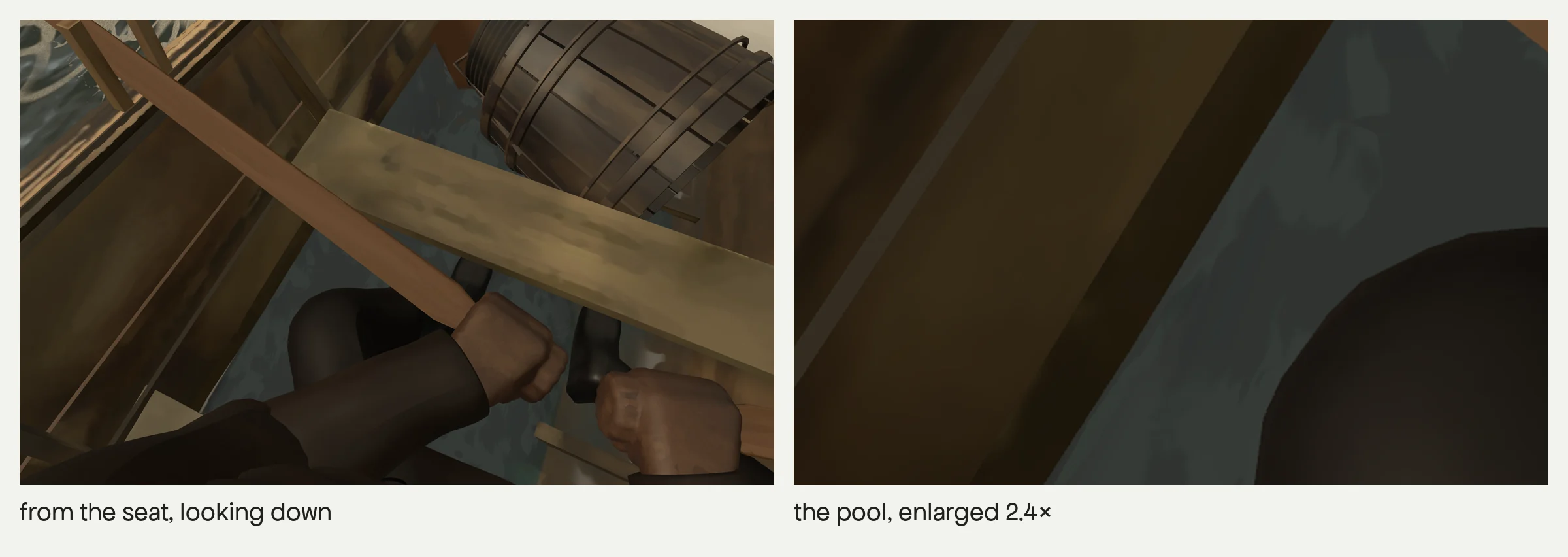
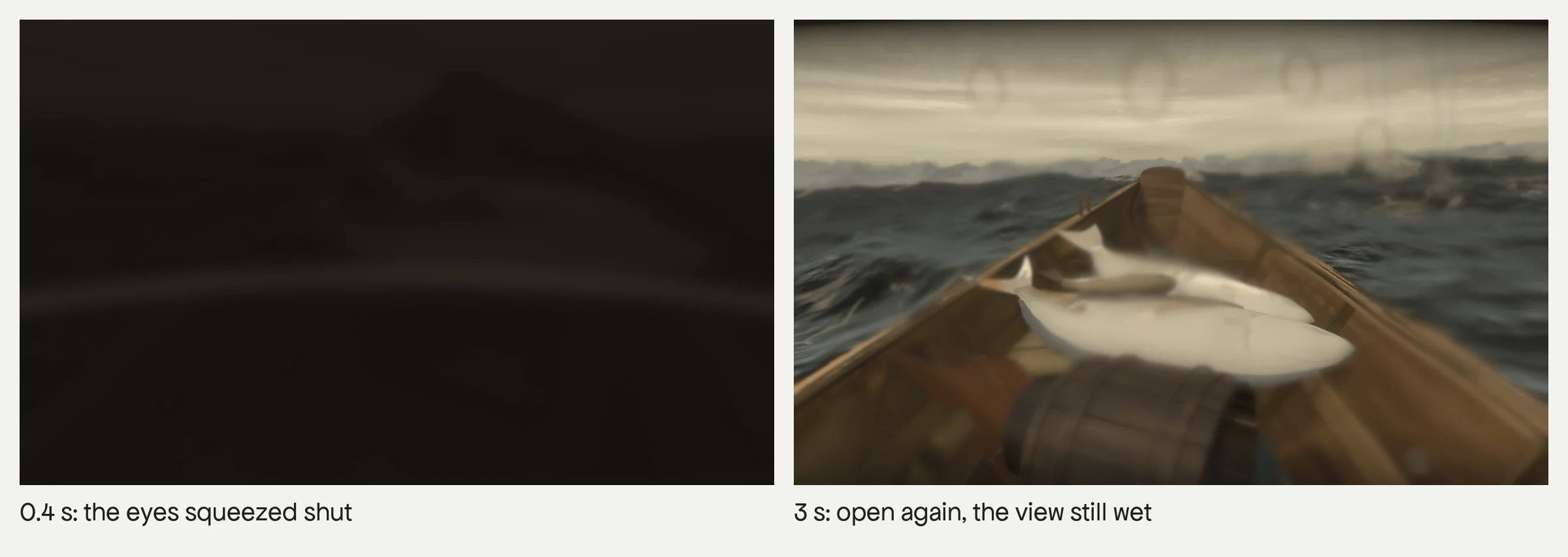
Spray comes from real contact between hull and wave. Sheets of water rise where a wave strikes, break into threads and drops, and turn back off the planks instead of passing through them. Early splashes looked like “painting blobs”, then like “blue water”; they are now clear grey water, with the scene showing through and torn edges going grey-white. Since the rower faces aft, now and then a wave comes over the rail at the face. At first its water ran down the view as if down a pane, “like there’s a glass in front of me”. Water does not reach a face that way: it comes in chunks, and it goes in the eyes. So now the water flies at the face in chunks, the eyes blink, or squeeze shut for a heavy hit, and the head flinches. When they open, the view is blurred, unevenly, and each blink clears it a little: in about a second and a half after a light splash, four seconds after a medium one, eight after a heavy one. A few drops hang on the lashes, soft and far out of focus, and after a heavy hit water runs down from the brow at the corners of the view (Plate 8.2).
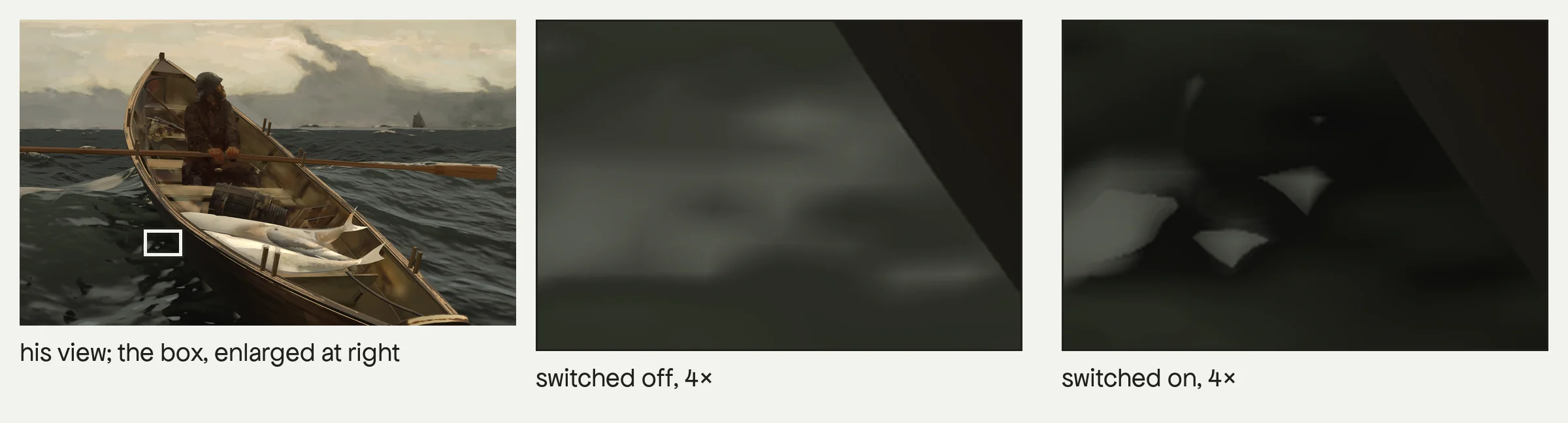
The boat also seemed to float “on the water instead of being one with the water”. Part of the cause was a lift given to the hull as the World opened, and a flat sheet of foam round it; now the water climbs the planks and piles at the stem. The rest was found while rowing: the sea beside the boat showed no shadow and no reflection of it. The hull, the man and the oars now block the reflected sky in the water beside them (Plate 8.3).
Last, the catch. The two halibut he painted were rebuilt at true size, about 1.5 m and 45 kg each, from Bigelow and Schroeder’s account of the species.9 The boat had to sit heavier on the fish side, so smaller fish were added. A heap of them was refused at once, with the instruction to “keep the two” and make the fish good. The answer was to let the catch fall. Blender’s rigid-body simulation dropped the fish onto loose boards laid across the after thwarts, in a boat rocking on the World’s own sea, until they came to rest (Plate 8.4). Their white sides are painted from the lit white of his fish.
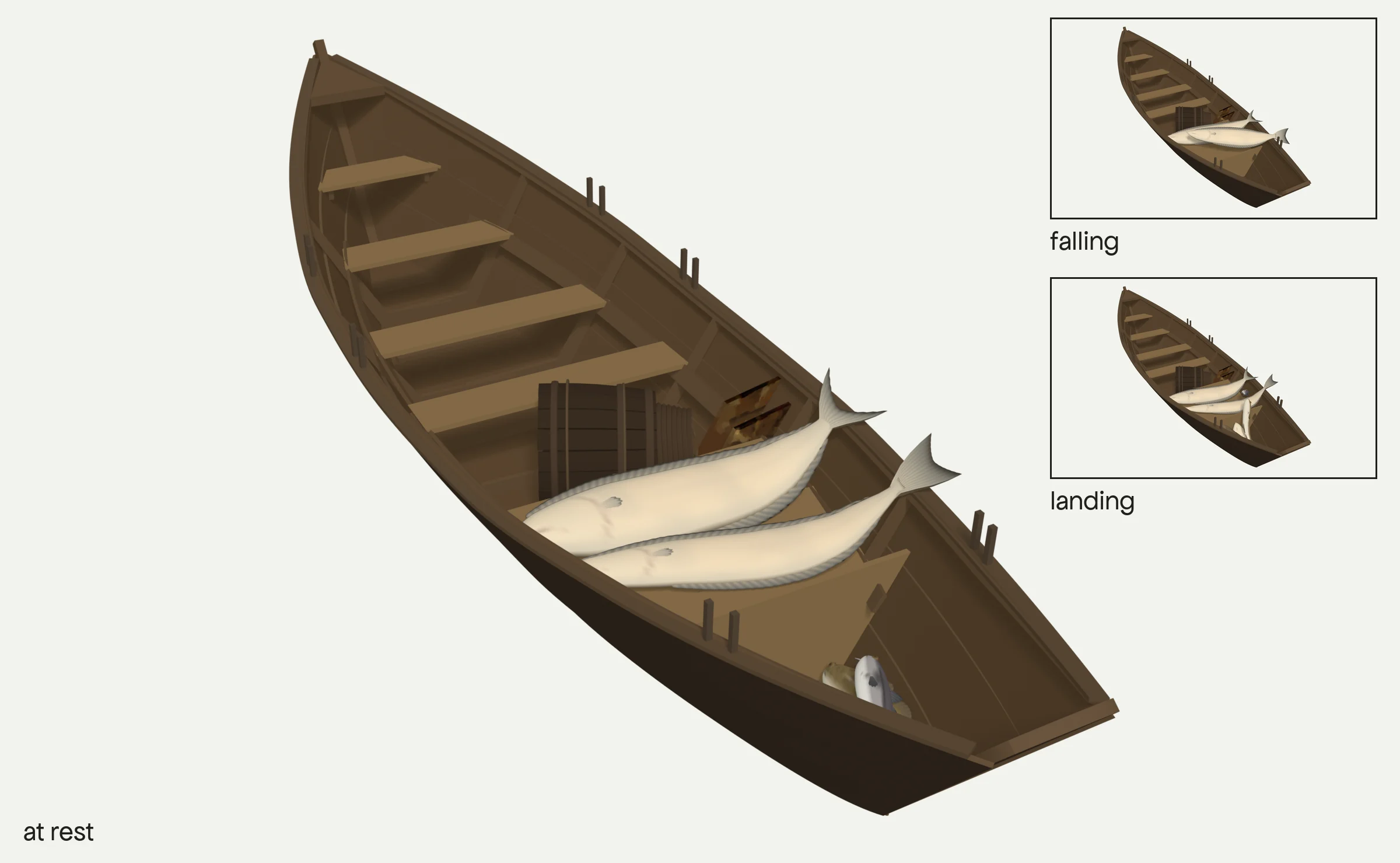
All of that is weather the boat makes for itself. The picture’s own weather is the fog.
Method
Pool: about 40 L at the start, heading for 80 to 120 L, capped at 240 L; it sits 4.3 points of L* under the near sea. Spray flies past the face every 5 to 7 s while rowing. Water in the eyes: a light hit every 20 to 30 s, a medium one every 60 to 90 s, a heavy one every 2.5 to 4 minutes, never in the first minute. The blur is three blurred copies of the frame mixed by a slowly moving mottle, sized in degrees, so nothing is ever sharper than what lies behind it; the view is clear again by 1.5, 4 and 8 s. A reflex blink closes the eye faster than an ordinary one, as high-speed video of air-jet reflexes shows (Espinosa, Pérez and Mas, 2020).18 Drops on the lashes about once a minute, on the view under 5% of a row. Hull’s dark at his view: the water beside the near side reads L* 5.7 with it and 30.6 without, against his 6.0. Catch: the two halibut with a few small halibut, cod and haddock; the boat sits a little lower at the stern.
9 The fog comes and goes
The canvas stops just before the fog arrives. The bank stands on the horizon, the streamer reaches out, the man looks. In the World, the fog arrives.
The fog bank and the fog’s sky are painted, and nothing simulates vapour. As it closes, the bank rises and spreads, and the ship goes first, fading into it. Then sheets of fog drift past the boat on the wind, and the sky turns grey. At its thickest the visitor sees between 100 and 180 metres. Then it thins: the bank sinks, its high tears going first, and the ship returns (Plate 9.1).
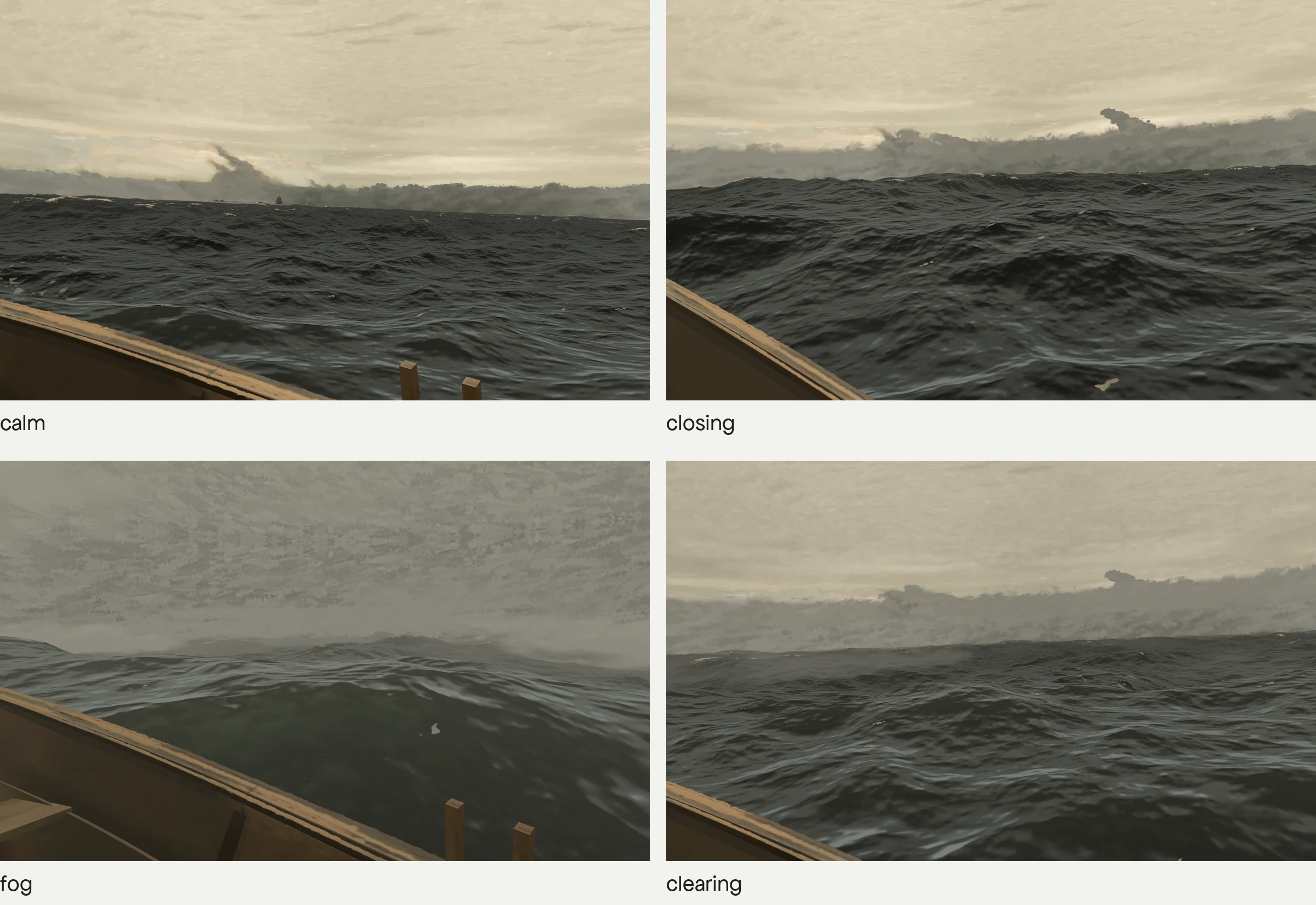
The first plan was a visit of twelve minutes, ending with a glide back into his painting. It was too long: “12 minutes is far too much”, and “this is not a game that people will play for a long time”. Now the fog comes and goes on its own. After a short calm it closes, holds and clears, then comes back after a pause of one, one and a half, two or three minutes, each time a little different (Plate 9.2). The visit lasts as long as the visitor stays.
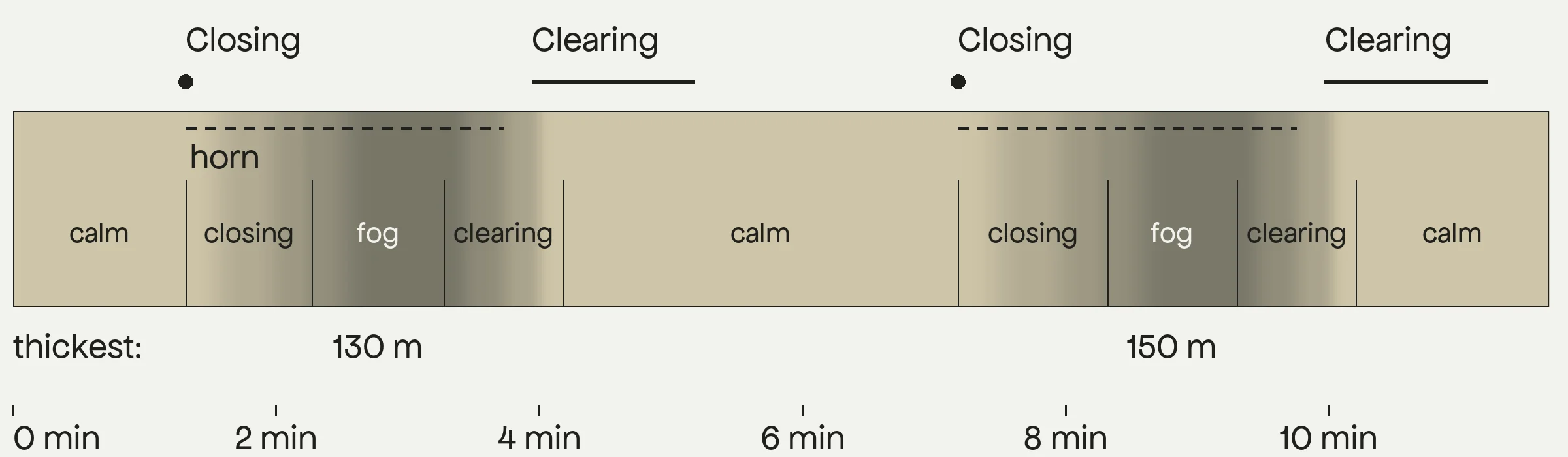
The sea and the wind are sounded in code from what the water is doing: a crest breaks in the sound where a crest breaks on the water, and the wind rises as the fog comes in. While the fog lasts, the ship calls. The skipper blows a shell horn, as the fishery reports of the time describe, “the old fashioned conch shell horn”, blown “from morning until night”.4 Over the calls he tires: the blasts grow shorter and weaker. At anchor in fog a vessel rang her bell at least every two minutes, by the rules of 1885. This one rings it as the fog closes and more often in the thick of it, and strikes eight bells as she shows again. Both are real recordings, retuned to the cello’s open strings.2425
The music follows the weather. It is based on a video by yeemz on Facebook: her cello came home from a tour so out of tune that it found a tuning of its own, and she plays it across her lap like a guitar, plucked, and strummed with the thumb. Her open strings ring as root, fifth, octave and twelfth, C♯–G♯–C♯–G♯, and the third, the note that would make the harmony happy or sad, is mostly left out. Among the music’s other inspirations is Brad Barr’s video of a thread tied to a guitar string and pulled, a technique of the Romanian violinist Nicolae Neacșu. The music was meant to give “a feel of loneliness”.
In the calm a piece may begin: the first one, or one of two hand-written versions of its phrases. As the fog begins to close, whatever is playing fades out gently, and then a piece called Closing thins to a held tone and ends on the open G♯, the note of the horn. In the thick of the fog the cello is silent, and only the sea, the wind, the horn and the bell remain. After the ship’s last call, as the fog clears, Clearing may follow, the one piece that closes. Nothing from the recordings that inspired them is used: the scores are new, played on cello samples released under CC0.23 The first two pieces can be heard on their own on the music page.
The last section measures how close the rest comes to his painting.
Method
The cycle: a first calm of 40 to 80 s, closing 50 to 80 s, fog 40 to 70 s, clearing 40 to 60 s, then calms of 60, 90, 120 or 180 s; the thickest visibility is drawn at random between 100 and 180 m each time. Contrast falls with distance following Koschmieder’s law. Plate 9.2 is the visit drawn from one fixed starting number; each visit draws its own. Horn: following Goode, Section IV, pp. 123 to 124; a CC0 recording, played at G♯4, three long blasts as the ship fades, then a call every 25 to 45 s, in the fog every 12 to 25 s. Bell: the International Regulations of 1885, article 12; a CC0 recording lowered to G♯6, rung in groups of strikes 70 to 115 s apart as the fog closes and 40 to 60 s apart in the fog, with eight bells as the ship returns. Fog does not muffle sound; the wind that comes with it does. Wind following Farnell’s Designing Sound; no birds and no voices, since he painted none. Tuning from the cellist’s recording, medium confidence; the pieces at 70 beats a minute. Music level and the sea’s dip under it were set by ear.
10 Against his hand
Inside his frame the World can be measured against the canvas. The same boxes were read on his photograph and on the World rendered from his view, in lightness (Plates 10.1a and 10.1b).
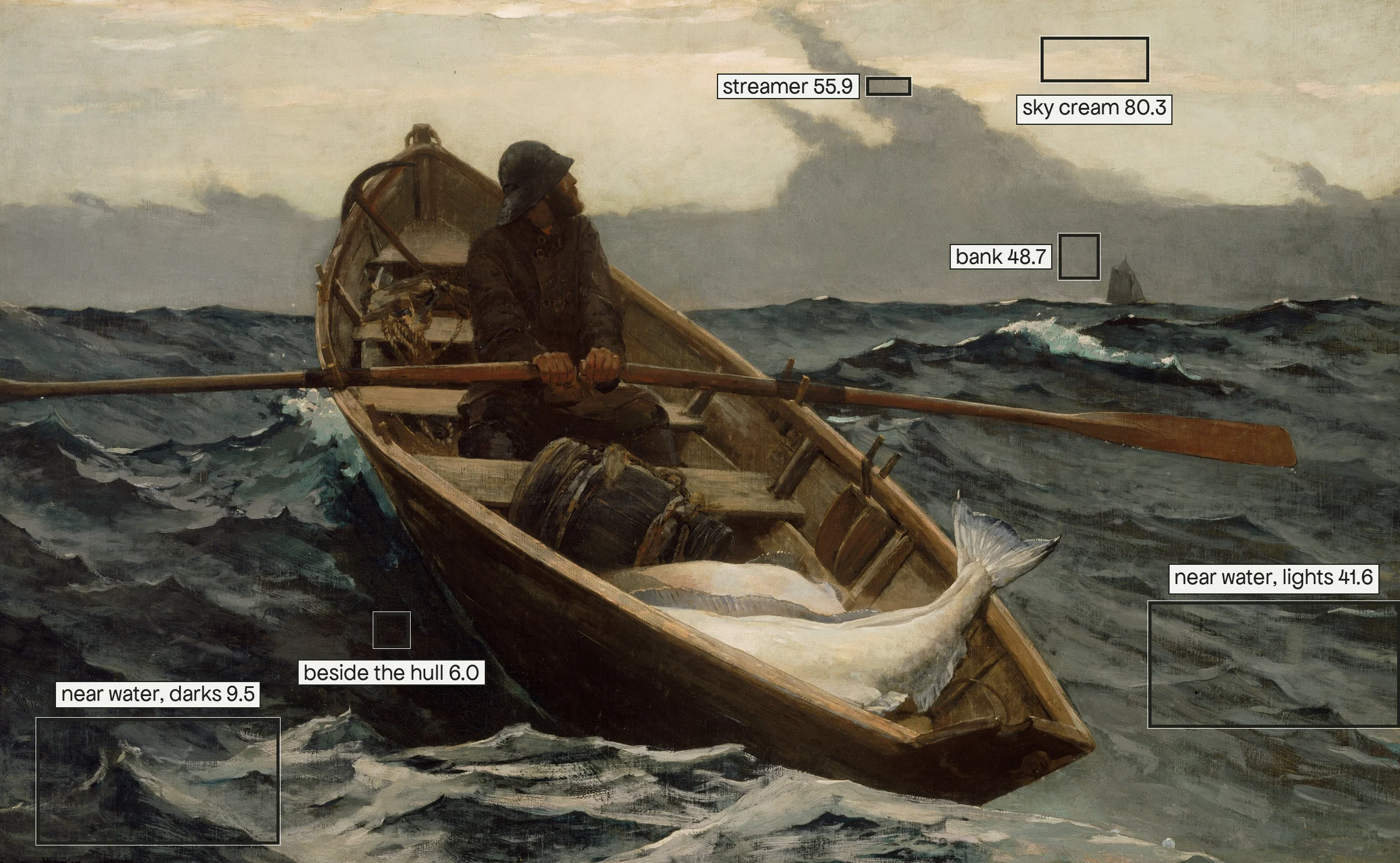
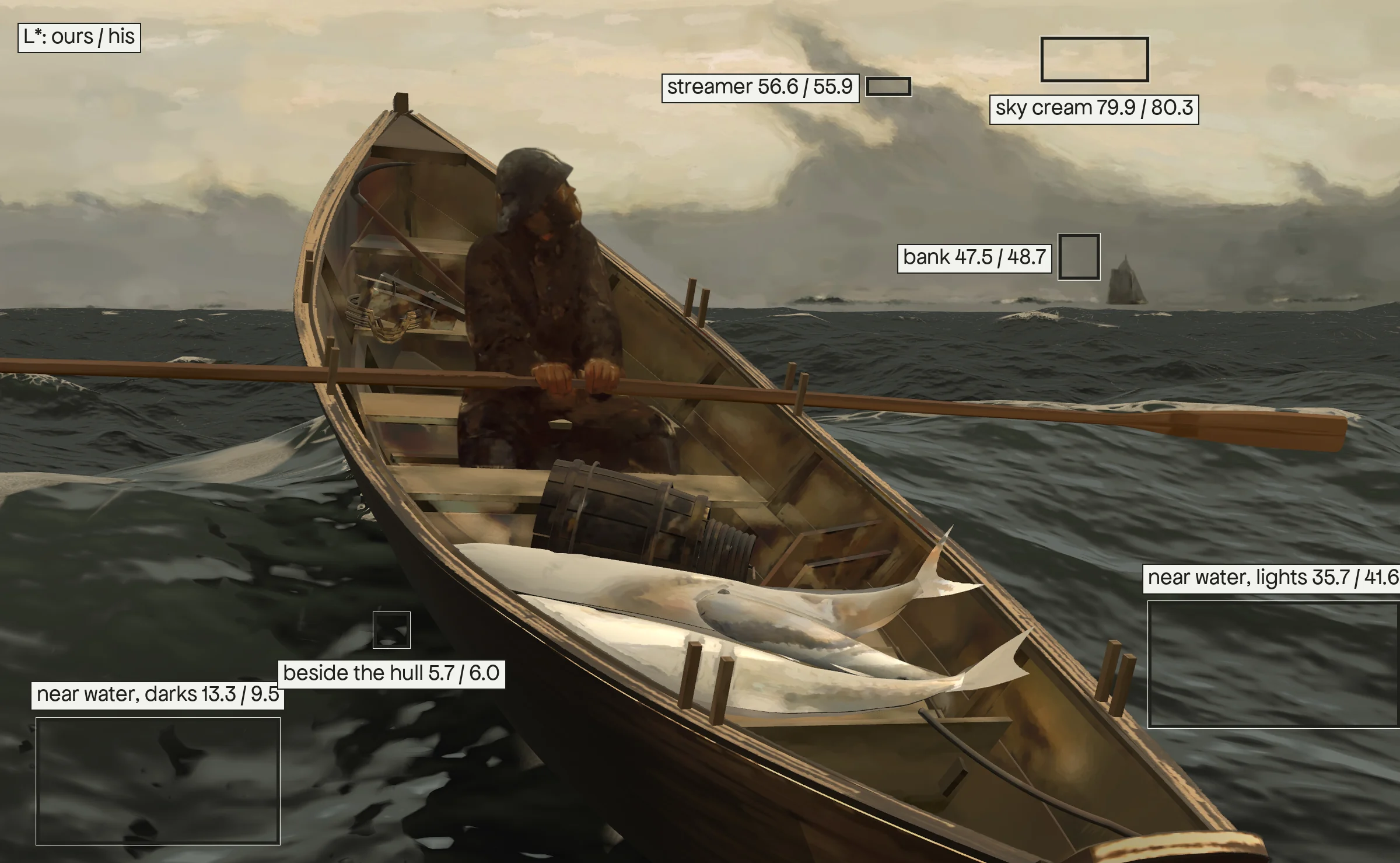
Some of it holds. The sky’s cream, the streamer and the bank sit close to his. The water beside the hull is dark, as his is.
Much of it does not. The near water is flatter than his: its troughs too light, its crests too dark. His near foam covers about a fifth of his near water; in the World, almost none. His horizon is broken by far swell tops; the World’s is ruled straight. The oar at his view falls more gently than his and reaches further out. As the fog closes, the bank’s top is rougher than his edge, its bumps about twice as close together. The sea carries none of his marks, by choice. And away from his viewpoint, no one has yet compared the World with the painting without knowing which was which.
Method
Lightness as CIELAB L*, his canvas against the World at his view in the calm, in the same boxes (Plates 10.1a and 10.1b): sky cream 80.3 and 79.9; streamer 55.9 and 56.6; bank 48.7 and 47.5; the near water’s darks, the darkest 30% of the box’s water with the foam left out, 9.5 and 13.3; its lights, the lightest 20%, 41.6 and 35.7; beside the hull 6.0 and 5.7. The oar’s loom falls 6.8° to the right on his canvas and 3.8° in the World, its tip 59 px further right at 1600 px wide. The closing bank’s top edge from the seat, about its own smooth line: 0.51° rms (0.31° leaving out one tall plume), a bump every 4.5°, with no regular spacing; his edge 0.21 to 0.28°, a bump every 7 to 10°.
The record supports a modest claim. From his spot, the World stands close to his composition and to his values in the sky. Its sea is believable water in his greys, without his marks. In the World, the fog he only hints at arrives, again and again.
The frame opens here. Row out, and turn back to find his view.
Method
Near foam covers 20.7% of his near water and about 0.1% of the World’s.
11 Sources
Primary and museum sources
- 1Museum of Fine Arts, Boston, The Fog Warning (Halibut Fishing), 94.72, collection record: https://collections.mfa.org/objects/31042
- 2N. Cikovsky Jr. and F. Kelly, Winslow Homer, National Gallery of Art, 1995: https://www.nga.gov/content/dam/ngaweb/research/publications/pdfs/winslow-homer.pdf
- 3W. H. Downes, The Life and Works of Winslow Homer, 1911: https://archive.org/details/cu31924015252004
- 4G. B. Goode, The Fisheries and Fishery Industries of the United States, Section IV, 1887: https://archive.org/details/fisheriesfishery04good
- 5G. B. Goode and J. W. Collins, The Fisheries and Fishery Industries of the United States, Section V, vol. 1: https://archive.org/details/fisheriesfishery0501good
- 6Wikimedia Commons, Winslow Homer - The Fog Warning - Google Art Project (the photograph measured here): https://commons.wikimedia.org/wiki/File:Winslow_Homer_-_The_Fog_Warning_-_Google_Art_Project.jpg

Boats, fish and weather
- 7J. Gardner, The Dory Book (the 1884 Portsmouth Navy Yard offsets, p. 147): https://ftpmirror.your.org/pub/misc/cd3wd/1002/_tr_435_The_Dory_Book26_674_jf_en_148870_.pdf
- 8Historic American Engineering Record, Schooner Lettie G. Howard, HAER NY-206: https://www.loc.gov/pictures/item/ny1621/
- 9H. B. Bigelow and W. C. Schroeder, Fishes of the Gulf of Maine, “Atlantic halibut”: https://cybrary.friendsofmerrymeetingbay.org/fgom/Hippoglossus_hippoglossus.htm
- 10Canadian Meteorological and Oceanographic Society, bulletin on Grand Banks fog: https://bulletin.cmos.ca/?p=4161
- 11V. Kleshnev, “The effects of stroke rate on biomechanical parameters and efficiency of rowing”, ISBS 1996: https://ojs.ub.uni-konstanz.de/cpa/article/view/2726
Methods
- 12J. Tessendorf, “Simulating Ocean Water”, course notes, 2004: https://jtessen.people.clemson.edu/reports/papers_files/coursenotes2004.pdf
- 13Ang, Catling, Cifariello Ciardi and Kozin, “The Technical Art of Sea of Thieves”, SIGGRAPH 2018: https://history.siggraph.org/learning/the-technical-art-of-sea-of-thieves-by-ang-catling-ciardi-and-kozin/
- 14GodotOceanWaves, an open FFT ocean: https://github.com/2Retr0/GodotOceanWaves
- 15Crest Ocean System (Wave Harmonic): https://github.com/wave-harmonic/crest
- 16Poseidon, an open WebGPU ocean (MIT): https://github.com/owenyuwono/poseidon
- 17“Interactive Water Simulation in Atlas”, GDC 2019: https://gpuopen.com/gdc-presentations/2019/gdc-2019-agtd6-interactive-water-simulation-in-atlas.pdf
- 18J. Espinosa, J. Pérez and D. Mas, “Comparative analysis of spontaneous blinking and the corneal reflex”, Royal Society Open Science 7, 201016, 2020: https://doi.org/10.1098/rsos.201016
- Cited by name, without links here: Chevreul, The Laws of Contrast of Colour; Loomis, Figure Drawing for All It’s Worth, 1943; Bridgman, Constructive Anatomy, 1920; Hampton, Figure Drawing: Design and Invention, 2009; Hasselmann et al. 1973 (the JONSWAP spectrum and its spreading); Koschmieder’s law of visibility; the International Regulations for Preventing Collisions at Sea, 1885; Farnell, Designing Sound, 2010.
Tools, sounds and assets
- 19libmypaint, the MyPaint brush engine: https://github.com/mypaint/libmypaint
- 20Blender: https://www.blender.org
- 21three.js: https://threejs.org
- 22MakeHuman MPFB, CC0 bodies for Blender: https://static.makehumancommunity.org/mpfb.html
- 23Karoryfer x bigcat, cello samples, CC0: https://github.com/sfzinstruments/karoryfer-bigcat.cello
- 24Ohrwurm, “Snailhorn”, Freesound 64830, CC0: https://freesound.org/s/64830/
- 25Sojan, “Ship Bell Single Ring”, Freesound 353233, CC0: https://freesound.org/s/353233/
Facts held loosely
- Where it was painted. Prout’s Neck is documented; the staging on the beach is reported by one biographer with no named witness.
- The Banks. The painting has been read as the Grand Banks since 1893. Homer’s own trip there is undocumented.
- The hour. The canvas fixes no sun. A low, veiled light from behind the boat is a reading.
- The ship’s distance. A first-hand account puts a dory about two miles from its vessel; at that range a schooner would be a speck. His view solves to about a kilometre for her painted size.
- Chevreul. Homer owned the book; nothing ties it to this oil.
- His marks. Their sizes come from strokes marked by eye; a profile across them reads about twice as wide. The shrink with depth uses a flat sea through the solved camera, a rough model where his near crests stand above the eye.
- The sea’s height. Every wave is doubled by choice; the result is steeper than real seas of its period.
- The horn and the bell. Goode describes the shell horn on fishing vessels in general, and the bell rule is for vessels at anchor; neither names this schooner.